The .280 Ackley Improved, the 7mm PRC, and the Idea for Ballistics Board
I set out to pick one do-it-all 7mm hunting rifle and comparing factory loads by hand got so tedious I built a new tool to help me do it. This is that story — and the data behind it.
Steve Sansford
Steve is the builder of Ballistics Board. He doesn't get to the range as often as he'd like, but he's been fascinated by exterior ballistics and the rabbit hole of cartridge comparison for as long as he's owned a rifle.
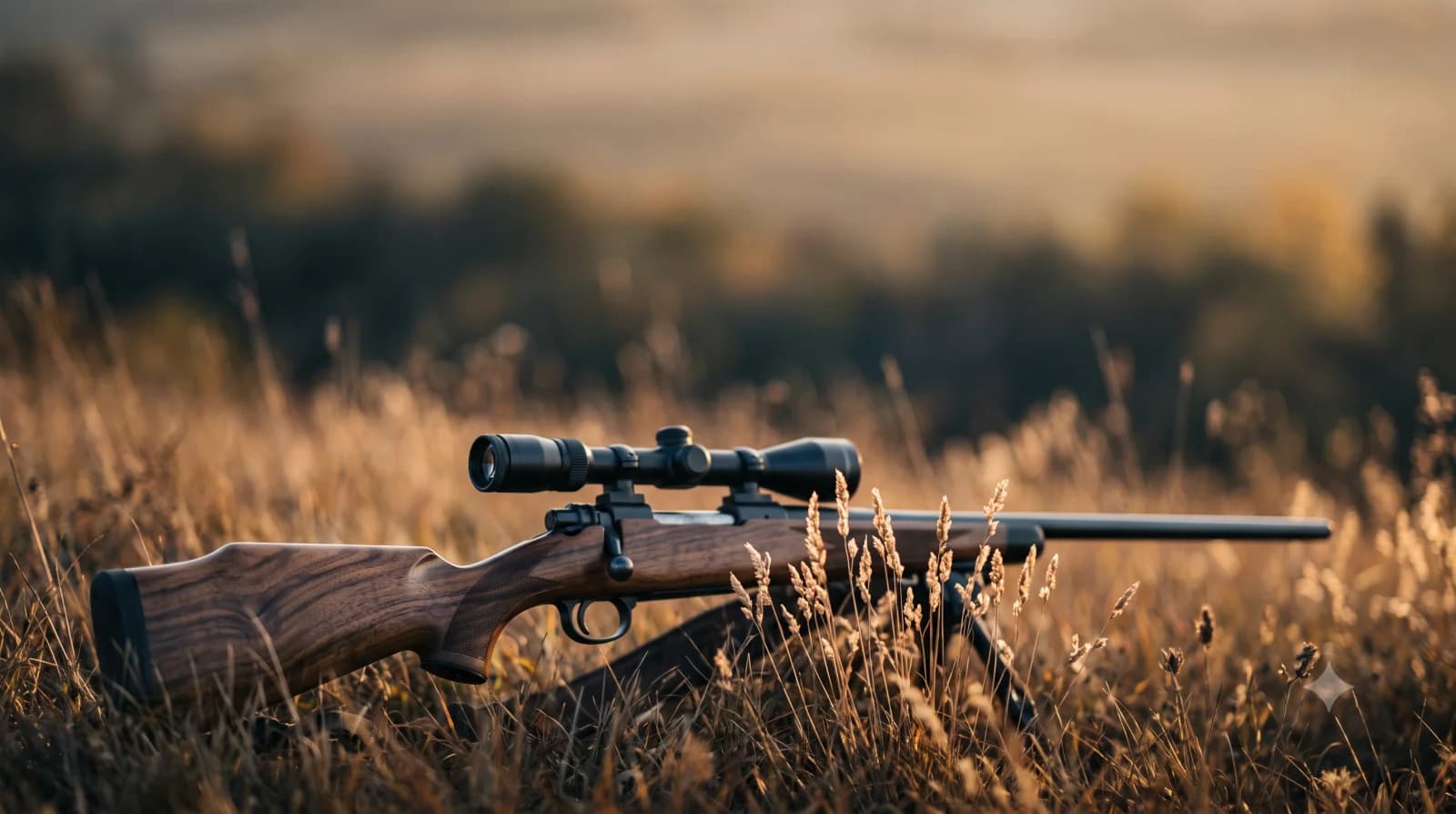
I own a .30-06. It is the quintessential go-anywhere, hunt-anything rifle — it will do whatever I ask of it and come back for more. There is genuinely nothing wrong with it. If you told me it's the greatest rifle cartridge ever invented and there was no need to invent anything else, I wouldn't disagree with you.
If it has a flaw, it's that it's a little short on cool factor a century after it was introduced. I want something a little more creative. And once you start looking at the .30 caliber in a long action and then step it down to a .284 — a 7mm — the ballistics just get better. It's why the 7mm-08 is so popular: it's everything the .308 is, only more efficient. The long-action version of that idea, the .280 Remington, never caught on, probably because the military married the country to the .30-06 and never looked back.
Then P.O. Ackley worked his magic on the .280 the way he did with so many cartridges — he opened up the case, added powder capacity, and turned it into what I'd argue is the best all-around long-action cartridge for North American hunting. It has the power of a .30-06 with better ballistics, and it has that cool factor. It was a wildcat until Nosler took it to SAAMI in 2007 and it was standardized in 2008. It does everything I'd ask a hunting rifle to do, and it does it with style.
So that was the plan. One rifle to do it all, chambered in .280 Ackley Improved.
Then Hornady went and made things more complicated
Right as I was ready to pull the trigger — figuratively — Hornady dropped the 7mm PRC. It's a genuinely brilliant piece of work: it throws a 7mm bullet meaningfully faster than the .280 AI and it's built from the ground up for heavy, high-BC projectiles. There's definitely a trade-off in cost per round and recoil, But it is ballistically superior to the .280 Ackley Improved.
Now the decision wasn't clean anymore. If I'm buying one 7mm rifle to do everything, what do I actually buy?
- The short-action 7mm-08 — light, handy, efficient?
- The cool and capable .280 Ackley Improved?
- The new hotness, the 7mm PRC?
I can't reload. My lifestyle doesn't allow for it. I don't have the space, so I'm shooting factory ammo, full stop. That narrows things in a hurry — factory offerings for all three are more limited than you'd think (I expect that to improve significantly with the PRC). — and it means the decision hinges on the loads that actually exist, not the handloads I could theoretically cook up.
How I used to do this
So I did what a lot of us do. I opened a spreadsheet.
I'd go to a manufacturer's website, find a load, grab the muzzle velocity and the ballistic coefficient, copy their ballistic table, and then flip back and forth between browser tabs trying to remember what the .280 AI was doing at 400 yards versus the 7mm PRC at 400 yards. I tracked the basics: cartridge, bullet, weight, G1 BC, muzzle velocity, energy at 300 and 500 yards. I kept it simple, because building it was tedious enough as it was.
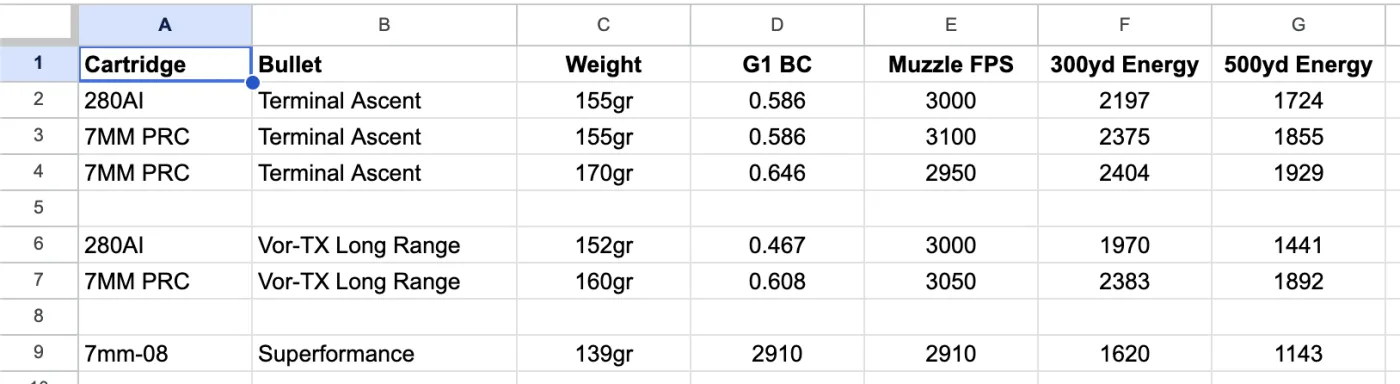
Look closely at that spreadsheet, because it's the whole reason Ballistics Board exists. See the 7mm-08 row? The G1 BC cell reads 2910 — the exact same number as the muzzle velocity right next to it. I fat-fingered a cell and pasted a velocity where a ballistic coefficient belonged, and I never caught it. I only noticed years later, when preparing to write this article.
That's the problem in a single square. It would be a genuinely expensive mistake to spend thousands of dollars on a custom rifle that turns out to be the wrong one because you fumbled a number in a spreadsheet while doing the math. Unlikely to change the outcome here — but the point stands, and it's a little horrifying to think about.
And a hand-built spreadsheet only tells you what you had the patience to type in. Mine tracked energy. But there's so much more to a real comparison — wind drift, drop, recoil, how much velocity a bullet sheds by the time it gets where you're pointing it. I've seen the firearms community's spreadsheet monsters build genuinely impressive workbooks. I just kept thinking: there has to be an easier way.
I wanted to go to a website, pick the Barnes VOR-TX LR load for the .280 Ackley, drop the Hornady Precision Hunter 7mm PRC right next to it, and just see it — on a graph, side by side, no Excel, no copy-paste, no typos. The numbers I needed, in the arrangement I needed them, without building the tool by hand every single time.
That didn't creep up on me. It hit me all at once that I'm not the only person trying to compare loads across cartridges — and that I could build the thing I wanted.
How I do it now
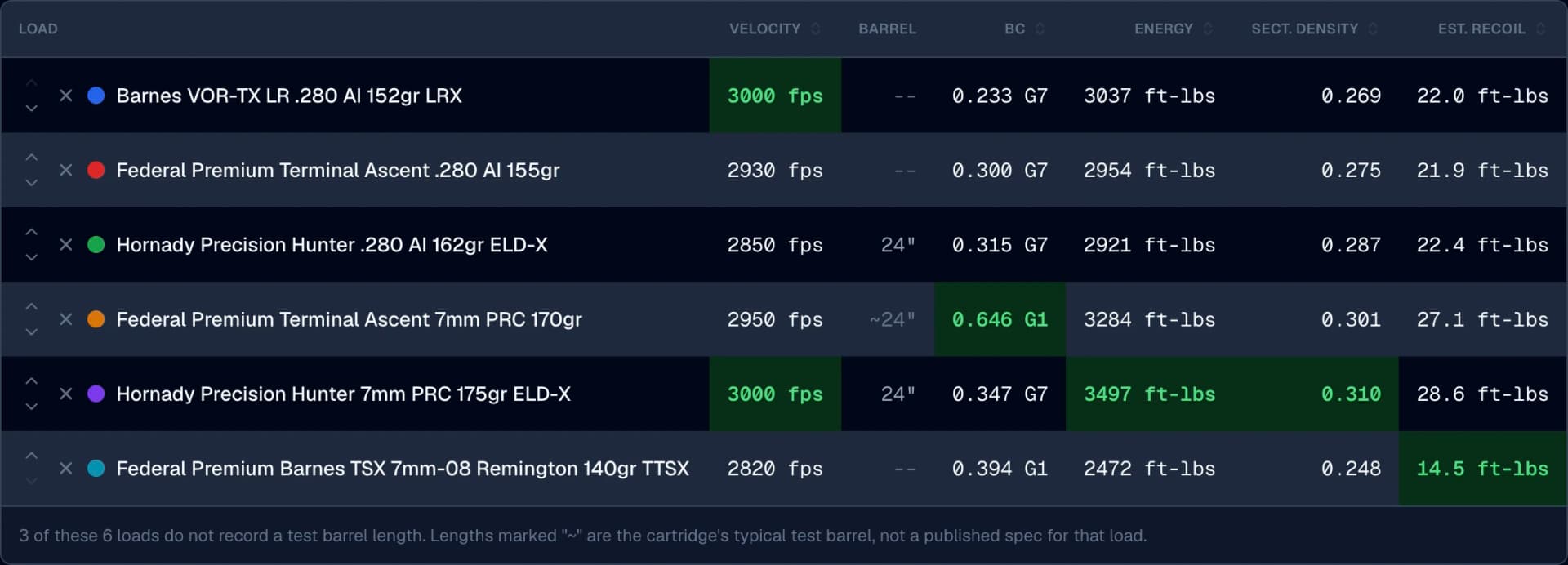
Here are the exact six loads I was weighing, dropped into Ballistics Board in about fifteen seconds — every value computed by the same ballistics calculator under standard conditions: sea level, 59°F, a 100-yard zero, and a 10 mph full-value crosswind.
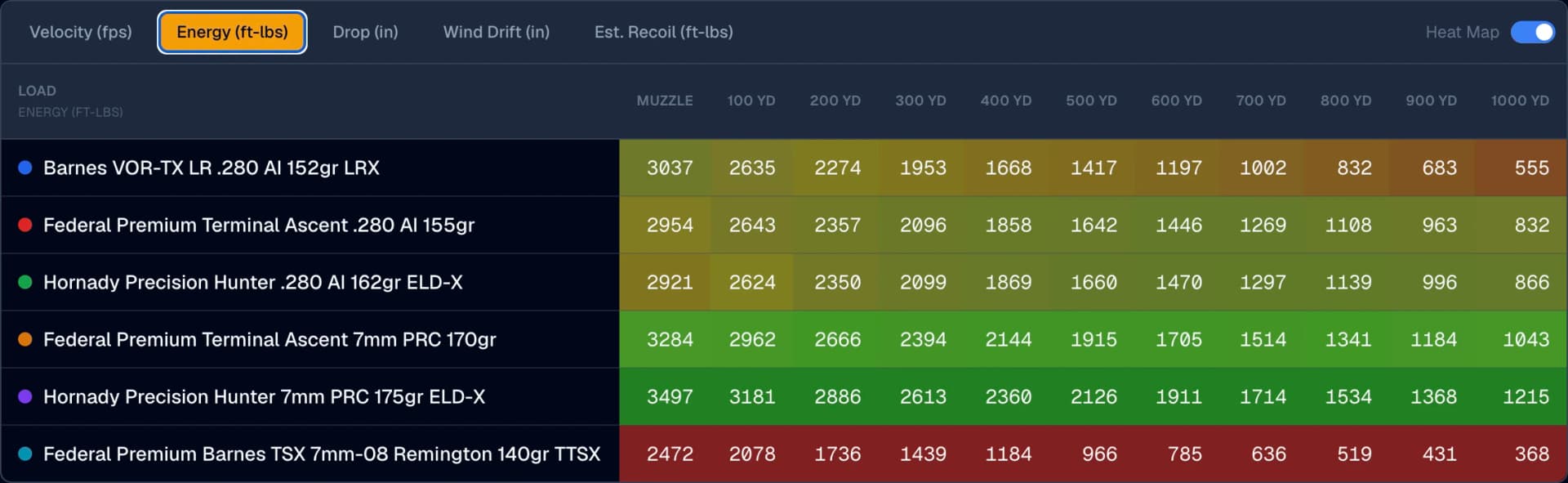
What took me thirty minutes to an hour in a spreadsheet — per comparison — now takes about thirty seconds, with more data than I ever had the patience to type by hand, and no cell for me to fat-finger. And it's more interesting than "the magnum wins."
Read that heat map left to right and you can watch each load bleed energy downrange. The two 7mm PRC loads stay green the longest — the Hornady load is still making 2,126 ft-lbs at 500 yards, more than the 7mm-08 has at 300. Two of the three .280 Ackley loads run a tight, efficient cluster a couple hundred foot-pounds behind the Federal PRC, and the Barnes trails them — more on that below. The 7mm-08 goes red early: lightest and handiest, but the first to run out of steam.
Trajectory tells the same story from a different angle.
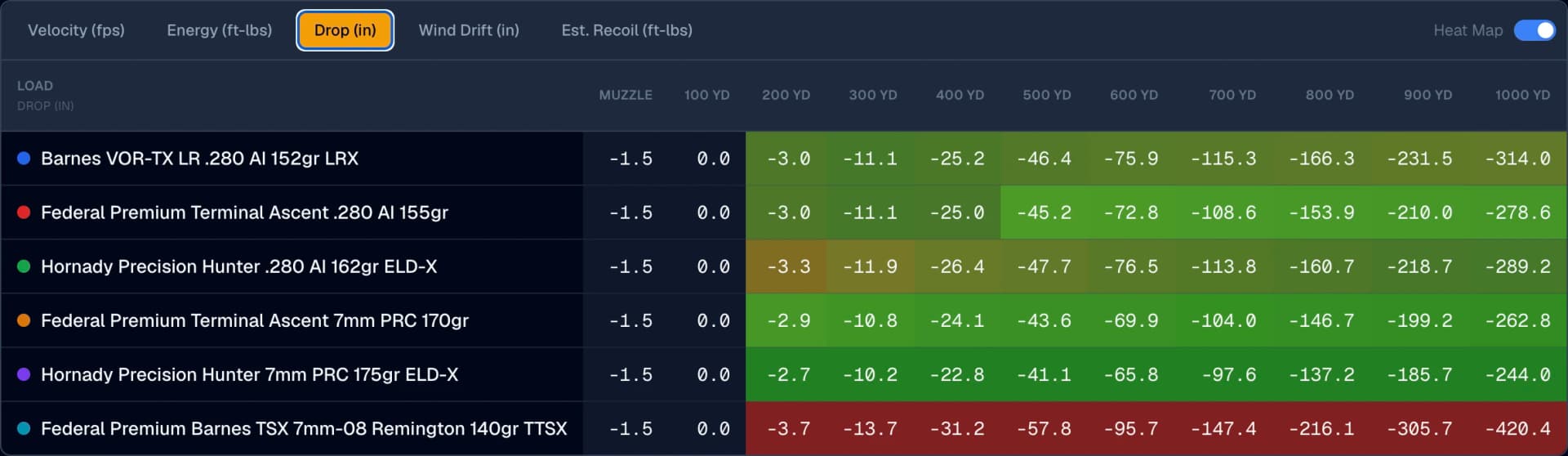
Inside normal hunting ranges they're bunched together, but distance sorts them out: by 700 yards the short-action 7mm-08 has dropped more than four feet farther than the flattest 7mm PRC load. Reach costs you something.
And what it costs you — before you ever touch the trigger — is recoil.
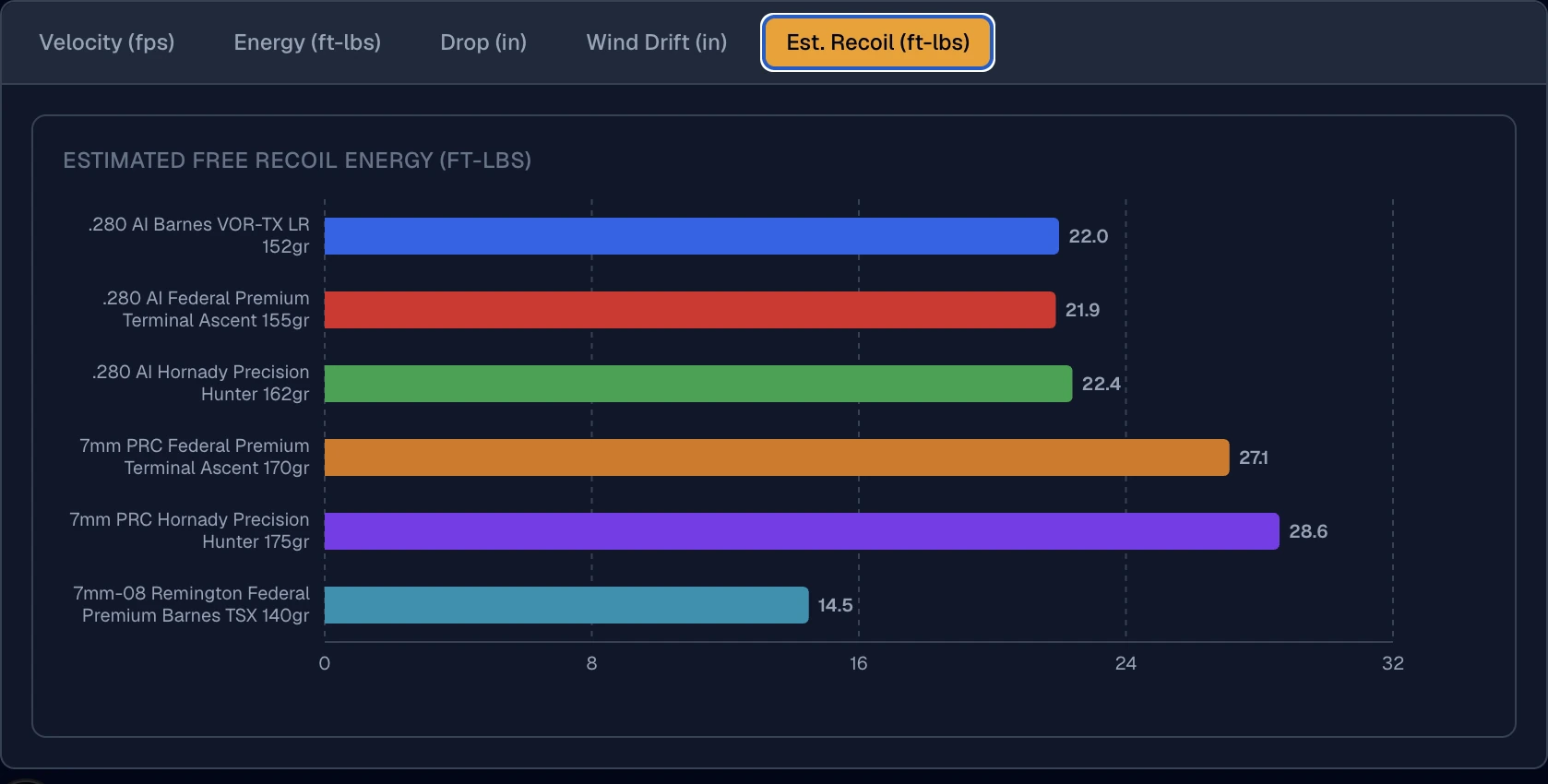
This is the number a spreadsheet never shows you until your shoulder does. The 7mm PRC's performance runs nearly twice the recoil of the 7mm-08 — roughly 28 ft-lbs against 15 — with the .280 Ackley loads sitting in the sensible middle near 22. For a rifle you carry all day and might have to shoot offhand, that matters as much as any energy figure.
The one that fascinates me is the Barnes VOR-TX LR in the .280 AI. On my old spreadsheet's terms it looks fantastic — it's the fastest .280 AI load here and the highest muzzle energy of the three. But it's a lighter monolithic bullet with the lowest BC of the .280 AI loads, and it bleeds. By 500 yards it's drifting 18.5 inches in that crosswind — four full inches more than the heavier .280 AI loads leaving the muzzle slower — and it's shed more retained energy than either. Muzzle velocity flattered it. The full trajectory told the truth. My old energy-only spreadsheet would never have caught that.
And yet the Barnes is the load I keep coming back to. It's a monolithic, lead-free bullet, and Barnes catalogs it as a dedicated long-range load in .280 Ackley Improved — and the fact that a mainstream maker offers one for a cartridge this niche tells you how many people love it. That's cool factor made real. Inside the ranges I actually hunt it gives up nothing that matters, which is why it, not the magnum, is the sweet spot for me.
The rabbit hole is the point
You could argue none of this matters. A dead deer is a dead deer, and a .30-06 kills one exactly as dead as a .280 Ackley. I won't argue with that.
But there's something genuinely fascinating about comparing ballistics — about chasing a couple fewer inches of drift at distance, squeezing a few more foot-pounds onto the target, understanding why one load outruns another. It's a rabbit hole. It's actually a pretty big rabbit hole. And I wanted to build the tool that helps people climb down it without an afternoon of tabs and typos.
So which one did I buy?
None of them. Because while I was busy building the tool, Federal came along and said hold my beer — and dropped the 7mm Backcountry: designed for a short barrel, light, handy rifle pushing a 7mm bullet at 80,000 psi. As if the decision needed to get harder.
Honestly, the delay was worth it. The whole point of a do-it-all 7mm is that it should be current, and the field keeps moving — the 7mm Backcountry is on the table now, and heavy 6.5 Creedmoor loads have gotten so good that the "one gun" conversation isn't even strictly a 7mm conversation anymore. Those are stories for their own articles. My quest for the ultimate 7mm do-it-all hunting rifle never ended with a rifle. It ended with Ballistics Board.
One honest caveat before you go run your own version of this. Every number above comes from the manufacturers' published, test-barrel specifications — that's what Ballistics Board is built on, and it's what any honest comparison starts from. Your rifle, your barrel length, and your conditions will chronograph differently. The tool shows you what a load is capable of and how loads stack up against each other on equal footing. What your rifle actually does on the day, and which cartridge is right for the hunting you do, is still yours to decide. It always was. The tool just makes the deciding a whole lot faster than a spreadsheet.
Run this exact comparison yourself — then swap in your own loads and see what the data says.
Splitting Hairs
The numbers behind the comparisons — what the data actually shows, and where it stops. No hype, no gear reviews.
Related Articles
Cartridges4 min read
.308 vs .30-06 vs .300 Win Mag vs .300 PRC: The Slower Magnum Wins
Everyone knows the ladder: more case, more powder, more performance. Run five Hornady Precision Hunter loads through the same math and the ladder holds — but the cartridge that wins at distance is the one that gave up 100 fps at the muzzle, and the .300 Win Mag needed two extra inches of barrel to lose.
Ballistics Board Staff·
Cartridges9 min read
6.5 Creedmoor +Peak vs .30-06: The One-Gun Rifle Bet You Don't Have to Make
The .30-06 has been the one-gun answer for a century. I ran Federal's 80,000-psi 6.5 Creedmoor +Peak against it without looking at a single number first — and the result changed which rifle I'm buying this fall, though not for the reason I expected.
Steve Sansford·
Cartridges7 min read
7mm Backcountry vs .280 Ackley Improved: Does the Ackley Still Make Sense?
The .280 Ackley Improved was my answer for a do-it-all 7mm — then Federal's steel-cased, 80,000-psi 7mm Backcountry showed up doing the same job from a shorter barrel. On coolness, ballistics, and availability, does the Ackley still hold up? I ran the numbers.
Steve Sansford·