7mm Backcountry vs .280 Ackley Improved: Does the Ackley Still Make Sense?
The .280 Ackley Improved was my answer for a do-it-all 7mm — then Federal's steel-cased, 80,000-psi 7mm Backcountry showed up doing the same job from a shorter barrel. On coolness, ballistics, and availability, does the Ackley still hold up? I ran the numbers.
Steve Sansford
Steve is the builder of Ballistics Board. He doesn't get to the range as often as he'd like, but he's been fascinated by exterior ballistics and the rabbit hole of cartridge comparison for as long as he's owned a rifle.
Back in the first thing I ever wrote on this site, I went looking for one do-it-all 7mm hunting rifle, talked myself into the .280 Ackley Improved, and then bought exactly nothing — because right as I was ready to pull the trigger, Federal said hold my beer and dropped the 7mm Backcountry. I left it there, as a cliffhanger, because at the time that's all it was: a press release and a promise.
It's not a promise anymore. It's on shelves, it's in rifles, and I've had a year to sit with the question it left me holding: does the .280 Ackley Improved still make sense? Not "is it cool" — it is — but does it still make sense, now that a steel case does the same job for less barrel? I judged it the only way I know how: coolness, ballistics, availability. I didn't chronograph anything. Every velocity and drift figure below is the manufacturers' published data run through our ballistics calculator under the same conditions — sea level, 59°F, a 100-yard zero, a 10 mph crosswind. I ran the math.
They're the same cartridge. Almost.
Here's the thing nobody tells you when they pit these two against each other: they are nearly the same round.
Both launch a .284 bullet. Both hold about 73 grains of water — that's case capacity, not powder charge, a distinction I embarrassingly had to double-check myself — within a grain or two of each other whichever way you measure it. That's a touch more room than a .30-06 and a long way short of a 7mm Rem Mag's 82-plus. Same bullet, same powder room, same long action. Hold onto that, because a grain or two of water can't come close to explaining the gap you're about to see. That gap isn't volume. It's pressure, full stop.
So what's actually different? Fifteen thousand psi. The Ackley gets its performance the old-fashioned way, the way P.O. Ackley got everything: he blew the shoulder out of a .280 Remington to make room for more powder, and lit it off at around 65,000 psi in brass. The Backcountry gets there by a different lever entirely — a one-piece steel Peak Alloy case that shrugs off 80,000 psi. Same idea, sixty years apart. The Ackley was the improved cartridge. The Backcountry is the improvement, improved.
Which means this whole comparison is an exercise in splitting hairs. So let's split them.
Coolness: closer than I wanted it to be
I gave the Ackley the cool-factor crown in my first piece and I'm not taking it back. It's one of the coolest cartridges ever necked, on one of the coolest actions ever built — Ackley's name, the wildcat-made-legit story, the whole romance of it. That's real and it doesn't evaporate because something faster showed up.
But I have to be honest: a steel-cased cartridge running 80,000 psi is also badass. It's not heritage-cool, it's frontier-cool — the sound of an engineering constraint that stood for a century getting quietly moved. That's its own kind of soul, and pretending otherwise would be nostalgia dressed up as judgment.
Ryan Muckenhirn — who cuts custom turrets and runs ballistic solutions for a living over at Vortex — put it about as strongly as a person can on the Vortex Nation podcast:
"This is the most quantum leap that we've had in that arena — my opinion — since we took the powder and we put it in a case."
Read that twice. He isn't saying it's the best 7mm, or the best hunting round. He's saying the steel case is the biggest thing to happen to the metallic cartridge since there was a metallic cartridge. That's either hype or the truest thing anyone's said about the Backcountry — and when I look at the numbers, I lean hard toward the latter. Coolness, for the first time, is a draw. I did not expect to type that.
Ballistics: no contest
Here's where the hair stops splitting and the gap opens up. On ballistics alone, there is no argument for the .280 Ackley Improved. None.
Don't take the cartridges' word for it — take the bullet's. Load the exact same projectile in both, a 155-grain Federal Terminal Ascent from the same maker, so the only thing that changes is the case around the powder. (Federal publishes a 24-inch test barrel for its Backcountry loads; it doesn't list one for the Ackley load.)
| Load | Muzzle velocity | Energy @ 500 yd | Wind drift @ 500 yd |
|---|---|---|---|
| .280 Ackley Improved — 155 gr Terminal Ascent | 2,930 fps | 1,642 ft-lbs | 14.3″ |
| 7mm Backcountry — 155 gr Terminal Ascent | 3,300 fps | 2,159 ft-lbs | 11.8″ |
| 7mm Backcountry — 170 gr Terminal Ascent | 3,150 fps | 2,214 ft-lbs | 11.8″ |
| 7mm PRC — 170 gr Terminal Ascent (the magnum, for scale) | 2,950 fps | 1,915 ft-lbs | 13.0″ |
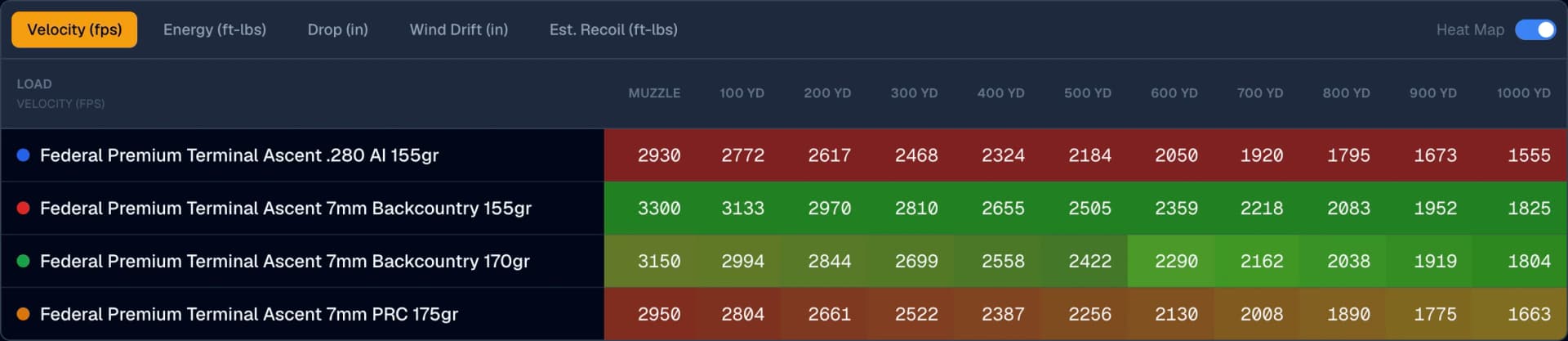
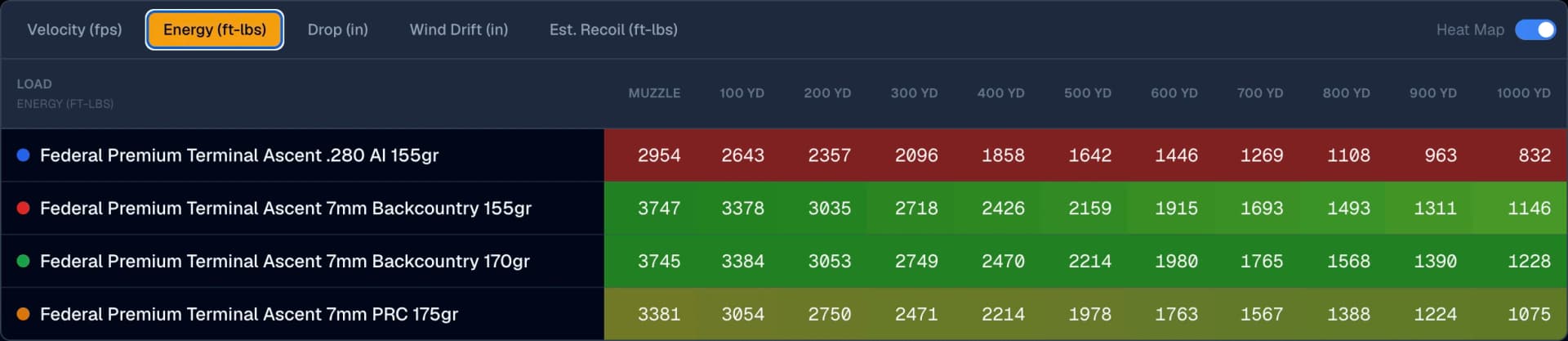
Same bullet. Same maker. The Backcountry leaves 370 fps faster and shows up at 500 yards with about 500 more foot-pounds — roughly 30% more energy — and two and a half inches less wind. That's not a cartridge advantage; that's a pressure advantage, made visible. And the Backcountry's headline trick, the one Federal put on the box, is that it's built for a 20-inch barrel — Ackley-class speed from four inches less pipe.
Watch that velocity gap the whole way down, not just at the muzzle — it never closes:
And because energy scales with the square of velocity, the gap only widens when you weigh it in foot-pounds:
Now, a confession that cuts against the marketing: the short barrel does nothing for me. I'm a bigger guy; a 24-inch rifle balances better in my hands, muzzle device and all, and four inches shorter doesn't feel one bit handier. I know a lot of hunters love a compact rifle. I'm not one of them. But here's the part that matters — it doesn't save the Ackley. Because 80,000 psi isn't a short-barrel gimmick; it's more velocity at any barrel length. Give me a 24-inch 7mm Backcountry and I don't get a stubby rifle, I get the whole table above. The Ackley loses the ballistics fight whether I want the short barrel or not.
None of this comes entirely free — the faster bullet does mean noticeably more recoil than the easygoing Ackley: 25.7 and 27.2 ft-lbs for the two Backcountry loads against the Ackley's 21.9. But notice why there's a 7mm PRC in that table for scale: the Backcountry's 170-grain load leaves the muzzle faster than the PRC's 170-grain load and kicks about the same, because it makes its speed with pressure instead of a bigger powder charge. That's the quiet part of the story — a magnum buys velocity by burning more powder, and more powder means more gas out the muzzle, which means more recoil. The Backcountry buys the same velocity with pressure, and your shoulder can tell the difference.
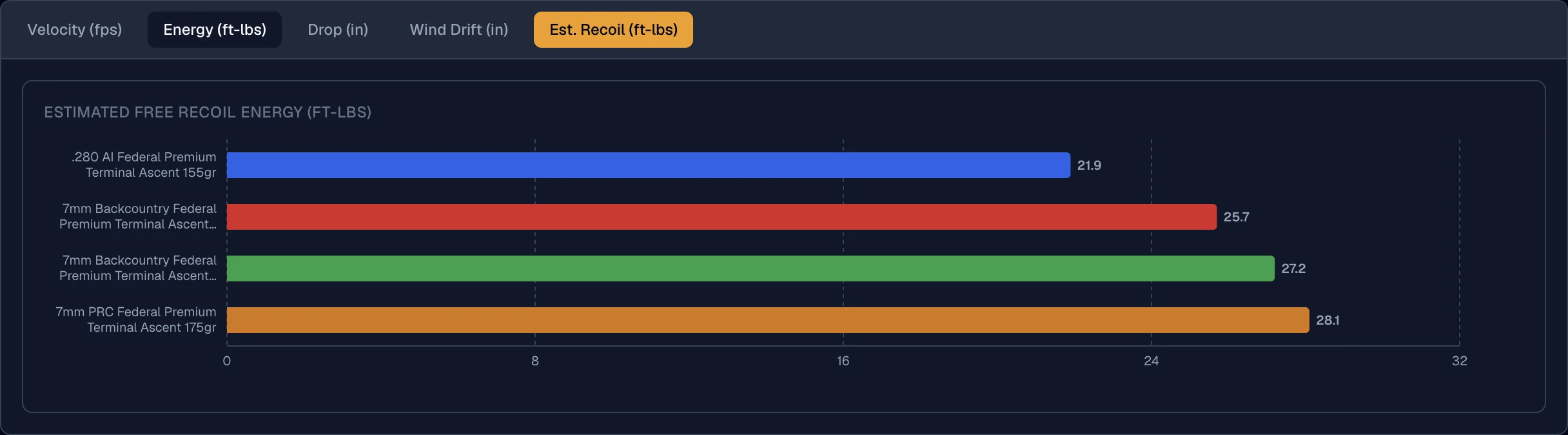
So it settles right where it belongs in the 7mm order: friskier than the mild Ackley, no worse than the magnum it just beat on speed — and what's left of it, that heavier 24-inch rifle and a muzzle device tuck away.
Availability: the tiebreaker splits down the middle
If ballistics were the whole story we'd be done. They're not, because you can't shoot a spec sheet — you have to buy the thing, and this is where the Ackley claws some ground back and then loses it somewhere more important.
On ammo, the old cartridge wins. At least five manufacturers load factory .280 Ackley Improved — Nosler, Federal, Barnes, Hornady, and Weatherby among them. The Backcountry has two, Federal and Remington, and they're the same parent company, so it's really one source with two labels. The Ackley's ammo is easier to find and comes from more houses. Advantage, Ackley — for now; Federal's clearly still filling the Backcountry lineup in.
On rifles, it's a rout, and it's the axis that actually decides this for a guy like me who buys factory guns and factory ammo. Nobody mainstream chambers a factory .280 AI anymore. Christensen did it, Weatherby did it in some Mark Vs, Savage had a few in the 110 line — but go to Savage's site today and the story is stark: zero rifles in .280 Ackley Improved. The caliber isn't even a filter option; it's been dropped from the catalog entirely. Meanwhile they list twelve models in 7mm Backcountry — across both the 110 bolt guns and the Impulse straight-pulls, right up through the flagship KLYM and Ultralite. The Backcountry didn't just get added to the lineup. It took the .280's slot.
That's the whole industry pointing at once. Manufacturers don't chamber twelve models in a cartridge they think is a fad, and they don't quietly delete a caliber they think still sells. They've decided the Backcountry does everything the Ackley does and more — which, if you scroll back up to that table, is exactly what the numbers say too.
Gun to my head
Fine. Forced to choose one to buy, this week, off a shelf: 7mm Backcountry. The ammo selection is thinner today, but it's growing and it's good, and the rifle selection at my price point isn't close. If you want a custom rifle, chamber whatever your heart wants — a custom .280 AI is a wonderful thing and gives up almost nothing but a few fps. But for a factory rifle and factory ammo, which is my whole life as a shooter, the Backcountry wins going away.
And I'm not out on a limb here. Remember Ryan Muckenhirn, the Vortex guy with the quantum-leap line? He owns a .280 Ackley Improved. Loves it. And on that same podcast, he mentioned he's having his own .280 AI rebarreled to 7mm Backcountry. Sit with that for a second: a man who runs the Ackley — who knows precisely what he's trading away — is converting the rifle. That isn't a marketing claim. That's a defection.
So there's the honest answer to "does the .280 AI still make sense": as an object of desire, absolutely. As the rifle you actually walk out of the store with, no — and it was availability that killed it, not ballistics.
So which one did I buy?
None of them. Again.
Because after a year of turning this over, I don't think the 7mm Backcountry is the destination. I think it's the proof of concept. What it really proves is that modern steel and modern machining can safely run a rifle cartridge at 80,000 psi — and every factory rifle on the planet is already proof-tested well past that. Once that's true, the cartridge itself almost stops being the point. The point is what Federal does next with the methodology.
The first thing my brain did when this dropped was reach for an existing cartridge. Imagine a .308 Winchester at 80,000 psi — .300 Win Mag ballistics out of a short-action deer rifle. Now imagine that logic pointed at any of a dozen cartridges people already own and love. That's the interesting cartridge. It doesn't exist yet, exactly, and I have a hunch about which one gets the treatment first — but that's a story for another article.
So I did what I did last time: I watched the field move, and I kept my wallet in my pocket. The quest that started with a .280 Ackley Improved still hasn't ended with a rifle. It might never. That might be the point.
Because split the hairs all the way down and the tiebreaker between these two nearly-identical cartridges was never ballistics, and it wasn't cool factor. It was which one you can walk in and buy a rifle for. And the most interesting 7mm in this whole story is the one that isn't on the shelf at all — yet.
Splitting Hairs
The numbers behind the comparisons — what the data actually shows, and where it stops. No hype, no gear reviews.
Related Articles
Cartridges4 min read
.308 vs .30-06 vs .300 Win Mag vs .300 PRC: The Slower Magnum Wins
Everyone knows the ladder: more case, more powder, more performance. Run five Hornady Precision Hunter loads through the same math and the ladder holds — but the cartridge that wins at distance is the one that gave up 100 fps at the muzzle, and the .300 Win Mag needed two extra inches of barrel to lose.
Ballistics Board Staff·
Cartridges9 min read
6.5 Creedmoor +Peak vs .30-06: The One-Gun Rifle Bet You Don't Have to Make
The .30-06 has been the one-gun answer for a century. I ran Federal's 80,000-psi 6.5 Creedmoor +Peak against it without looking at a single number first — and the result changed which rifle I'm buying this fall, though not for the reason I expected.
Steve Sansford·

Cartridges6 min read
Best 7mm Cartridges for Elk: 7mm PRC, 7mm Rem Mag, and .280 AI
Don't shop the headstamp — shop the job. We set two rules an elk load has to clear at 500 yards, then ran the numbers on every 7mm hunting load in the database to see which cartridges actually make the cut.
Ballistics Board Staff·