.308 vs .30-06 vs .300 Win Mag vs .300 PRC: The Slower Magnum Wins
Everyone knows the ladder: more case, more powder, more performance. Run five Hornady Precision Hunter loads through the same math and the ladder holds — but the cartridge that wins at distance is the one that gave up 100 fps at the muzzle, and the .300 Win Mag needed two extra inches of barrel to lose.
Ballistics Board Staff
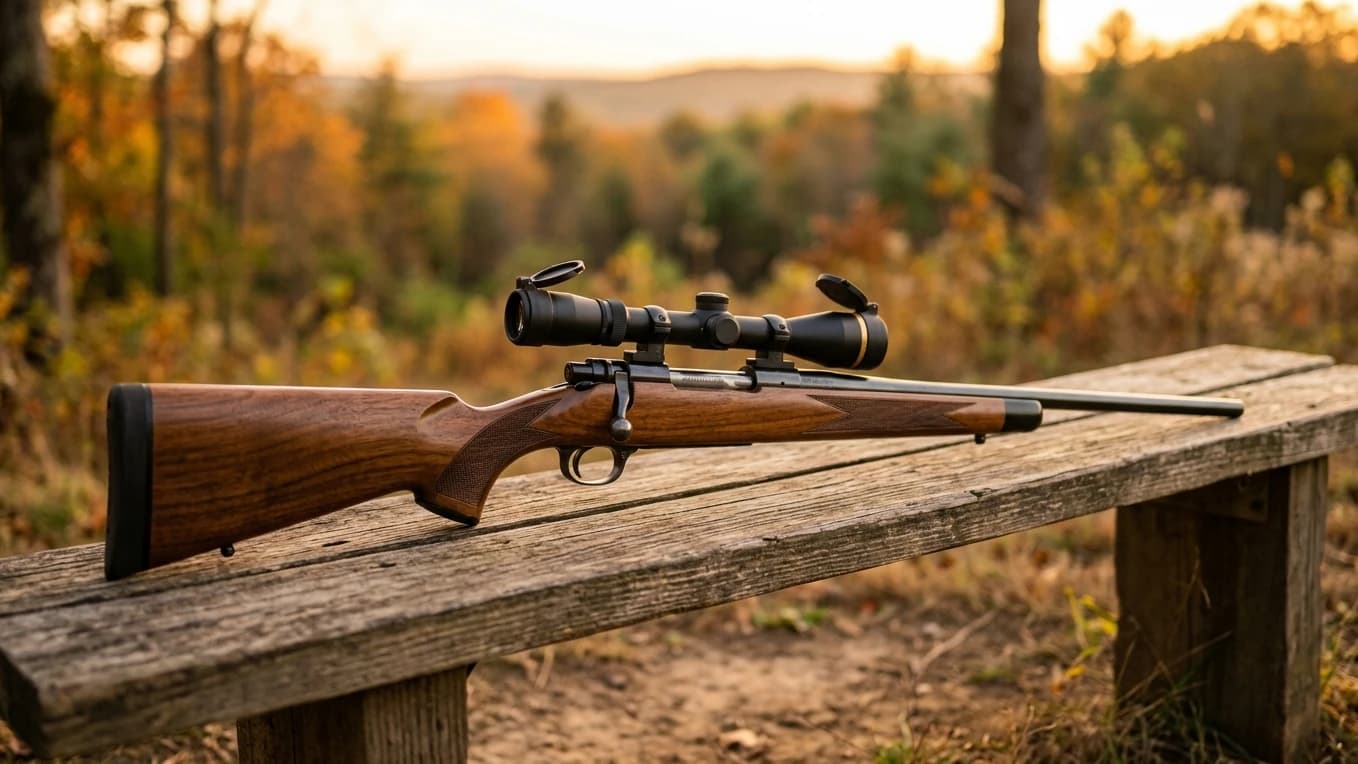
There is a ladder every deer camp knows by heart. The .308 Winchester is the sensible one. The .30-06 Springfield is the one your grandfather had and it does everything. The .300 Winchester Magnum is what you step up to when you get serious about elk, and the .300 PRC is what you step up to when the Win Mag stops being enough. More case, more powder, more performance, and the only question is how much recoil you're willing to absorb on the way up.
The ladder is real. What's wrong is the assumption underneath it — that the rungs are ordered by how fast the cartridge is.
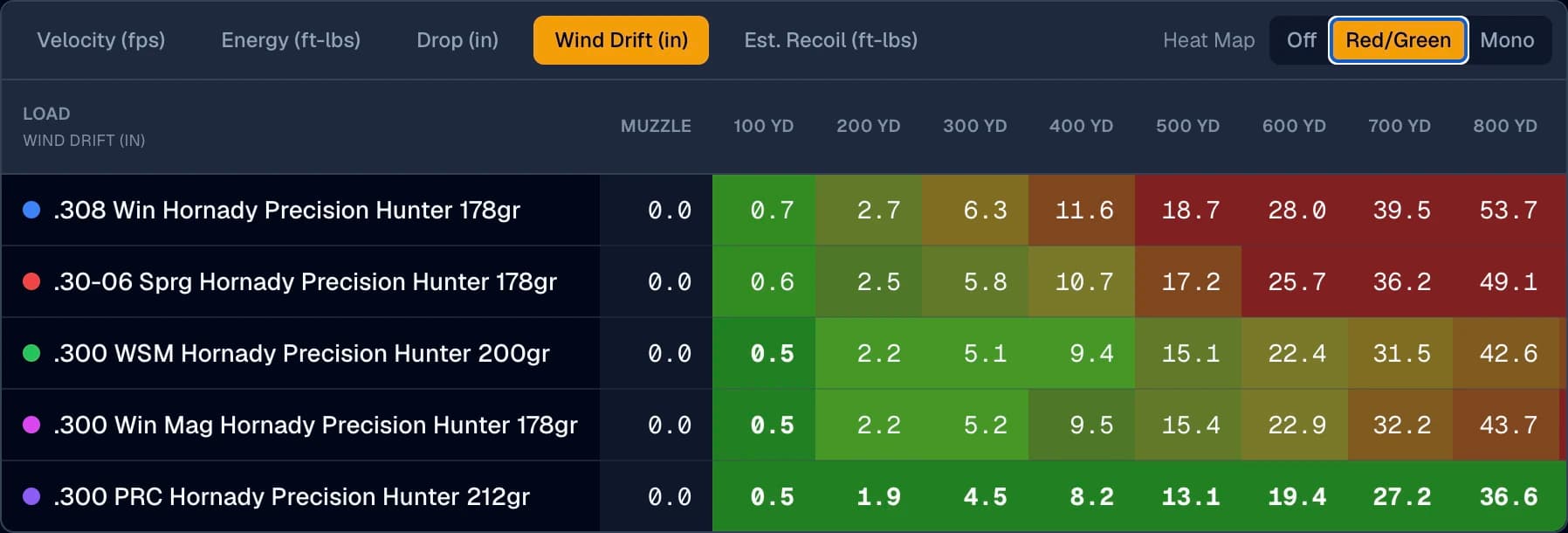
We ran five loads through the same math to find out what each step actually buys. Every one is a Hornady Precision Hunter, which is deliberate: three of the five carry the identical 178-grain ELD-X bullet at an identical G7 ballistic coefficient of 0.278, so between those three the only thing that changes is how much powder is behind it. That's as close to a controlled experiment as a factory catalogue allows. Every figure below is the manufacturer's published data run through our ballistics calculator under identical conditions: sea level, 59°F, 29.92 inHg, a 100-yard zero, and a 10 mph full-value crosswind. We didn't fire a shot — we ran the math.
What 360 feet per second is worth
Start with the three that share a bullet. The .308, the .30-06 and the .300 Win Mag all launch the same 178-grain ELD-X, at 2,600, 2,750 and 2,960 fps respectively. Nothing differs but velocity.
| Cartridge | MV | Wind @ 500 | Drop @ 500 | Velocity @ 500 | Holds 1,500 ft-lbs to |
|---|---|---|---|---|---|
| .308 Winchester | 2,600 | 18.7" | −61.4" | 1,855 | 430 yd |
| .30-06 Springfield | 2,750 | 17.2" | −53.8" | 1,980 | 525 yd |
| .300 Win Mag | 2,960 | 15.4" | −45.1" | 2,156 | 645 yd |
The ladder holds exactly as advertised. Every step up is faster, flatter, and drifts less. The 360 fps between the .308 and the .300 Win Mag is worth 3.3 inches of wind at 500 yards, 16.3 inches of drop, and 215 extra yards of elk-legal energy.
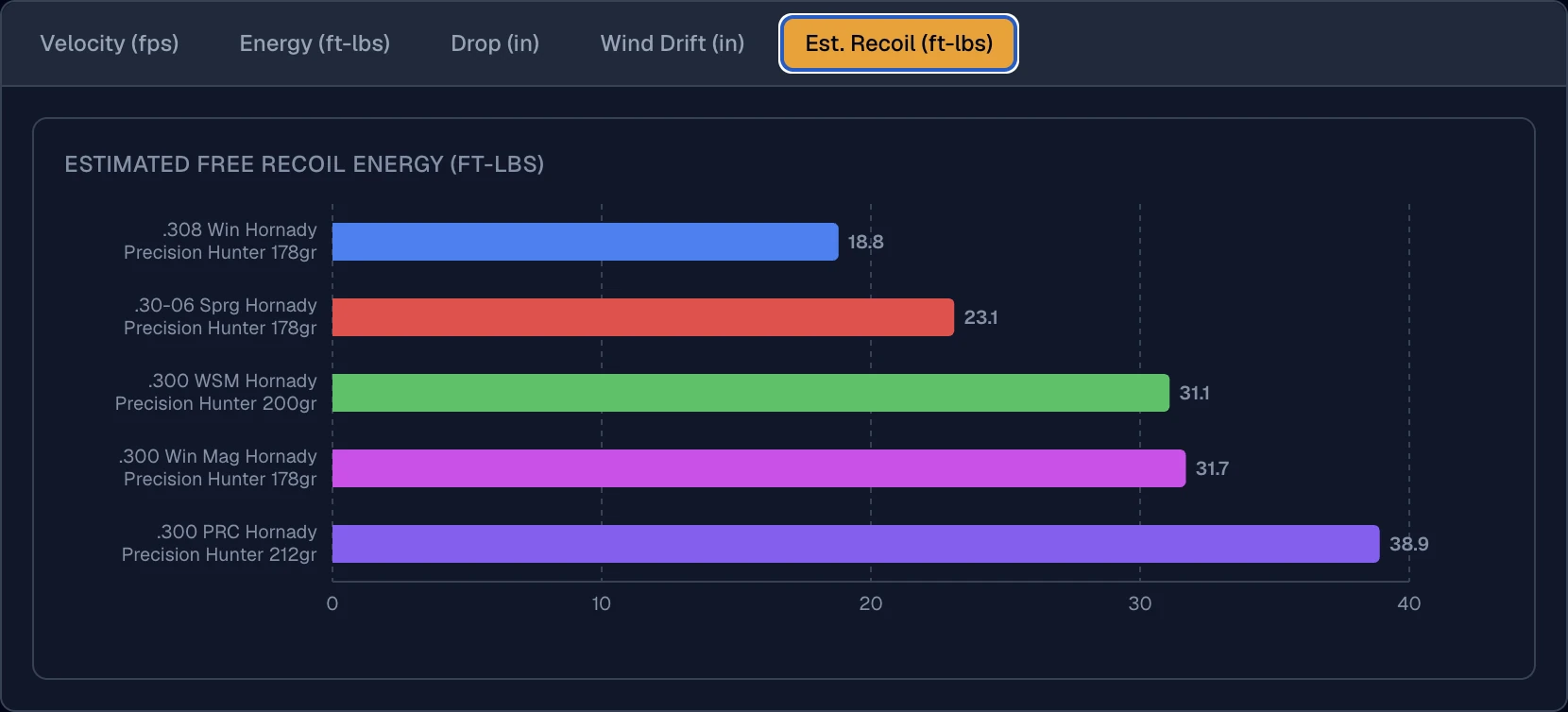
It is also worth 69% more recoil — 18.8 ft-lbs to 31.7, computed for an 8-pound rifle. That is the price list, and it's an honest one. Nobody is being lied to about what a magnum does.
The rung that isn't where you think
Now add the other two, and the tidy ordering falls apart.
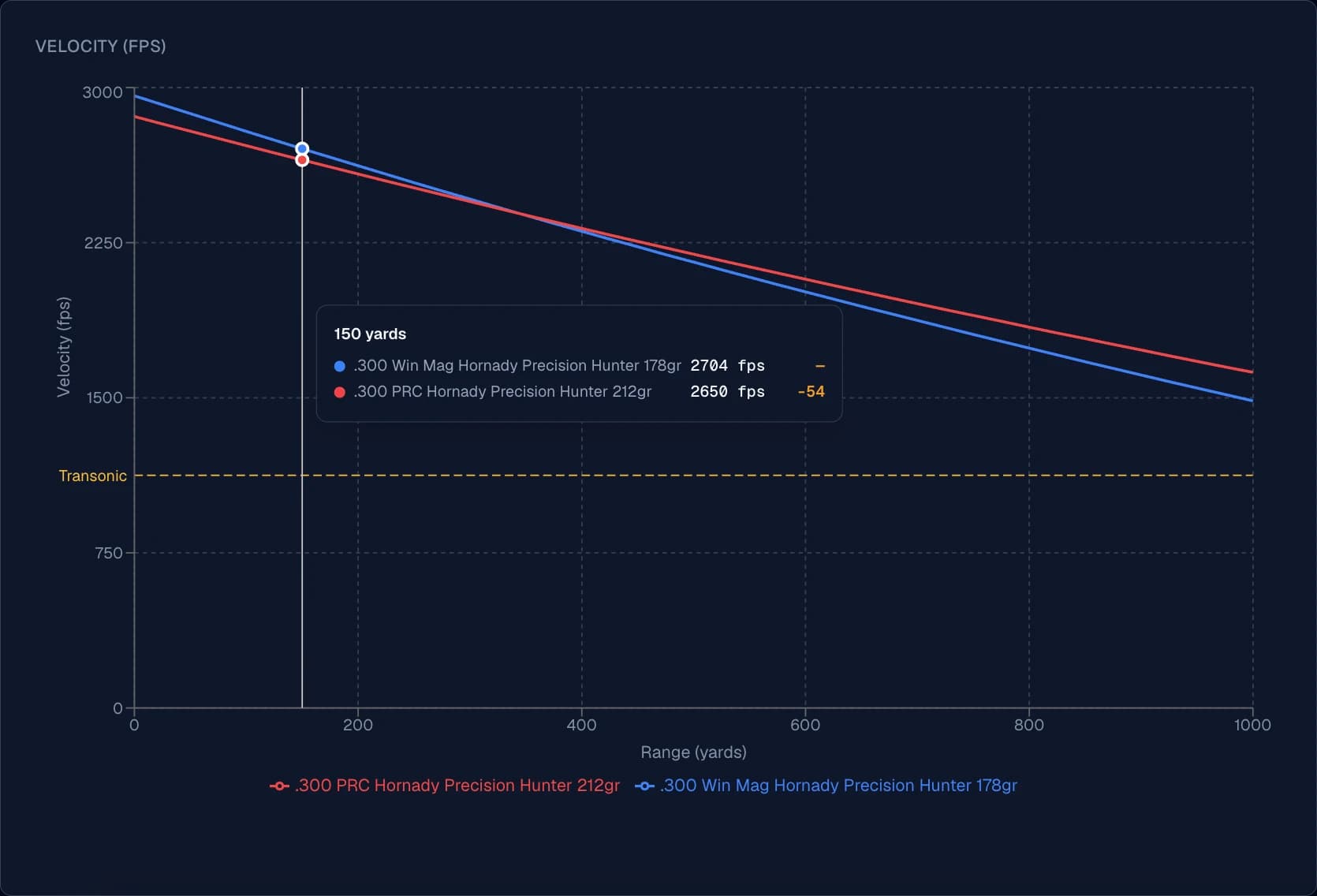
The .300 PRC is the biggest cartridge here by reputation, and slower than the .300 Win Mag at the muzzle: 2,860 fps against 2,960. It gives up 100 fps before the bullet has gone a yard.
It gets all of it back and then some.
| Range | .300 Win Mag | .300 PRC | PRC lead |
|---|---|---|---|
| Muzzle | 2,960 | 2,860 | −100 fps |
| 350 yd | 2,382 | 2,383 | +1 fps |
| 500 yd | 2,156 | 2,194 | +38 fps |
| 700 yd | 1,874 | 1,955 | +81 fps |
The crossover is at 350 yards. Past that the slower cartridge is the faster one, and the gap keeps widening. At 500 yards the PRC also drifts 2.3 inches less in the same wind, carries 2,265 ft-lbs against 1,836, and holds the 1,500 ft-lb line out to 850 yards where the Win Mag runs out at 645.
None of that comes from powder. It comes from the bullet: 212 grains at a G7 of 0.334, against 178 grains at 0.278. The .300 PRC spends its case capacity on a heavier, slipperier projectile; the .300 Win Mag spends its on speed. Downrange, the bullet wins.
It is not free. A heavier bullet on a bigger powder charge adds to both halves of the recoil equation, and the PRC comes out at 38.9 ft-lbs against the Win Mag's 31.7 — 23% more, for the cartridge that is slower out of the muzzle.
The short magnum nobody mentions
The .300 Winchester Short Magnum makes the same point from the other direction, and more quietly.
It holds about 80 grains of water to the .300 Win Mag's 91.5 — 13% less case. It launches a 200-grain ELD-X at 2,820 fps, 140 fps slower. By the ladder's logic it should sit a clear rung below.
It doesn't. The WSM holds 1,500 ft-lbs to 700 yards against the Win Mag's 645. It drifts 15.1 inches at 500 against 15.4. It carries 1,945 ft-lbs at 500 against 1,836. And it does all of that at 31.1 ft-lbs of recoil against 31.7 — slightly less — from a short action.
The .300 Win Mag wins on raw velocity and on drop, and that's the whole of it.
The limits
Every load here is a Hornady Precision Hunter, and that is the point rather than a gap. Holding the product line constant is what makes the three-way comparison meaningful — three cartridges, one bullet, one variable. It also means this is a comparison of these five loadings, not of the five cartridges in the abstract. A .308 loaded with a heavy high-BC match bullet closes a great deal of the gap shown here, and that is the same lesson arriving from the other side.
The .300 Win Mag's velocity comes from a 26-inch test barrel. The other four are 24. That flatters the Win Mag by roughly the length of barrel most people don't have, and it still loses to the PRC downrange and ties the WSM. Correcting for it would widen every gap the Win Mag loses and narrow the ones it wins.
Recoil is computed, not measured. These are free-recoil figures for an 8-pound rifle with the powder charge estimated from case capacity. They are sound for comparing one cartridge against another and they are not what your shoulder reports: rifle weight, stock geometry, a brake and a recoil pad all move the number, and magnum rifles are often built heavier, which quietly returns some of that 69%.
Nothing here is short of energy inside 400 yards. All five carry more than 1,500 ft-lbs to 400, and all five stay supersonic past 1,000. If your shooting lives inside the range where most game is actually taken, every one of these cartridges is already enough, and the differences on this page are arguments about the last hundred yards.
Barrel life and ammunition cost are unpriced here, and they don't move in your favour as you climb. So is recoil's effect on how well you shoot, which is the variable most likely to matter and the one no ballistics calculator can see.
What the ladder actually measures
More case capacity does buy more performance. The claim is true. What it doesn't tell you is the ranking, because capacity is a budget and the cartridges differ in what they spend it on.
Spend it on velocity and you get the .300 Win Mag: flattest of the five to 700 yards, fastest to 350 yards, and beaten past that by a cartridge that spends a bigger case on a better bullet instead. Spend it on bullet and you get the .300 PRC and the .300 WSM, which give up muzzle velocity and take back wind, energy and range.
So the useful question isn't how far up the ladder to climb. Between the .30-06 at 23.1 ft-lbs and the .300 PRC at 38.9 there is a 68% increase in recoil and 325 yards of extra elk-energy range — and if your longest honest shot is 300 yards, you have bought the recoil and none of the range. Decide the distance first. The cartridge follows from it, and it may well be further down the ladder than the ladder suggests.
Splitting Hairs
The numbers behind the comparisons — what the data actually shows, and where it stops. No hype, no gear reviews.
Related Articles
Cartridges9 min read
6.5 Creedmoor +Peak vs .30-06: The One-Gun Rifle Bet You Don't Have to Make
The .30-06 has been the one-gun answer for a century. I ran Federal's 80,000-psi 6.5 Creedmoor +Peak against it without looking at a single number first — and the result changed which rifle I'm buying this fall, though not for the reason I expected.
Steve Sansford·
Cartridges7 min read
7mm Backcountry vs .280 Ackley Improved: Does the Ackley Still Make Sense?
The .280 Ackley Improved was my answer for a do-it-all 7mm — then Federal's steel-cased, 80,000-psi 7mm Backcountry showed up doing the same job from a shorter barrel. On coolness, ballistics, and availability, does the Ackley still hold up? I ran the numbers.
Steve Sansford·

Cartridges6 min read
Best 7mm Cartridges for Elk: 7mm PRC, 7mm Rem Mag, and .280 AI
Don't shop the headstamp — shop the job. We set two rules an elk load has to clear at 500 yards, then ran the numbers on every 7mm hunting load in the database to see which cartridges actually make the cut.
Ballistics Board Staff·