Best 7mm Cartridges for Elk: 7mm PRC, 7mm Rem Mag, and .280 AI
Don't shop the headstamp — shop the job. We set two rules an elk load has to clear at 500 yards, then ran the numbers on every 7mm hunting load in the database to see which cartridges actually make the cut.
Ballistics Board Staff

There's an unwritten rule behind almost everything on this site: shop the bullet, not the headstamp. Figure out the job you need done, then go find the load that does it — the letters stamped on the case are the last thing to worry about, not the first.
There's exactly one time that rule flips: when you're buying the rifle. Then the headstamp is the decision, because it's the one thing you can't change later. That's the shopper this article is for — the one standing in front of the rack asking which 7mm to carry into elk country. So instead of arguing cartridges, we're going to do it the way the tool was built to do it: define the job first, then see which 7mms can actually do it.
Every number below is manufacturers' published data run through our ballistics calculator under one set of conditions — sea level, 59°F, a 100-yard zero, and a 10 mph full-value crosswind. We didn't fire a shot; we ran the math.
What an elk actually demands at 500 yards
Set two rules. Not vibes — numbers a load either clears or it doesn't.
Rule one: enough energy on arrival. The long-standing convention for elk is about 1,500 ft-lbs of retained energy at the target. Be honest about what that number is, though: it's a rule of thumb, not physics. What kills an elk is a bullet through both lungs. Energy is the margin — the cushion that forgives a bad angle, a raked shoulder, a hair of imperfect placement. A mature bull's heart-lung area runs somewhere around 15 to 18 inches across depending on the animal and who's measuring it; we'll use a conservative 16 inches as the vital zone. Put the bullet in that circle and 1,500 ft-lbs is the insurance behind it. Miss the circle and no amount of energy saves the shot. So we set the floor at 1,500 ft-lbs at 500 yards — and remember it's the margin, not the mechanism.
Rule two: wind you can hold for, not dial for. This is where the last article pays off. At 500 yards in a 10 mph crosswind, even the best hunting bullet money can buy drifts 10 to 16 inches — the entire width of that vital zone. Read that again: the finest load on the shelf, in a moderate wind, can walk clean across an elk's chest at 500. Wind is not optional out there. You cannot dead-center-hold and ignore it.
But here's the payoff for choosing a slick, heavy bullet: for the loads that make our cut, that drift is only about 2 to 3 MOA. That's a correction you can hold — put the windward edge of the vitals on the crosshair, or a single hashmark of a modern reticle — without ever reaching up to dial the turret. A junk low-BC bullet blows past what you can confidently hold. A premium one keeps the wind in hold-off territory. So rule two isn't a fixed inch count; it's a standard: the load has to keep wind drift small enough to hold, not dial. In practice, across the field, that lands every qualifier under about 16 inches — under one vital zone.
Two rules. Energy floor, wind ceiling. Now let the database answer.
The 7mm field
We ran every 7mm hunting load with published velocity and BC through the ballistics calculator and kept only the ones that clear both rules at 500 yards. Dozens of 7mm loads make it — which is the first honest finding: there is no single "best 7mm for elk." There's a field of them. Here's the best-drifting flagship load from each qualifying 7mm cartridge, sorted by wind.
| Cartridge | Flagship load | Wind drift @ 500 | Energy @ 500 |
|---|---|---|---|
| .28 Nosler | 175 gr Nosler Trophy Grade | 11.7" (2.2 MOA) | 2,255 ft-lbs |
| 7mm PRC | 175 gr Hornady Precision Hunter | 11.7" (2.2 MOA) | 2,126 ft-lbs |
| 7mm Backcountry | 170 gr Federal Terminal Ascent | 11.8" (2.3 MOA) | 2,214 ft-lbs |
| 7mm Rem Mag | 162 gr Hornady Precision Hunter | 13.2" (2.5 MOA) | 1,830 ft-lbs |
| .280 Ackley Improved | 162 gr Hornady Precision Hunter | 14.1" (2.7 MOA) | 1,660 ft-lbs |
Then drag the range slider to watch the gaps open.
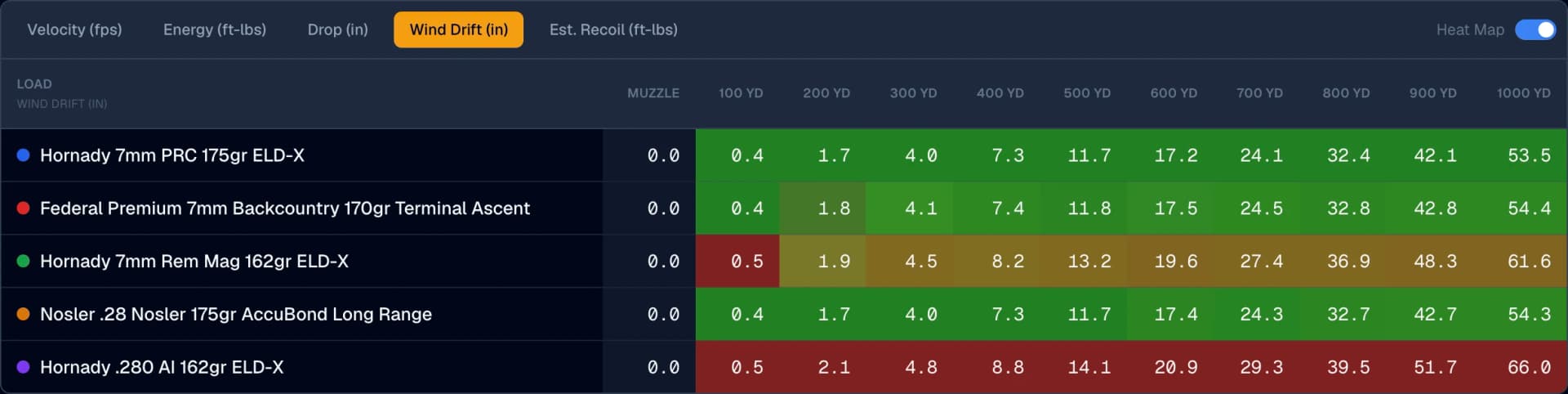
Every one of these clears both rules with room to spare. The spread from top to bottom is real but small — about two and a half inches of wind and 600 ft-lbs of energy separate the flattest-shooting modern magnum from the classic. The honest read: all five of these cartridges will kill an elk at 500 yards with the load shown. What separates them is how much margin they hand you, and how hard you have to work for it.
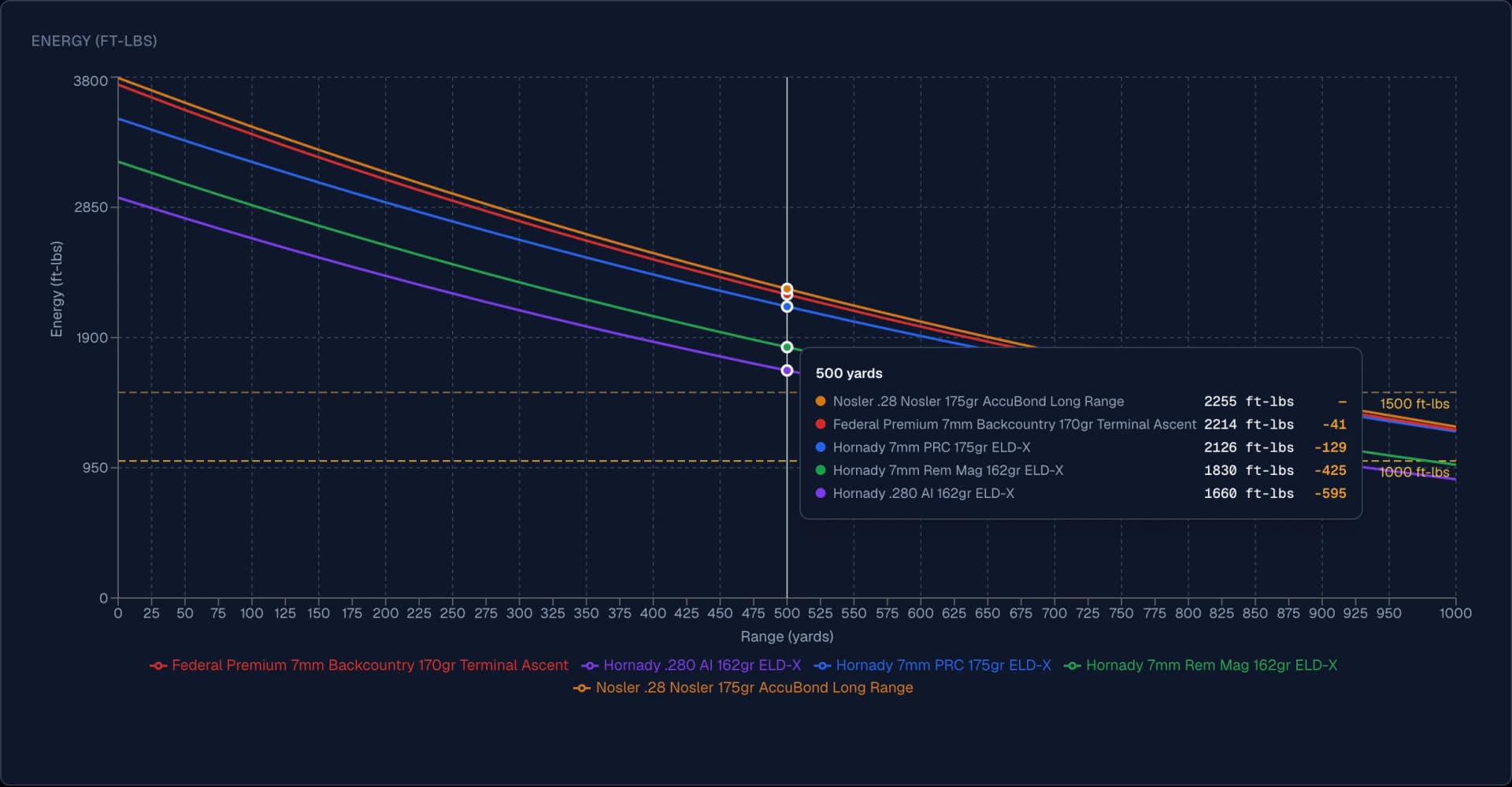
The two speed-and-BC standouts — the .28 Nosler and the 7mm PRC — do it with the most cushion, burning more powder to get there. The .280 Ackley Improved sits last on both counts, right at the edge of the energy floor. That's not a knock; it's the honest picture of a superbly balanced cartridge asked to do a magnum's job at magnum distance. (It's also, for what it's worth, the cartridge that started this whole website — it qualifies, and it qualifies last, and both of those things are true.)
Same cartridge, different bullet
Pick your headstamp and you're not done — you're at the start of the real decision. Because the swing between loads inside one cartridge is as big as the swing between cartridges. This is the same lesson from the wind-drift piece, aimed at elk: the cartridge gets you in the game; the bullet is what actually clears the bar.
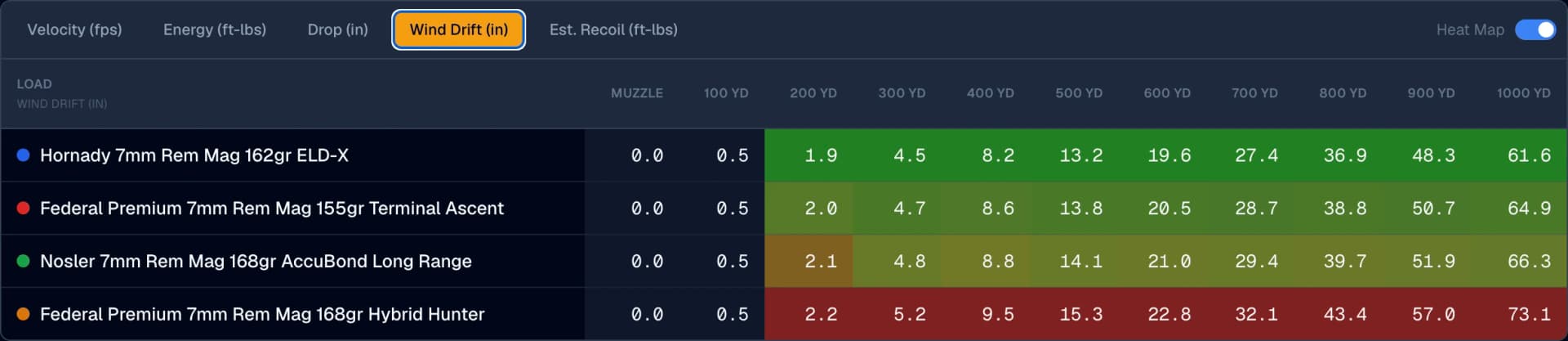
Take the 7mm Remington Magnum — the most popular elk 7mm ever made — and line up four premium loads in it:
| 7mm Rem Mag load | Wind drift @ 500 | Energy @ 500 |
|---|---|---|
| 162 gr Hornady Precision Hunter (ELD-X) | 13.2" | 1,830 ft-lbs |
| 155 gr Federal Terminal Ascent | 13.8" | 1,733 ft-lbs |
| 168 gr Nosler Trophy Grade (AccuBond LR) | 14.1" | 1,746 ft-lbs |
| 168 gr Federal Berger Hybrid Hunter | 15.3" | 1,660 ft-lbs |
Every one of these is a premium bullet — bonded, controlled-expansion, built by people who know exactly what an elk's shoulder does to a projectile. And every one of them clears our elk criteria. But the top load gives up two full inches less wind than the bottom one, in the same rifle, at the same range. Choose the bullet for the shot you expect, not the picture on the box.
Now the 7mm PRC — the cartridge that redrew this map — with four of its own:
| 7mm PRC load | Wind drift @ 500 | Energy @ 500 |
|---|---|---|
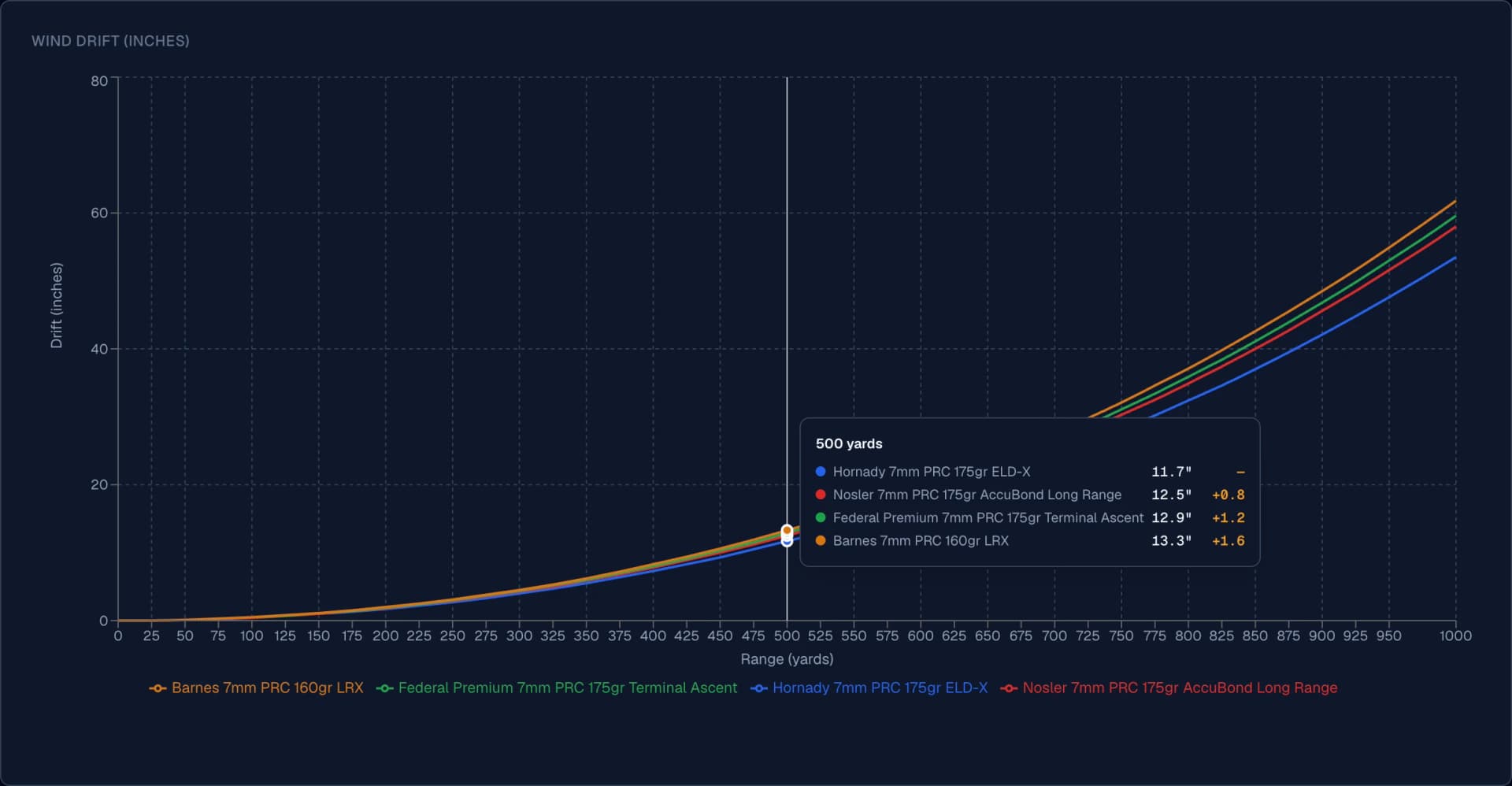
| 175 gr Hornady Precision Hunter (ELD-X) | 11.7" | 2,126 ft-lbs |
| 175 gr Nosler Trophy Grade (AccuBond LR) | 12.5" | 2,055 ft-lbs |
| 175 gr Federal Terminal Ascent | 12.9" | 1,978 ft-lbs |
| 160 gr Barnes VOR-TX LR (monolithic) | 13.3" | 1,874 ft-lbs |
Here's the number that settles the endless PRC-versus-Rem-Mag argument without a single opinion: the 7mm PRC's worst-drifting flagship load — the Barnes mono at 13.3 inches — still carries more energy at 500 (1,874 ft-lbs) than the 7mm Rem Mag's best (1,830). That's the whole cartridge in one line. The PRC doesn't win by a landslide; it wins by handing you more margin across more loads, so you have to try harder to pick a bad one.
Where this stops
Everything above is a 500-yard, buying-the-rifle argument, and it's worth naming what it doesn't cover.
- If you already own a 7mm, you don't need this article — you need a filter. Punch your cartridge into the load list and sort the qualifying loads yourself. The headstamp decision is made; now you're back to shopping the bullet, which is where you should have been all along.
- 1,500 ft-lbs is a convention, not a guarantee. A perfectly placed 1,400 ft-lb bullet kills cleaner than a poorly placed 2,500 ft-lb one every day of the week. The floor is a screening tool, not a promise. Placement is the whole game; energy is the margin around it.
- Real elk aren't broadside paper. Our vital-zone math assumes a square, unhurried, broadside shot. Angle, terrain, and adrenaline all shrink the target and none of them are in the ballistics calculator. The 16-inch circle is a best case.
- The wind is modeled, and it's honest about being full-value. A 10 mph pure crosswind is close to a worst case for a given wind speed. Quartering winds drift less; gusts and terrain make the call harder than the math. The drift numbers are what the physics says; reading the wind in the field is still on you.
Buy the cartridge that clears the bar
The tidy answer to "best 7mm for elk" is that the question is aimed one notch too high. You don't need the best 7mm. You need a 7mm that clears the two rules — enough energy in the vitals, wind you can hold instead of dial — and then a premium bullet loaded to do it. Several 7mms clear that bar. The 7mm PRC and .28 Nosler clear it with the most room; the 7mm Rem Mag and .280 Ackley Improved clear it with less, and clear it all the same.
So do it the way the rack-side shopper should: set your rules, then let the data hand you the field. Pull up Compare, drop in the 7mm loads you're weighing, set the range to 500 and the wind to 10, and read the two columns that matter — energy at the target and drift you can hold. The headstamp is the one decision you can't take back. Make it the one you checked the math on first.
Splitting Hairs
The numbers behind the comparisons — what the data actually shows, and where it stops. No hype, no gear reviews.
Related Articles
Cartridges9 min read
6.5 Creedmoor +Peak vs .30-06: The One-Gun Rifle Bet You Don't Have to Make
The .30-06 has been the one-gun answer for a century. I ran Federal's 80,000-psi 6.5 Creedmoor +Peak against it without looking at a single number first — and the result changed which rifle I'm buying this fall, though not for the reason I expected.
Steve Sansford·
Cartridges7 min read
7mm Backcountry vs .280 Ackley Improved: Does the Ackley Still Make Sense?
The .280 Ackley Improved was my answer for a do-it-all 7mm — then Federal's steel-cased, 80,000-psi 7mm Backcountry showed up doing the same job from a shorter barrel. On coolness, ballistics, and availability, does the Ackley still hold up? I ran the numbers.
Steve Sansford·
Cartridges6 min read
6.5 Creedmoor vs .260 Remington: Splitting Hairs Over a Rifle I Didn't Even Buy
I set out to buy an East Coast whitetail rifle and talked myself into the esoteric .260 Remington over the 6.5 Creedmoor. Then I ran the numbers — and learned more about how we really pick a cartridge than about ballistics.
Steve Sansford·