Wind Drift: Why Ballistic Coefficient Beats Velocity at Distance
Everyone reaches for the fastest load to fight the wind. It's exactly backwards. We ran the numbers on five popular .308 loads from the manufacturers' published data — and the slowest bullet drifts the least, while two loads of the same weight come out 25 inches apart.
Ballistics Board Staff

Ask a room full of shooters how to beat the wind and most will give you the same answer without thinking: shoot something faster. A flatter, quicker bullet spends less time in the air, so the wind has less time to move it. It sounds like physics. It's the reasoning behind every "I run the light bullet because it's screaming fast" post ever typed.
It's also backwards. The fastest load in your safe is very often the worst one in a crosswind, and you can prove it without leaving a single cartridge behind — because the thing that actually beats the wind isn't printed in big numbers on the box. It's the ballistic coefficient, the unglamorous decimal most people scroll right past.
To show it, we didn't cross-shop cartridges. We held the rifle constant — a single .308 Winchester at one set of conditions — and changed nothing but the bullet. Every number below is manufacturers' published data run through our ballistics calculator under identical conditions: sea level, 59°F, a 100-yard zero, and a 10 mph full-value crosswind. We didn't fire a shot — we ran the math.
Wind drift isn't what you think it is
Start with what the wind is actually doing, because the common mental picture is wrong.
The wind is not grabbing a bullet screaming along at 2,800 fps and shoving it sideways in real time — at that speed it barely gets a grip. What it's really exploiting is lag time: the gap between how long the bullet takes to reach the target and how long it would take if the air weren't slowing it down. A bullet in a vacuum reaches 1,000 yards in a fixed amount of time set purely by its speed. A real bullet arrives late, because drag has been bleeding off its velocity the whole way. That difference — those extra fractions of a second — is exactly how long the crosswind has been pushing it off line.
So the question that decides wind drift isn't "how fast did it leave?" It's "how much speed did it keep?" A bullet that sheds velocity slowly accumulates less lag and drifts less. A bullet that sheds velocity quickly piles up lag and gets blown around, no matter how fast it started.
That property — resistance to shedding speed — is the ballistic coefficient. A high BC means a slippery bullet that holds its velocity. And here's the part that breaks the intuition: raising muzzle velocity shortens the flight a little, but it also means more drag to fight, so the two effects largely cancel. Raising BC has no such penalty. At distance, BC is the lever that matters, and velocity is the one everybody grabs by mistake.
One rifle, five bullets
Enough theory. Here are five factory .308 Winchester loads — all modeled from the same rifle and the same conditions — sorted by how far they drift at 1,000 yards in that 10 mph wind.
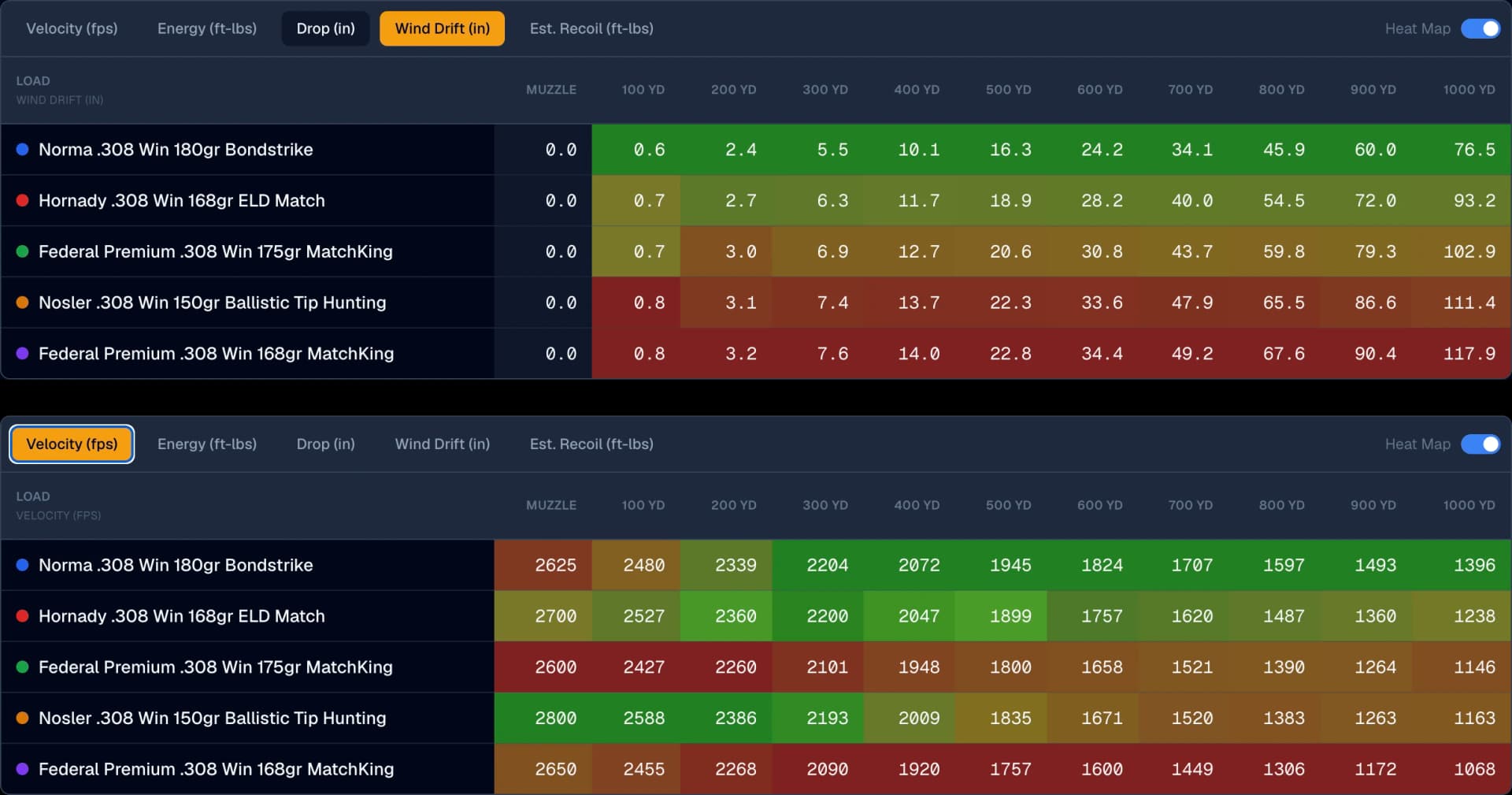
| Bullet | Muzzle velocity | BC | Wind drift @ 1,000 yd |
|---|---|---|---|
| 180 gr Norma Bondstrike | 2,625 fps | .615 G1 | 76.5" |
| 168 gr Hornady Match (ELD) | 2,700 fps | .263 G7 | 93.2" |
| 175 gr Federal Gold Medal (SMK) | 2,600 fps | .257 G7 | 102.9" |
| 150 gr Nosler Ballistic Tip | 2,800 fps | .435 G1 | 111.4" |
| 168 gr Federal Gold Medal (SMK) | 2,650 fps | .230 G7 | 117.9" |
Read it from the top and the folklore falls apart.
The load that drifts the least is the heaviest and among the slowest — the 180-grain Bondstrike, ambling out at 2,625 fps, the exact bullet you'd skip if you were shopping by velocity. The fastest load in the group, the 150-grain Ballistic Tip at 2,800 fps, sits second from the bottom. Sort this table by muzzle velocity and you get almost no relationship to the wind column at all. The number on the box that everyone reads first is the one that predicts the least.
Now look at the two loads that matter most — the pair in the middle and the bottom, both 168 grains. Same bullet weight. Same rifle. Fifty feet per second apart at the muzzle. And by 1,000 yards they're nearly 25 inches apart in the wind — 93.2" for the Hornady, 117.9" for the Federal. Two boxes on the same shelf that a shopper would treat as interchangeable, "168-grain .308 match," and one gives up two full feet of wind to the other. The only meaningful difference between them is the bullet's shape: a sleeker ELD design holding a .263 G7 against an older MatchKing profile at .230. That gap is the ballistic coefficient, made visible.
It doesn't even take a thousand yards to see it start. At 500 those same two 168s are already 4 inches apart; the error just compounds the farther out you go.
Load all five and drag the range slider — you can watch the lines fan apart.
Where velocity does earn its keep
None of this means muzzle velocity is worthless, and the honest version of the story has edges worth naming.
Velocity is the tiebreaker between bullets of nearly equal BC. Two loads with the same slippery profile, one 200 fps faster? The faster one wins the wind, because now speed is breaking a tie instead of fighting a deficit. That's real, and it's why, all else equal, more speed is still worth having.
What velocity can't do is out-run a genuine BC deficit — and we went looking. Searching our whole load database for a faster, lower-BC bullet that still beat a slower, higher-BC one, the only cases that turned up were ones where the BC gap was almost nothing, a percent or two, and even then it took several hundred extra fps to win by an inch or two at 1,000 yards. To overcome a real BC gap — say a tenth and a half of G1 — you'd need something like 900 fps of extra muzzle velocity that no cartridge on the shelf is going to hand you, and you'd win by a rounding error. A tenth of a point of BC is simply worth more than a few hundred fps. That's the exchange rate, and it's brutally one-sided.
Two more honest edges. This is a 1,000-yard argument — inside 300 yards the spread between good loads shrinks to something most shooters will never notice, so if your shots are close, chase whatever else you like. And the lowest-BC bullets have a second problem waiting for them out there: as they bleed toward the transonic zone around 1,100 fps they get less stable and less predictable, which is part of why the bottom of that chart falls apart faster than the top. High BC keeps a bullet supersonic and well-behaved longer — one more advantage velocity can't buy back.
Shop the bullet, not the headstamp
The practical takeaway is almost too simple: the box tells you the wrong number first. Muzzle velocity is printed big because it's easy to feel good about. Ballistic coefficient is buried because it's a decimal that means nothing until you're standing behind the rifle in a crosswind — at which point it means almost everything.
So when you're building a load for distance, sort by BC, not by velocity. On any .308 load list — or sort the bullets themselves by BC — the heavy, sleek, "slow" match bullets that muzzle-velocity shopping talks you out of are the ones that get to the target with the least wind correction and the most margin for a misread. It's the same lesson the 6mm GT quietly taught in our .243 comparison — a factory load leaving slower than the 6mm Creedmoor yet drifting less on a higher-BC bullet — and the same reason the 147-grain load beat lighter bullets in the 6.5 Creedmoor story. Different cartridges, one rule.
Don't take our five loads for it. Put your own on the chart: pull up Compare, drop in the loads you actually shoot, and set the wind. The fastest one probably won't be the flattest where it counts — and now you'll know before the wind does.
Splitting Hairs
The numbers behind the comparisons — what the data actually shows, and where it stops. No hype, no gear reviews.
Related Articles
Ballistics6 min read
Maximum Point-Blank Range, Explained — Your Vital Zone Matters More Than Your Cartridge
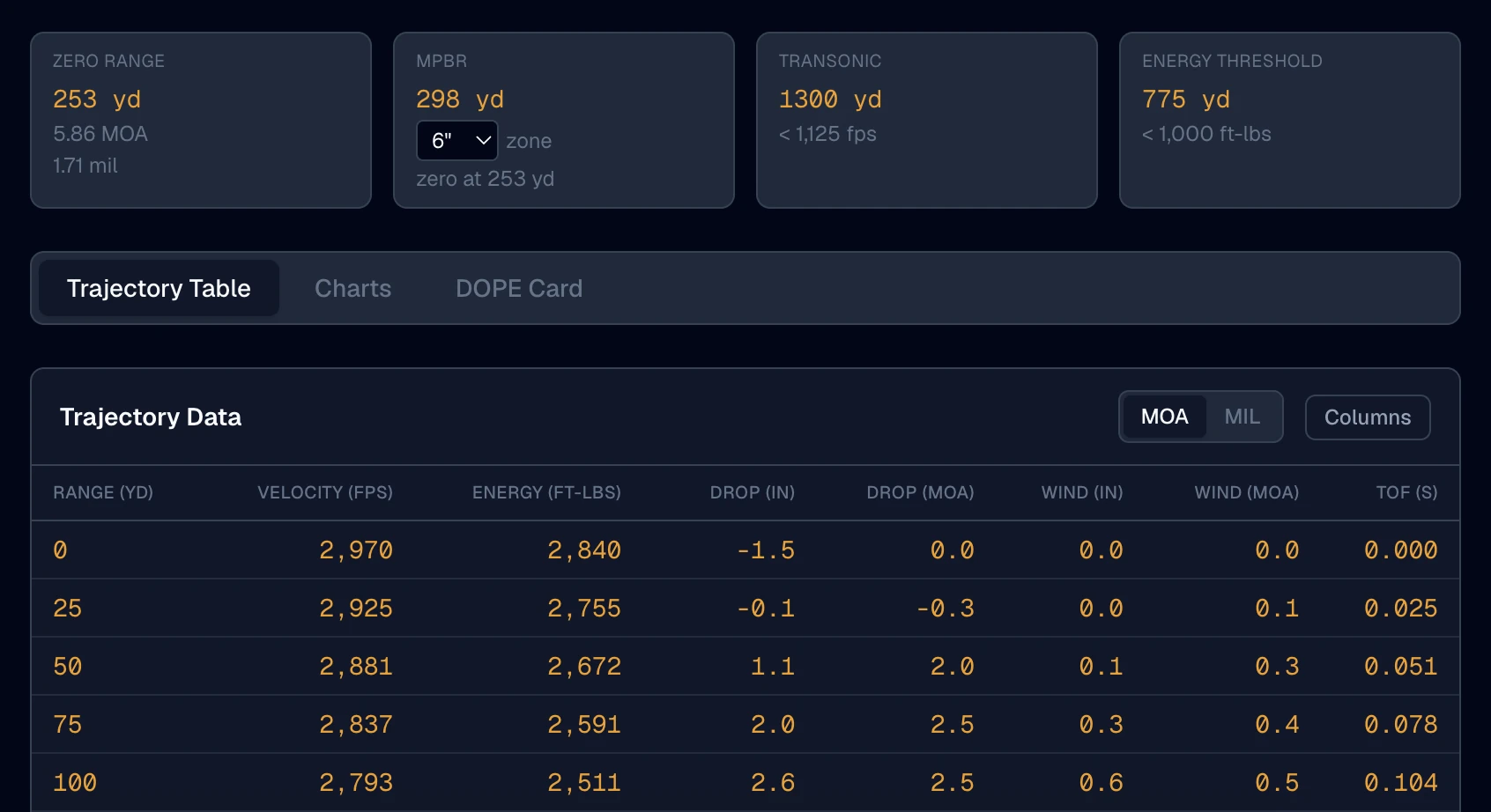
Maximum point-blank range is the longest distance you can hold dead-on and still hit the vitals. We ran all 64 .270 Winchester factory loads through our ballistics calculator: the entire field spans 62 yards, while changing the vital-zone assumption on a single load swings it 109. The number you invent moves the answer more than the ammunition you buy.
Ballistics Board Staff·
Ballistics9 min read
Altitude and Temperature Don't Move Your Zero — Unless You Zeroed Far Out
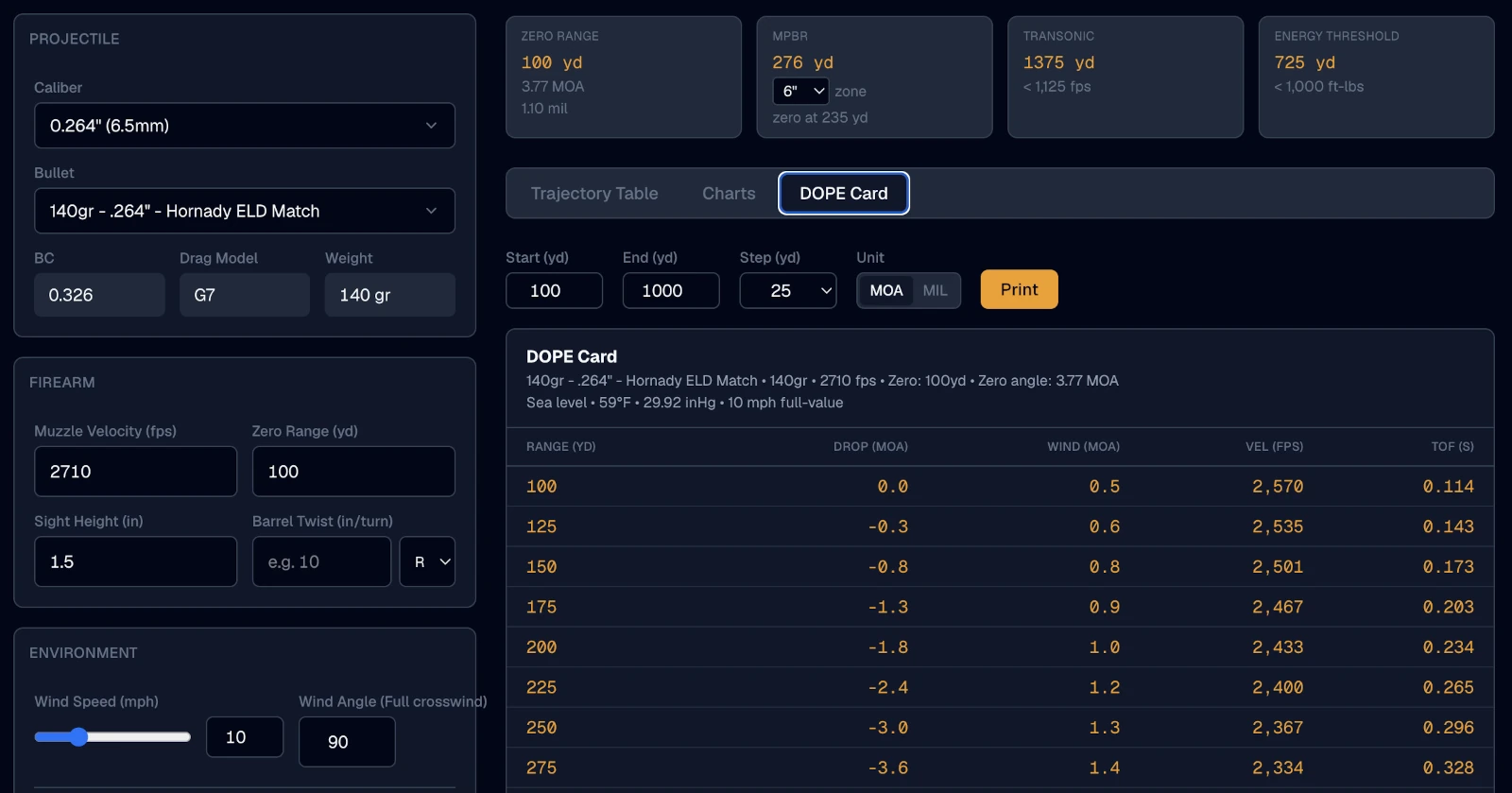
Everyone says to re-zero when you get to the mountains. We ran a 6.5 Creedmoor from sea level to 10,000 feet and from 0°F to 100°F, and a 100-yard zero never moved — 0.04 inch across the entire envelope. What moves is everything past it: 33 inches at 1,000 yards. Unless your zero itself is distant, in which case all of this inverts.
Ballistics Board Staff·
Cartridges9 min read
6.5 Creedmoor +Peak vs .30-06: The One-Gun Rifle Bet You Don't Have to Make
The .30-06 has been the one-gun answer for a century. I ran Federal's 80,000-psi 6.5 Creedmoor +Peak against it without looking at a single number first — and the result changed which rifle I'm buying this fall, though not for the reason I expected.
Steve Sansford·