Altitude and Temperature Don't Move Your Zero — Unless You Zeroed Far Out
Everyone says to re-zero when you get to the mountains. We ran a 6.5 Creedmoor from sea level to 10,000 feet and from 0°F to 100°F, and a 100-yard zero never moved — 0.04 inch across the entire envelope. What moves is everything past it: 33 inches at 1,000 yards. Unless your zero itself is distant, in which case all of this inverts.
Ballistics Board Staff
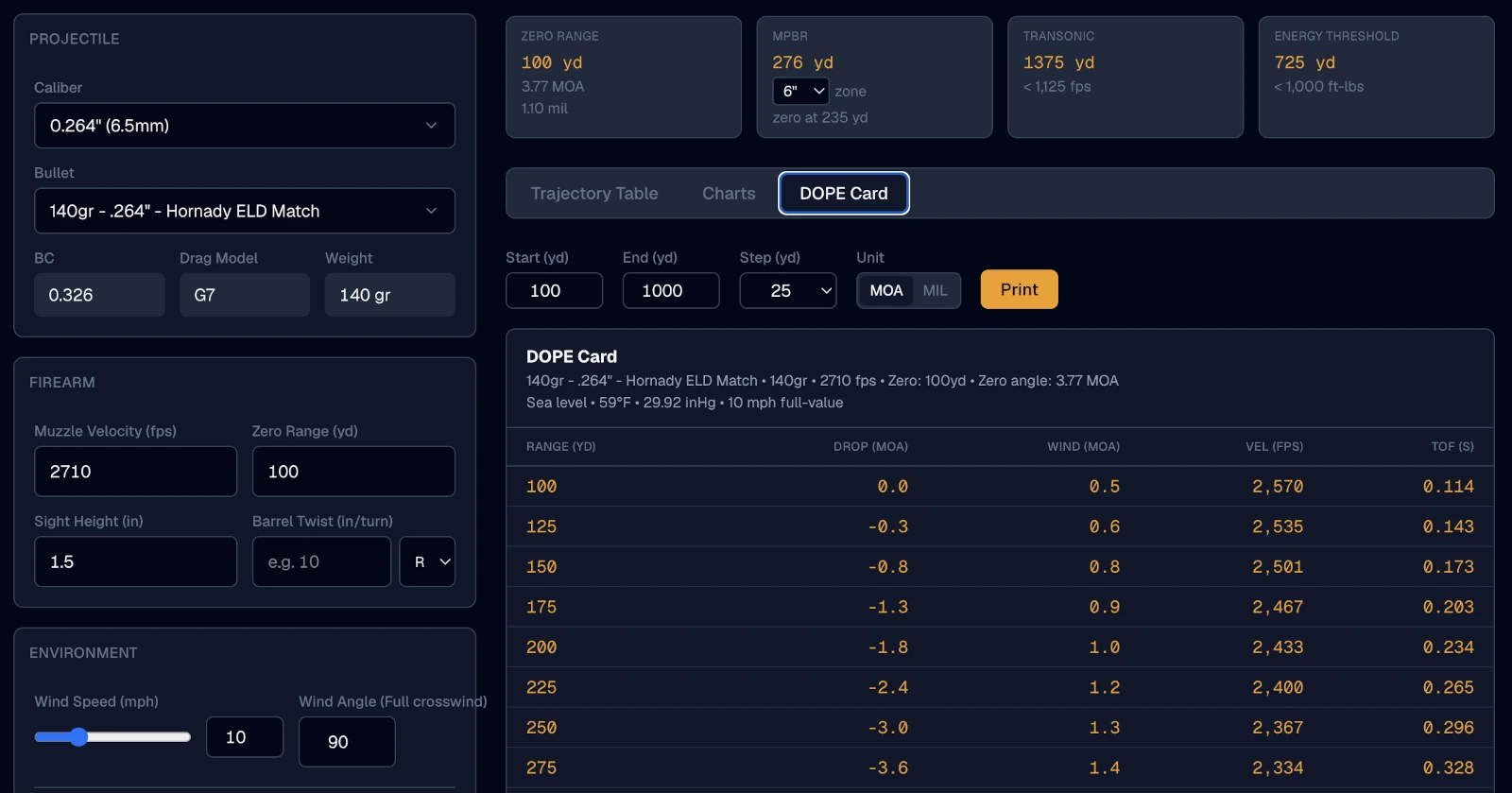
Everybody gets the same advice before a mountain hunt, and it always sounds like the responsible thing to do: your rifle is zeroed for home, so when you get up in the thin air, re-zero it. Some versions add a number — a couple of inches at altitude, more if it's cold.
It's good advice attached to a wrong reason. Thin air really does change where your bullet lands, and by more than most people expect. But if you shoot the 100-yard zero that nearly everyone shoots, it does not move your zero. The two are different claims, and only one of them survives contact with the numbers.
That "if" turns out to matter more than we expected, so we'll come back to it — there is a zero distance past which the folklore becomes true.
Every figure below is manufacturers' published data run through our ballistics calculator. Where our other articles hold conditions fixed, this one changes them on purpose: the baseline is sea level, 59°F, a 100-yard zero and a 10 mph full-value crosswind, and every comparison says exactly which knob moved. We didn't fire a shot; we ran the math.
Your zero is an angle, and the air barely touches it
A "100-yard zero" isn't really a property of your rifle. It's a consequence of one — the angle between your line of sight and the bore's line of departure. Set that angle, and where the bullet crosses your line of sight afterward depends on velocity, ballistic coefficient, sight height and, yes, the air it's flying through.
So the honest question isn't "does my point of impact at 500 yards change" — it obviously does. It's "does the angle I dialed in at home still put the bullet on the dot at 100 yards up here?"
Here's that angle for a 140-grain Hornady ELD Match 6.5 Creedmoor at 2,710 fps, solved across the whole envelope a North American shooter can plausibly stand in:
| Conditions | Zero angle needed |
|---|---|
| Sea level, 0°F | 3.781 MOA |
| Sea level, 59°F | 3.773 MOA |
| Sea level, 100°F | 3.768 MOA |
| 5,000 ft, 59°F | 3.759 MOA |
| 10,000 ft, 0°F | 3.753 MOA |
| 10,000 ft, 100°F | 3.744 MOA |
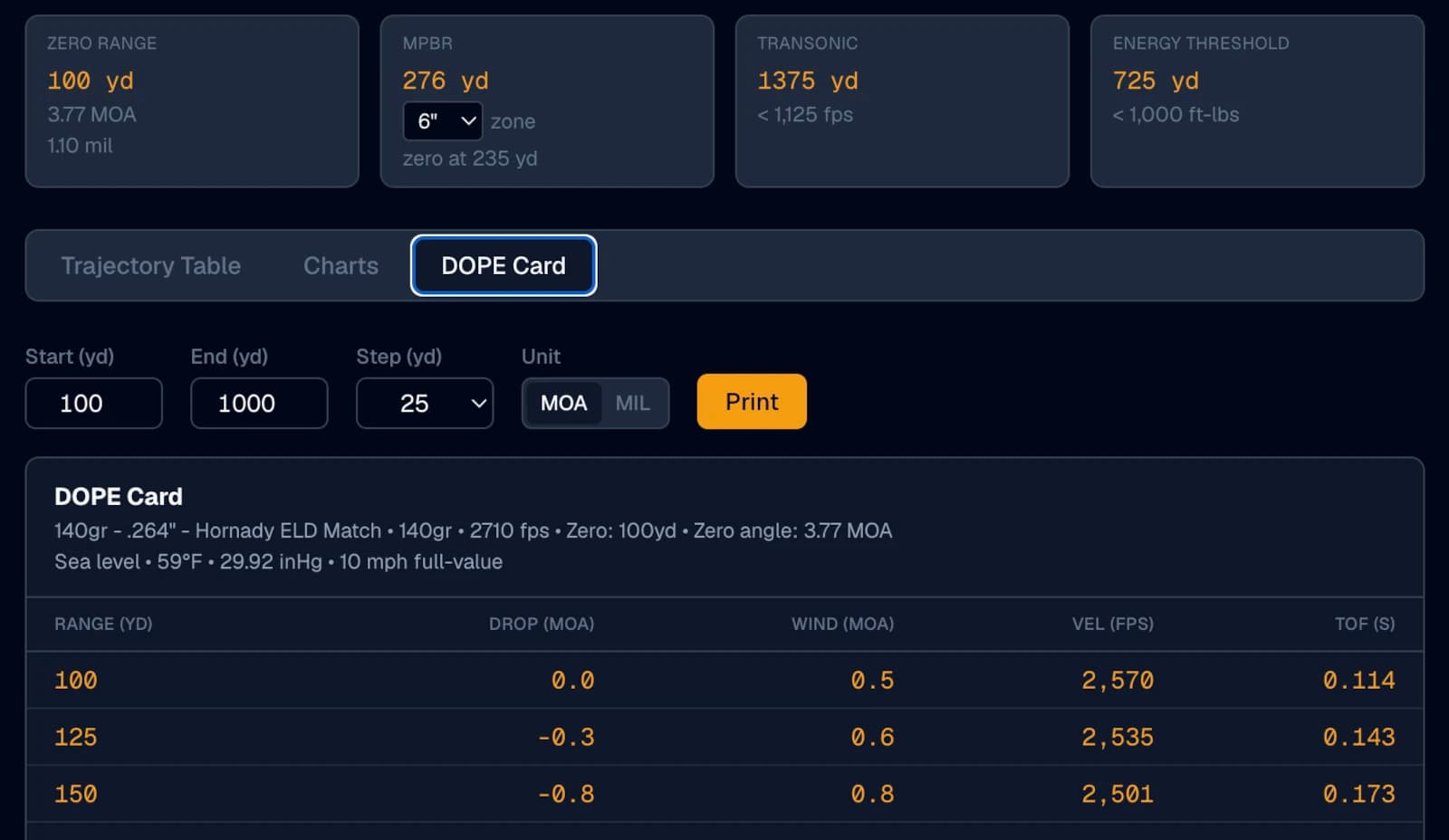
That zero angle is the number on the summary card — 3.77 MOA, 1.10 mil — and it is what your scope is really set to. Hold that figure in mind; it barely moves for the rest of this article.
Top to bottom, that's a spread of 0.037 MOA — about four hundredths of an inch at 100 yards. You could not measure it. You could not shoot it. A rifle that holds half an inch at 100 yards has a group ten times wider than the entire effect, which means any "shift" you see on the paper after confirming at elk camp is your rifle, your rest, your ammo lot, or you — not the mountain.
That is the whole re-zeroing myth, in one column of numbers. At 100 yards, the angle doesn't care.
Your near zero is doing you a favor you didn't ask for
There's a boundary on that conclusion, and it's the most interesting thing in this article.
The table above is insensitive to the atmosphere because a 100-yard zero barely asks the rifle to do anything. Look at the angle itself: 3.77 MOA. That's all the elevation needed to carry the bullet 100 yards, because it has hardly begun to fall. A 1,000-yard zero for the same load needs roughly 35 MOA — nine times as much angle, all of it compensating for accumulated drop. And drop is exactly what air density scales. A near zero gives the atmosphere almost nothing to work on; a distant zero hands it a great deal.
Hornady's engineers make this exact point on their podcast episode on the "wandering zero", using almost the same experiment we did: zero in Alaska at sea level and 20°F, then go shoot in the western mountains at 8,000 feet and 90°F. Their verdict for a 1,000-yard zero is "you're going to be like mils off." We ran their scenario through our own calculator. They're right, and it isn't close:
| Zero range | Where you hit at your own zero range, Alaska → mountains |
|---|---|
| 100 yd | 0.0" |
| 200 yd | +0.3" |
| 300 yd | +0.9" |
| 500 yd | +4.9" (0.27 mil) |
| 800 yd | +24.8" (0.86 mil) |
| 1,000 yd | +56.2" (1.56 mil) |
Same rifle, same load, same untouched turret. At 100 yards your zero is atmospherically bulletproof. At 1,000 yards it's nearly five feet off — because the launch angle that puts a bullet on target at 1,000 yards is doing 35 MOA of work, and thin air changes the price of that work. The angle your rifle needs swings 0.029 MOA for a 100-yard zero and 5.363 MOA for a 1,000-yard one across those same two environments. Same physics, 185 times the consequence.
That's the honest boundary on this article's headline. Your zero doesn't move — as long as it's a near zero. Almost everybody's is, which is why the reassurance holds for almost everybody. If you're one of the people running a true long-distance zero, everything above inverts on you, and the shooters most likely to do that are the ones most likely to travel to shoot.
What actually moves: everything past the zero
Now the other half, where the folklore was pointing at something real.
Air is what slows a bullet down, and there's a quarter less of it at 8,000 feet. That doesn't change how the bullet leaves; it changes how much it's punished on the way. Same load, same rifle, same 100-yard zero — sea level versus a cold morning at 8,000 feet:
| Range | Sea level, 59°F | 8,000 ft, 20°F | Difference |
|---|---|---|---|
| 300 yd | −13.4" | −12.9" | 0.5" |
| 400 yd | −29.6" | −28.3" | 1.3" |
| 500 yd | −53.2" | −50.3" | 2.9" |
| 700 yd | −126.3" | −117.1" | 9.2" |
| 1,000 yd | −319.3" | −285.8" | 33.5" |
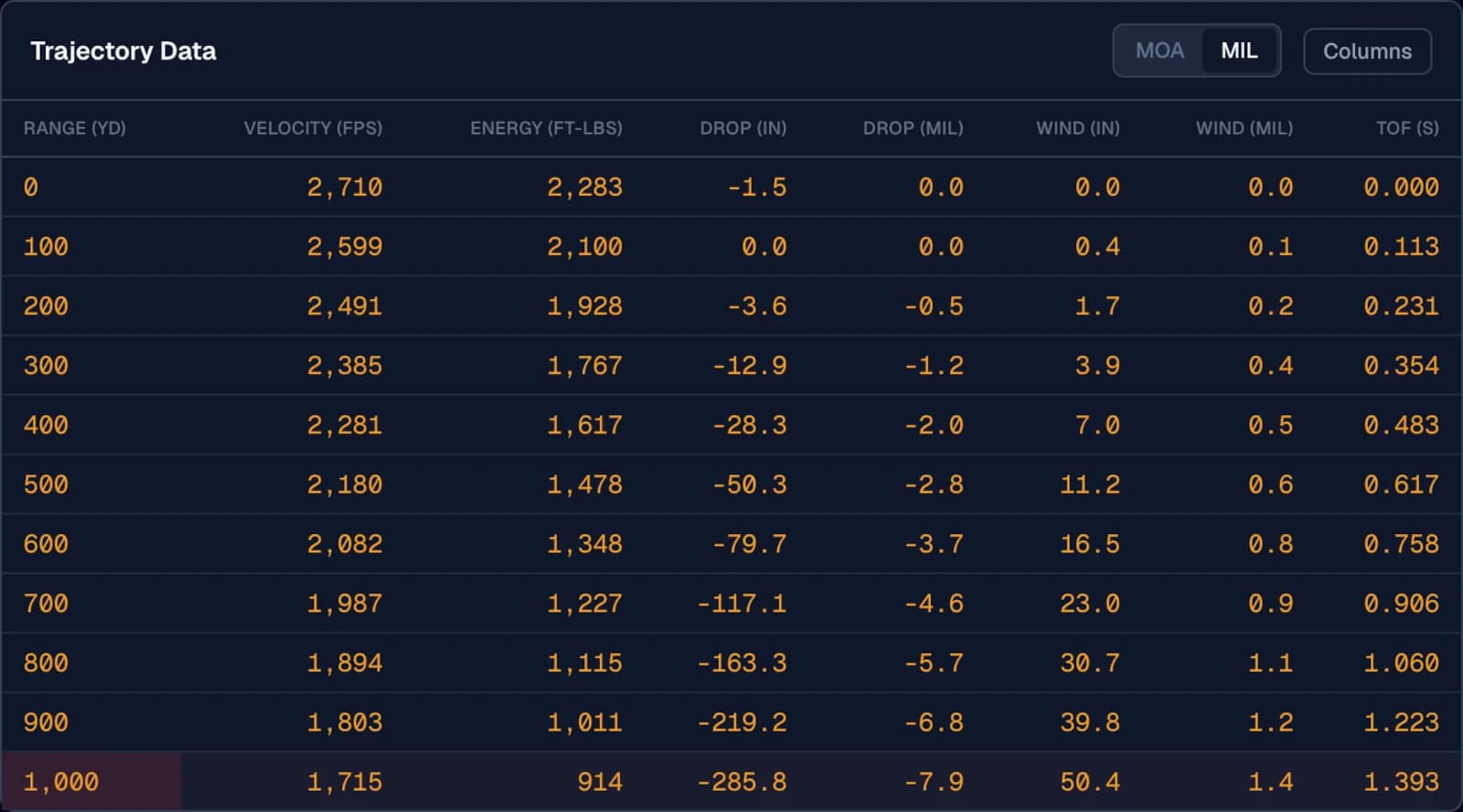
Change the altitude and temperature fields and watch the table redraw; set them back to 0 and 59°F to get the sea-level column.
Read the difference column as a shape rather than a set of numbers. Through 300 yards it's half an inch — genuinely nothing, smaller than your rifle's dispersion. At 400 it's 1.3 inches, still inside any vital zone. Then it turns on: 2.9 inches at 500, 9.2 at 700, and 33.5 inches — nearly three feet, about 3.2 MOA — at 1,000.
That's the practical line. Under roughly 400 yards, atmosphere is not your problem. Past 500, with a real elevation change, it's the difference between the top of the vitals and the spine.
The thin air pays you elsewhere too. Wind drift at 500 yards falls from 14.6 inches to 11.2. And the load stays supersonic to 1,750 yards instead of 1,375 — the transonic figure on the summary card moves 375 yards downrange, because there's less air to bleed velocity into.
Cold and altitude are not the same lever — they fight
Here's where the rules of thumb quietly fail, and it's the part worth carrying into the field.
People file "high" and "cold" together under thin mountain air. They're opposites. Cold air is denser. Hold a rifle at sea level and drop the temperature from 59°F to 20°F and the air gets about 8 percent thicker — the bullet lands 11.2 inches lower at 1,000 yards, not higher.
So a cold morning at altitude is a tug of war. At 8,000 feet and 59°F the air is 26 percent thinner than standard. At 8,000 feet and 20°F it's only 20 percent thinner — the cold has handed back about a quarter of what you climbed for. In practical terms:
8,000 feet at 20°F has the same air density as about 6,000 feet at 59°F.
Anyone applying a pure altitude correction on a cold morning is over-correcting by roughly 2,000 feet of elevation.
Which lever is bigger? Altitude, but not overwhelmingly. Sea level to 10,000 feet at a fixed 59°F cuts density about 31 percent. A full seasonal swing — 0°F to 100°F, same place, same elevation — moves it about 20 percent, the same density span as roughly 6,000 feet of climbing. Altitude wins the argument; temperature is emphatically in it.
Low-BC bullets are the ones that get moved
One more pattern, and it's the same one our wind drift analysis turned up: the number that decides how much the atmosphere pushes you around is the ballistic coefficient.
Run the same trip — sea level to 8,000 feet and 20°F — with a 129-grain InterLock American Whitetail at 2,820 fps, a perfectly good hunting load with a much draggier bullet:
| Load | Shift at 500 yd | Shift at 1,000 yd |
|---|---|---|
| 140 gr ELD Match (.326 G7) | 2.9" | 33.5" |
| 129 gr InterLock (.445 G1) | 4.3" | 60.1" |
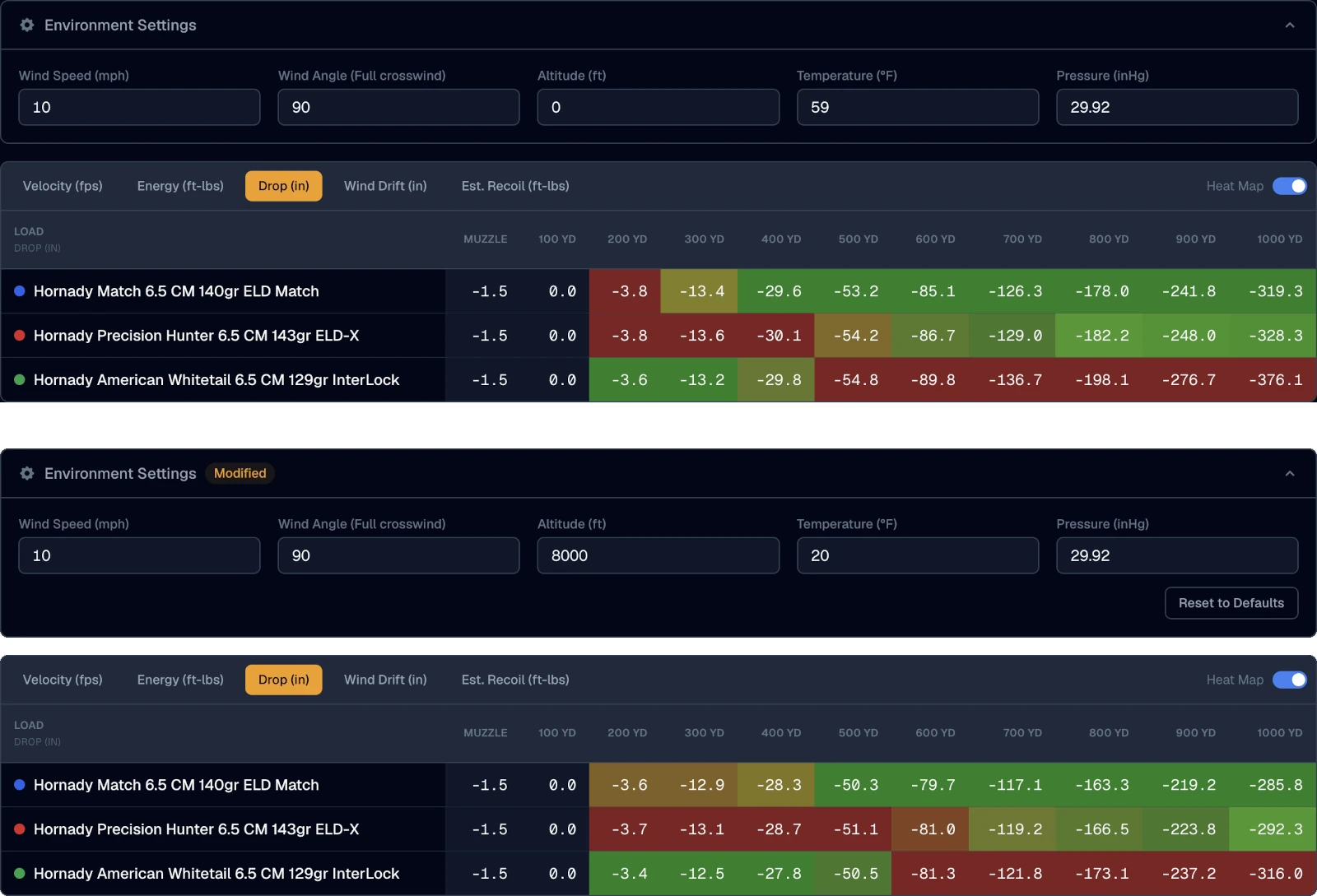
Compare the same cell between the two tables rather than reading across one: the top table is sea level, the bottom is elk camp, and the gap between them is the whole subject.
The slippery bullet moves appreciably less — a little over half as much at 1,000 yards, and roughly two-thirds as much at 500. That follows directly from what BC is: a measure of how little the air gets to do to the bullet. Less air interaction means less to change when you change the air. A high-BC bullet gives you flatter shooting, less wind, and dope that travels better — the same decimal buying the same advantage a third time.
Where the numbers stop
Several things this analysis does not know, and the first three are each bigger than the effect the article is about.
We don't model what cold does to your powder. Muzzle velocity is an input to our calculator — the manufacturer's published figure, measured at their temperature, not yours. Real ammunition chronographs slower when it's cold, commonly cited at roughly 1 to 1.5 fps per degree for powders that aren't temperature-stable. Call it 50 fps for a 40-degree drop, and that alone moves impact 2.4 inches at 500 yards — more than double the 0.9 inches the denser cold air accounts for on its own — and 14.8 at 1,000, against the air's 11.2. The effect nobody models is larger than the one everybody does, and on a cold morning they stack in the same direction. If you have chronograph data from a cold range, type that velocity into the calculator. It matters more than the temperature field does.
You are probably not zeroed where you think you are. Our calculator, like every other one, has to be told a zero range, and that number is the single connection between its math and your rifle. If your mean point of impact sits two tenths of an inch high at 100 yards — which is inside one click on a tenth-mil scope, so you'd call it zeroed and go home — you are actually zeroed somewhere around 116 yards, and telling the calculator "100" is an input error five times larger than anything the atmosphere does to that zero. This is the wandering zero people complain about, and it is a measurement and sample-size problem, not a weather problem. Hornady's tunnel data puts the mean-point-of-impact scatter of a three-shot group at ±0.4 inch even from a machine rest with no shooter involved. Fix that before you worry about air density.
We don't model aerodynamic jump. Our wind figures are horizontal drift only — the sideways push a crosswind gives a bullet over its time of flight. A crosswind also deflects a bullet vertically as it leaves the muzzle, an effect most ballistic solvers including ours don't compute. It's small, but at 100 yards a light crosswind can move point of impact on the order of a tenth of a mil, which is several times the atmospheric zero shift we just spent an article measuring. Practical upshot: don't establish a zero in a crosswind and then blame the mountain for the result.
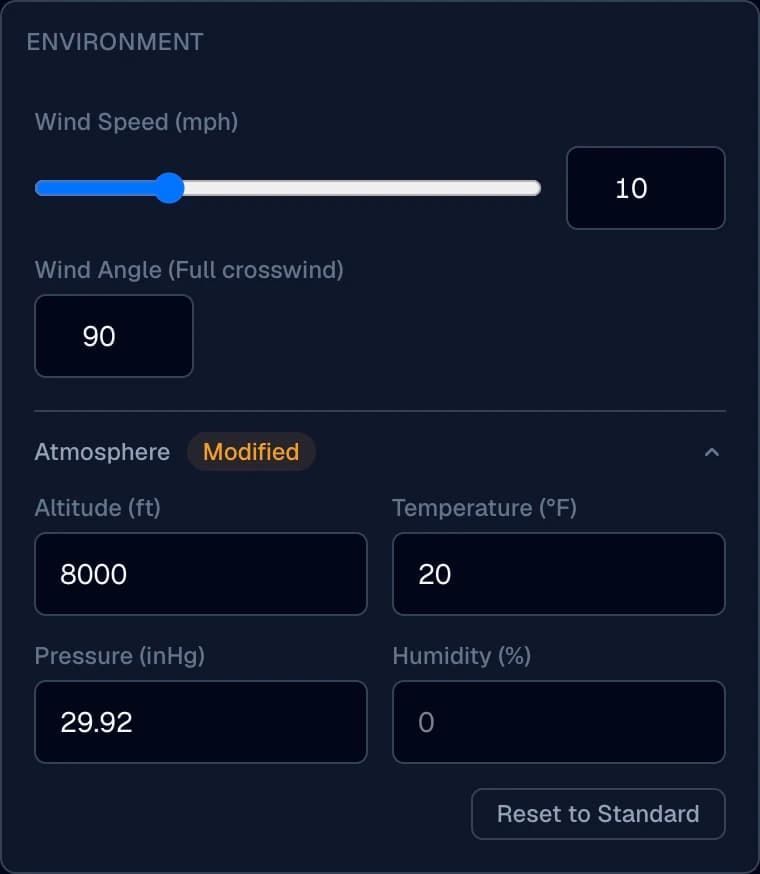
Station pressure and barometric pressure are not interchangeable. Our altitude and pressure fields expect a sea-level-corrected barometer reading — what airports and weather apps report. A Kestrel gives you station pressure, which already has the altitude baked in. Enter both and you've corrected twice and thinned the air far more than reality. Using a handheld meter's pressure? Set altitude to 0.
Humidity is noise. Going from bone dry to 100 percent at 80°F moves 1,000-yard drop by 2.1 inches and 500-yard drop by two tenths of an inch. It's in the model for completeness. Worth a shrug, not a calculation. (For what it's worth it runs the way people don't expect — humid air is slightly less dense, because water vapor is lighter than the air it displaces.)
And your scope has to earn it. A 3.2 MOA correction at 1,000 yards is only worth computing if your turret actually delivers 3.2 MOA when you dial it. Optics that don't track true will eat a correction this size without telling you.
Re-run your dope, not your zero
The advice was pointing at something real and naming it wrong. Altitude and temperature will absolutely move your bullet — three feet at 1,000 yards between a sea-level range and a cold morning at 8,000 feet is not a subtlety. They just don't do it by moving your zero, which stays put to within four hundredths of an inch across every condition you'll ever shoot in.
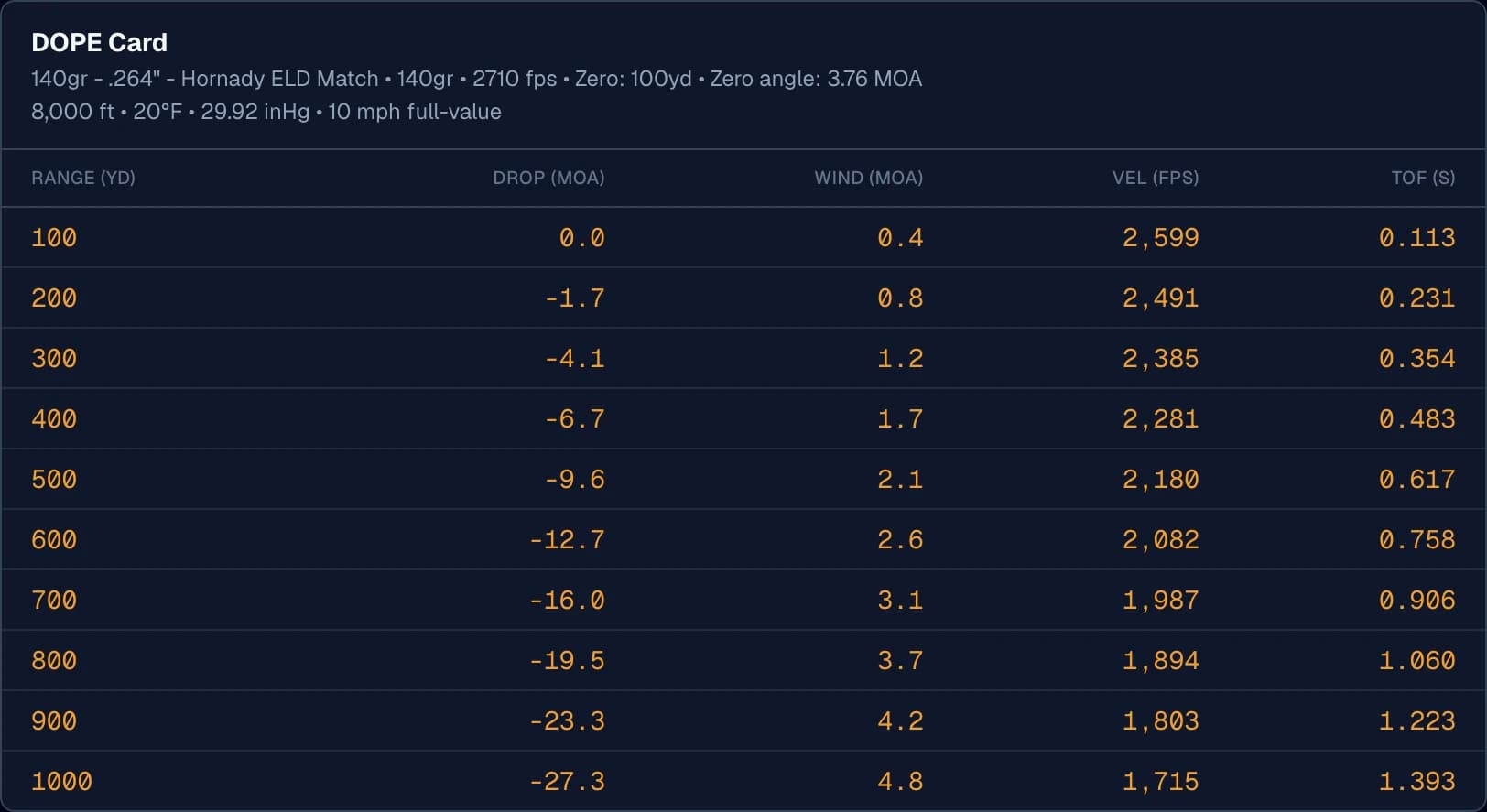
Two things on that card. The second line names the atmosphere it was built for — a dope card that doesn't is a set of numbers with no expiry date on them. And the zero angle still reads 3.76 MOA, against the 3.77 MOA on the sea-level card at the top of this article. Eight thousand feet of elevation and thirty-nine degrees of temperature, and the number your scope is actually set to moved by one hundredth of a minute. Everything else on the card changed.
So the trip prep is: leave the turret alone, and rebuild the drop chart. Put your load and your destination's elevation and temperature into the ballistics calculator before you go, and print the dope for where you're going to be standing rather than where you zeroed. If you're staying inside 400 yards, you can skip even that.
And do still confirm your zero when you arrive — because rifles ride in truck beds and get handed to baggage handlers, and scope mounts move. Just don't expect the mountain to be what moved it, and don't do it with three rounds. A three-shot group's mean point of impact scatters by roughly ±0.4 inch even off a machine rest, so a three-shot confirmation at elk camp will very often show you a quarter-inch to three-quarter-inch "shift" that isn't there. Correct for that and you've just broken a zero that was fine. That's the whole wandering-zero ritual in one sentence: not the atmosphere moving your rifle, but a sample too small to tell you anything, acted on anyway. Confirm with enough rounds to mean something, or confirm by hitting something at distance, or leave the turret alone.
If you shoot a draggy hunting bullet and this feels like a lot of bookkeeping, there's a shortcut hiding in the last table: a higher-BC bullet in the same cartridge, like the 143-grain ELD-X, does less of this to you in the first place. It's the same conclusion the 6.5 Creedmoor keeps arriving at from every direction.
Splitting Hairs
The numbers behind the comparisons — what the data actually shows, and where it stops. No hype, no gear reviews.
Related Articles
Ballistics6 min read
Maximum Point-Blank Range, Explained — Your Vital Zone Matters More Than Your Cartridge
Maximum point-blank range is the longest distance you can hold dead-on and still hit the vitals. We ran every .270 Winchester factory load in our database through our ballistics calculator: the entire field spans 65 yards, while changing the vital-zone assumption on a single load swings it 109. The number you invent moves the answer more than the ammunition you buy.
Ballistics Board Staff·
Ballistics5 min read
Wind Drift: Why Ballistic Coefficient Beats Velocity at Distance
Everyone reaches for the fastest load to fight the wind. It's exactly backwards. We ran the numbers on five popular .308 loads from the manufacturers' published data — and one of the slowest bullets drifts the least, while two loads of the same weight come out 29.5 inches apart.
Ballistics Board Staff·
Cartridges4 min read
.308 vs .30-06 vs .300 Win Mag vs .300 PRC: The Slower Magnum Wins
Everyone knows the ladder: more case, more powder, more performance. Run five Hornady Precision Hunter loads through the same math and the ladder holds — but the cartridge that wins at distance is the one that gave up 100 fps at the muzzle, and the .300 Win Mag needed two extra inches of barrel to lose.
Ballistics Board Staff·