6.5 Creedmoor vs .308 Winchester: Is One Really Ballistically Superior?
Is the 6.5 Creedmoor actually superior to the .308 Winchester? We ran matched factory loads through our ballistics calculator — velocity, energy, wind, drop, and recoil — and the honest answer comes with a catch.
Ballistics Board Staff
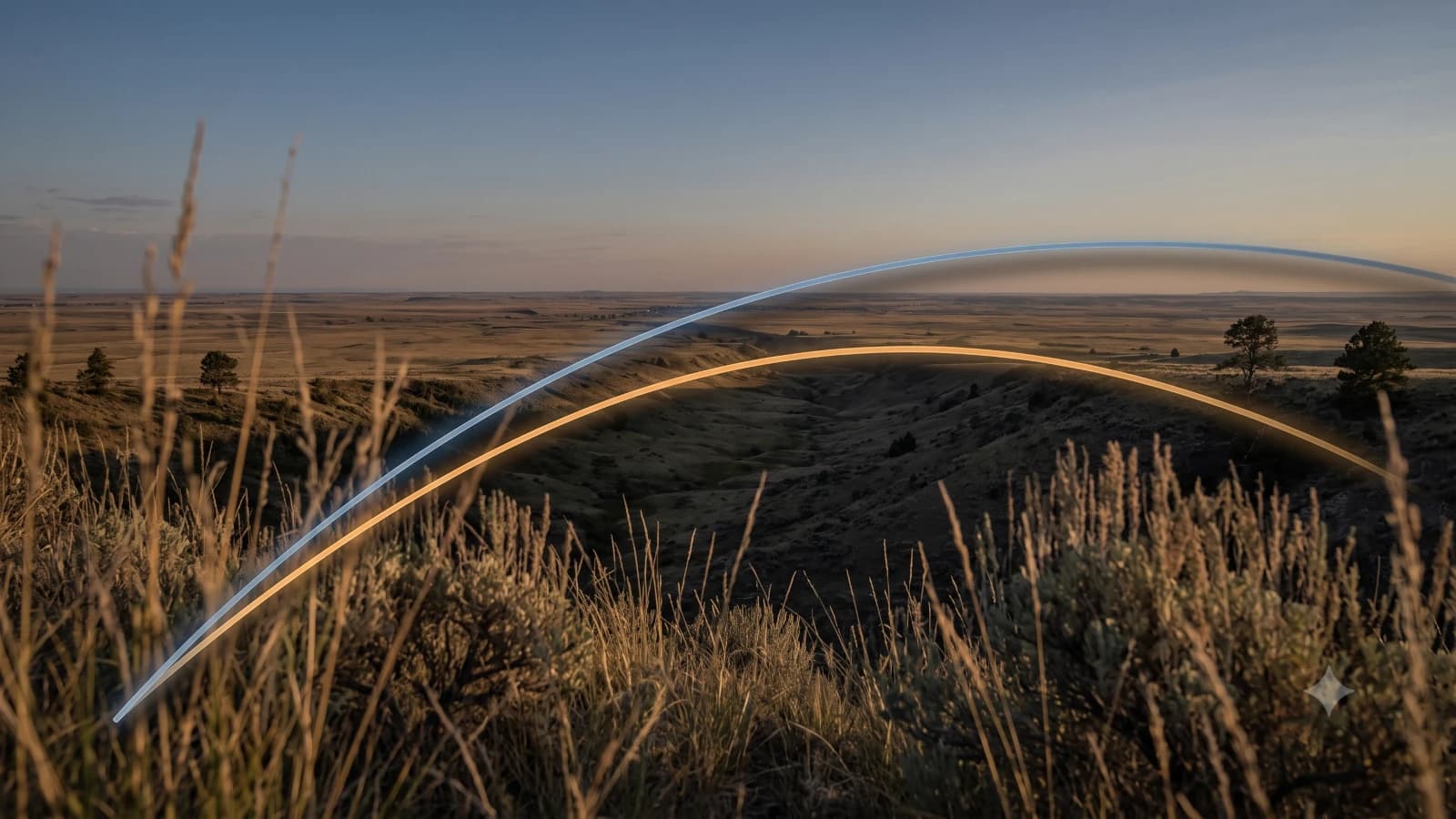
Every online shooting forum has the same thread. Someone asks whether they should buy a 6.5 Creedmoor or a .308 Winchester, two hundred replies pile up, and somewhere in the middle someone declares — as settled fact — that the 6.5 Creedmoor is simply the ballistically superior cartridge.
It's the most-argued sentence in American rifle shooting. So let's settle the ballistics part cleanly, and then talk about why it might not be the part that decides your rifle.
The .308 Winchester has been the do-everything cartridge since 1952. The 6.5 Creedmoor showed up in 2007, built from the ground up to launch long, high-BC bullets for long-range competition. Different eras, different design goals, same endless argument. Every number below comes from manufacturers' published specifications run through our ballistics calculator under identical conditions: sea level, 59°F, a 100-yard zero, and a 10 mph full-value crosswind.
Control the bullet, and the answer is yes
The problem with most versions of this argument is that they compare a light, fast 6.5 Creedmoor load against a heavy, slow .308 load and credit the cartridge for a difference the bullet is creating. To ask whether the cartridge itself is more efficient, you have to hold the bullet constant.
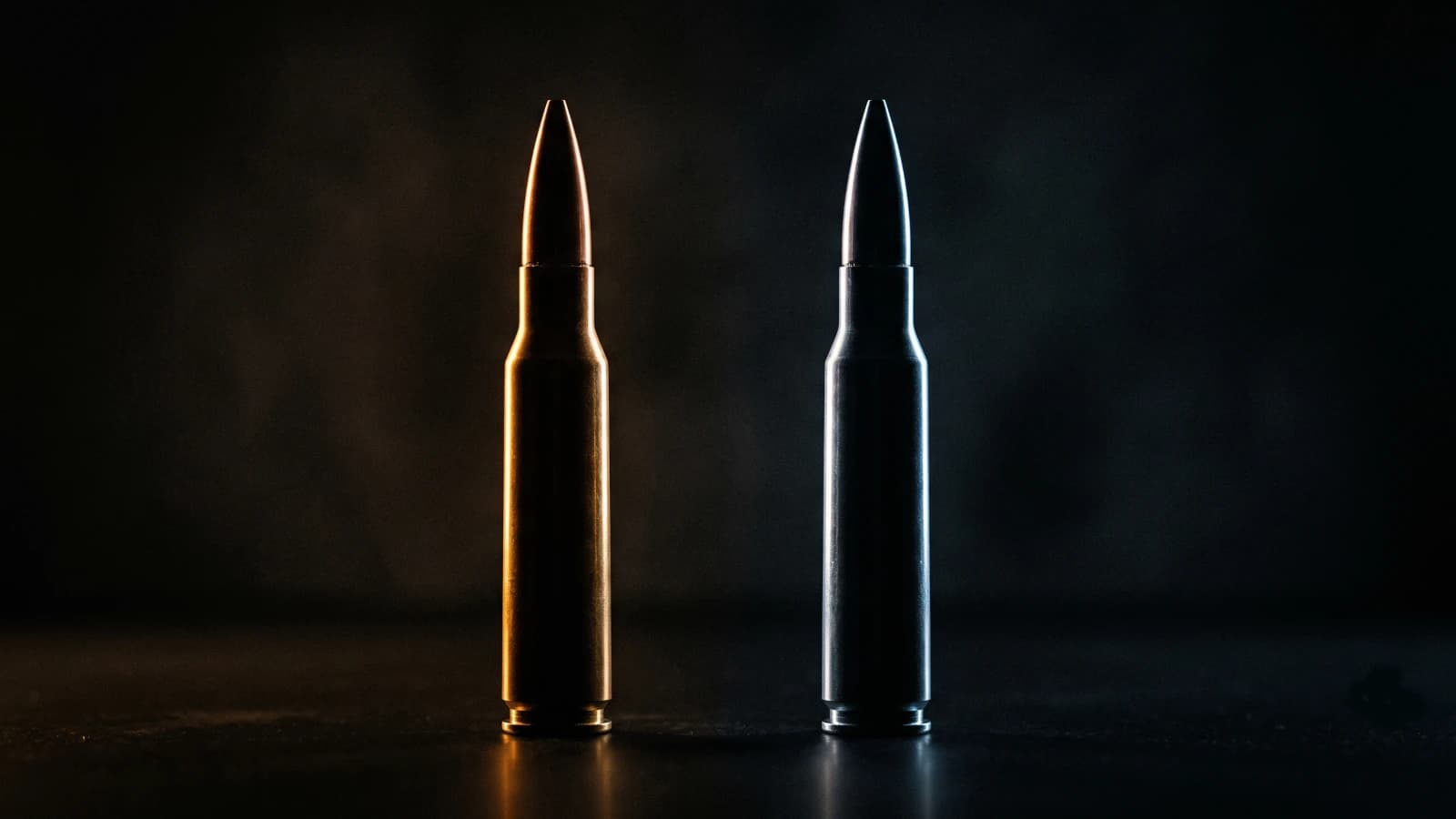
So we did. Barnes loads the Tipped Triple-Shock in both — a 130-grain TTSX in the .308 at 3,125 fps, and a 120-grain TTSX in the 6.5 Creedmoor at 2,910 fps. Same monolithic-copper bullet, near-matched weights, and the .308 gets a 215 fps head start off the muzzle.
That .308 load is no strawman. It's the .308 at its flattest and fastest — Vortex's Ryan Muckenhirn devoted an episode of the #10MinuteTalk series to this exact 130-grain TTSX as his pet .308 load, precisely because it pushes past 3,100 fps and shoots like something the .308 isn't supposed to be. If "best" means flat and fast — the 6.5 Creedmoor's own game — this is the .308 playing it about as well as the .308 can.
And it still gets run down.
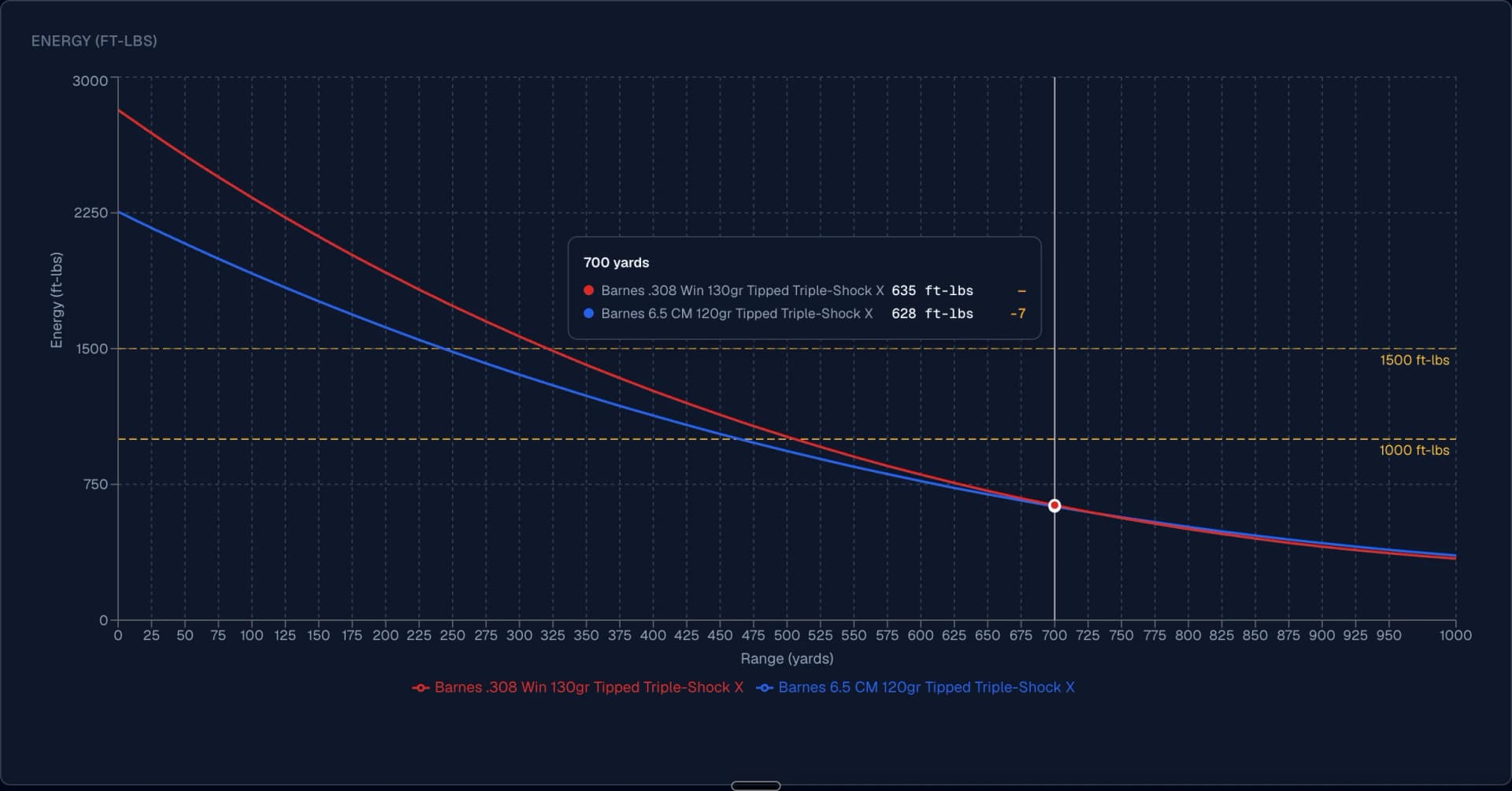
The .308 leaves faster and hits harder at the muzzle — 2,818 ft-lbs against the 6.5's 2,256. But the smaller-bore bullet carries a higher ballistic coefficient (0.412 versus 0.350), so it sheds speed more slowly, and the head start doesn't last:
- Velocity ties at around 525 yards. Past that, the 6.5 Creedmoor is the faster bullet the rest of the way.
- Energy crosses just past 750 yards — beyond that, the lighter 6.5 bullet is delivering more retained energy than the heavier .308.
- Wind drift favors the 6.5 Creedmoor at every distance. In that 10 mph crosswind at 500 yards it drifts about 22 inches to the .308's 25, and the gap only widens.
- Drop stays nearly identical out to 1,000 yards, where the two are within an inch and a half of each other before the 6.5 pulls ahead.
Spot the .308 a heavier bullet and more muzzle velocity, and the 6.5 Creedmoor still wins the back half of the flight — on aerodynamics alone. On the narrow question the forums actually argue, the verdict is clean: yes, the 6.5 Creedmoor is the more ballistically efficient cartridge.
Now put a real bullet in a real rifle
Here's where "best" stops being a single number. Flat-and-fast is one definition of best. Maximum thump at the ranges you actually hunt is another — and by that definition, a light 130-grain bullet is not the .308 at its best at all. The .308's real advantage was never speed. It's that it comfortably shoots heavier bullets than the 6.5 Creedmoor, and heavier bullets carry energy.
Look at what happens with a premium bonded hunting bullet in each — Federal's Terminal Ascent, a 175-grain in the .308 and a 130-grain in the 6.5 Creedmoor.
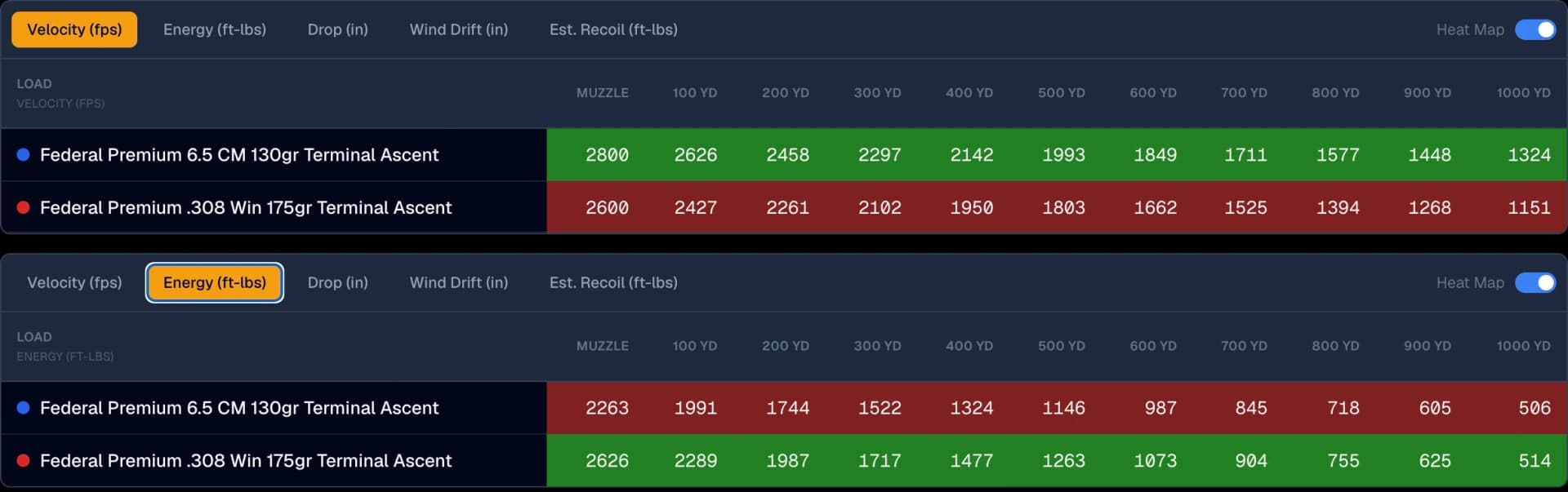
This time there's no crossover — just two cartridges playing to opposite strengths, all the way out. The 6.5 Creedmoor shoots flatter and drifts less at every range. But the heavier .308 bullet carries more energy at every range inside 1,000 yards. At 300 yards — a long poke for most hunting — the .308 is putting roughly 1,720 ft-lbs on target to the 6.5's 1,520. The "inferior" cartridge is delivering about 200 ft-lbs more punch, right in the heart of the range where game is actually shot.
That energy isn't free. It's paid for at the shoulder. Through a typical 8-pound rifle, the 175-grain Terminal Ascent .308 generates about 18.3 ft-lbs of free recoil against the 6.5 Creedmoor's 13.1 — roughly 40% more. Even the fast, light Barnes .308 kicks about 27% harder than its 6.5 counterpart. For a recoil-sensitive shooter, or a rifle you carry all day and may have to shoot offhand, that's not a footnote.
And there's a limit to how much any of this matters where most hunting happens. Inside 300 yards, the trajectory difference between these cartridges is a couple of inches — smaller than the vital zone on a deer, and swamped entirely by the shooter and the shot. At 100 yards in the timber, the ballistic argument is effectively noise. The 6.5 Creedmoor's efficiency is real, and it lives almost entirely past 500 yards. The .308's other virtues live everywhere else: longer barrel life, ammunition on every shelf and usually cheaper, and a far deeper bench of heavy bullets for big, tough game.
So which one's better?
Is the 6.5 Creedmoor ballistically superior to the .308 Winchester? Yes — and the data barely leaves room to argue. It flies flatter, fights wind better, and does it with meaningfully less recoil. Where the forums are right, they're right.
But "superior on paper" and "right for your hunt" are different questions, and the honest answer to the second one depends on a single number you already know: the distance you actually shoot.
Inside 500 yards — where the overwhelming majority of hunting happens — these two are close enough that the decision comes down to things the ballistics chart never shows: which rifle fits you, how much recoil you want to absorb, whether you'd rather have the 6.5's flat-shooting ease or the .308's heavier-bullet energy, and what's cheap and available where you live. Inside any range at which you should be taking an animal, they're twins. Pick one and go.
Past 500 yards, the argument ends. The 6.5 Creedmoor pulls away and it isn't close.
Which leaves one interesting question hanging. This whole debate assumes a trade: the .308's close-range punch or the 6.5's downrange reach, pick one. But what if you didn't have to? That's exactly the bet behind the new 80,000-psi 6.5 Creedmoor +Peak loads — and it's a story for its own article.
Splitting Hairs
The numbers behind the comparisons — what the data actually shows, and where it stops. No hype, no gear reviews.
Related Articles
Cartridges9 min read
6.5 Creedmoor +Peak vs .30-06: The One-Gun Rifle Bet You Don't Have to Make
The .30-06 has been the one-gun answer for a century. I ran Federal's 80,000-psi 6.5 Creedmoor +Peak against it without looking at a single number first — and the result changed which rifle I'm buying this fall, though not for the reason I expected.
Steve Sansford·
Cartridges7 min read
7mm Backcountry vs .280 Ackley Improved: Does the Ackley Still Make Sense?
The .280 Ackley Improved was my answer for a do-it-all 7mm — then Federal's steel-cased, 80,000-psi 7mm Backcountry showed up doing the same job from a shorter barrel. On coolness, ballistics, and availability, does the Ackley still hold up? I ran the numbers.
Steve Sansford·

Cartridges6 min read
Best 7mm Cartridges for Elk: 7mm PRC, 7mm Rem Mag, and .280 AI
Don't shop the headstamp — shop the job. We set two rules an elk load has to clear at 500 yards, then ran the numbers on every 7mm hunting load in the database to see which cartridges actually make the cut.
Ballistics Board Staff·