6.5 Creedmoor +Peak vs .30-06: The One-Gun Rifle Bet You Don't Have to Make
The .30-06 has been the one-gun answer for a century. I ran Federal's 80,000-psi 6.5 Creedmoor +Peak against it without looking at a single number first — and the result changed which rifle I'm buying this fall, though not for the reason I expected.
Steve Sansford
Steve is the builder of Ballistics Board. He doesn't get to the range as often as he'd like, but he's been fascinated by exterior ballistics and the rabbit hole of cartridge comparison for as long as he's owned a rifle.
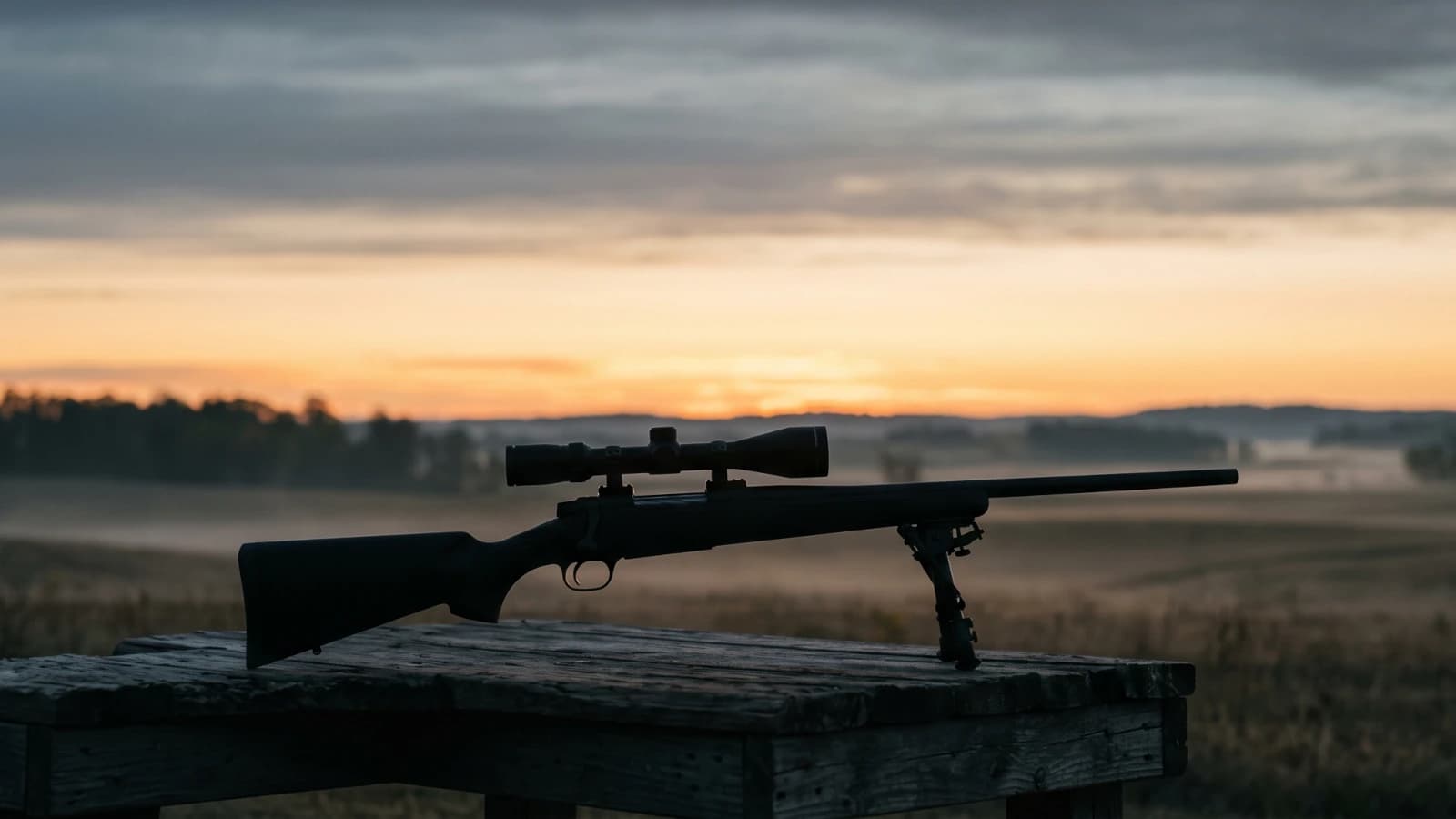
Beware the man with one gun — he probably knows how to use it. It's a compliment aimed at focus, but underneath it sits a real question shooters have argued about for a century: if you could own exactly one rifle, what would it be chambered in?
The traditional answer is the .30-06 Springfield, and it's traditional because it's good. North America, Europe, most of Africa — it's not ideal for varmints and you'd want care on dangerous game, but everything in between it handles without breaking stride. I own one. It has never given me a reason to doubt it.
But "one gun" for me has never meant one gun for hunting. It means one gun, full stop. What if I want to plink at a hundred yards on a Saturday, or ring steel at a thousand? The .30-06 does both — and beats you up a little while it does. After a box of twenty I'm feeling it. That's what the traditional answer skips, and it's quietly been the whole argument for me.
The machine already told me the answer
I've written before about asking an AI what rifle to buy — clean slate, no emotion, just requirements. It came back with 6.5 Creedmoor and .308 Winchester. Both excellent one-gun choices; both a little shy of the .30-06 on the biggest game at the longest ranges. That's the trade the 30-calibers lay out plainly — the .308 handles anything inside 300 yards, elk at 600 wants a .300 Winchester Magnum and the recoil that comes with it, and the .30-06 sits in the middle doing most of what both ends do. A 6.5 Creedmoor does the .308's job comfortably, falls a little shy of the .30-06, and a long way shy of the magnum.
Then Federal put a 6.5 Creedmoor in a steel case and ran it at 80,000 psi.
I wrote everything above before looking at a single number
That's the whole reason this article exists. I've spent a year building a tool that runs these comparisons in thirty seconds, and I deliberately did not run this one — I wanted to write down what three decades of reading told me to expect, then watch the tool grade it.
Here's what I expected: the +Peak putting the Creedmoor clearly above the .308 and knocking on the .30-06's door, close enough that recoil would decide it. I did not expect it to beat the .30-06. I was buying a 6.5 Creedmoor either way — I want one and I already own a .30-06 — so this was only going to tell me what I was choosing.
Every number below comes from manufacturers' published specifications run through the same ballistics calculator at identical conditions: sea level, 59°F, a 100-yard zero, 1.5 inches of sight height, and a 10 mph full-value crosswind.
First, does the case do what Federal says it does?
Federal claims 300 fps over brass-case 6.5 Creedmoor and 100 over the 6.5 PRC — easy claims to repeat, hard to check. Except that Federal loads the same bullet, their 130-grain Terminal Ascent, in all three. Same projectile, same weight, same BC, three cases: about as close to a controlled experiment as a factory catalogue ever gives you.
| Cartridge | Muzzle velocity | Energy at 500 yd | Wind at 500 yd | Recoil |
|---|---|---|---|---|
| 6.5 Creedmoor | 2,800 fps | 1,133 ft-lbs | 17.9" | 13.1 ft-lbs |
| 6.5 PRC | 3,000 fps | 1,331 ft-lbs | 16.1" | 17.4 ft-lbs |
| 6.5 Creedmoor +Peak | 3,100 fps | 1,437 ft-lbs | 15.2" | 14.9 ft-lbs |

Three hundred over the Creedmoor. One hundred over the PRC. Not approximately — exactly, on both counts.
Now look at the last column, which Federal doesn't advertise. The +Peak beats the 6.5 PRC — same bullet, 100 fps faster, 106 more ft-lbs at 500, nearly an inch less drift — at 14 percent less recoil. The PRC gets its performance the way cartridges always have: bigger case, more powder, magnum bolt face, fewer rounds in the magazine. The +Peak gets it from pressure. You aren't paying in the usual currency.
Now the real question: the warhorse
A note on method. It would be easy to pick a middling .30-06 load and let the 6.5 walk over it, and you'd be right to call it. So I did the opposite and gave the .30-06 the best bullet in the catalogue: across all 115 .30-06 loads we hold with a published velocity and BC, the highest coefficient is Norma's 180-grain Bondstrike at .615 — an excellent bullet that doesn't get enough credit. Against it, the heaviest +Peak load, the 156-grain Berger Elite Hunter at .679. Those are the published G1 figures; the calculator solves on the published G7s, 0.347 against 0.308, and the order holds on both.
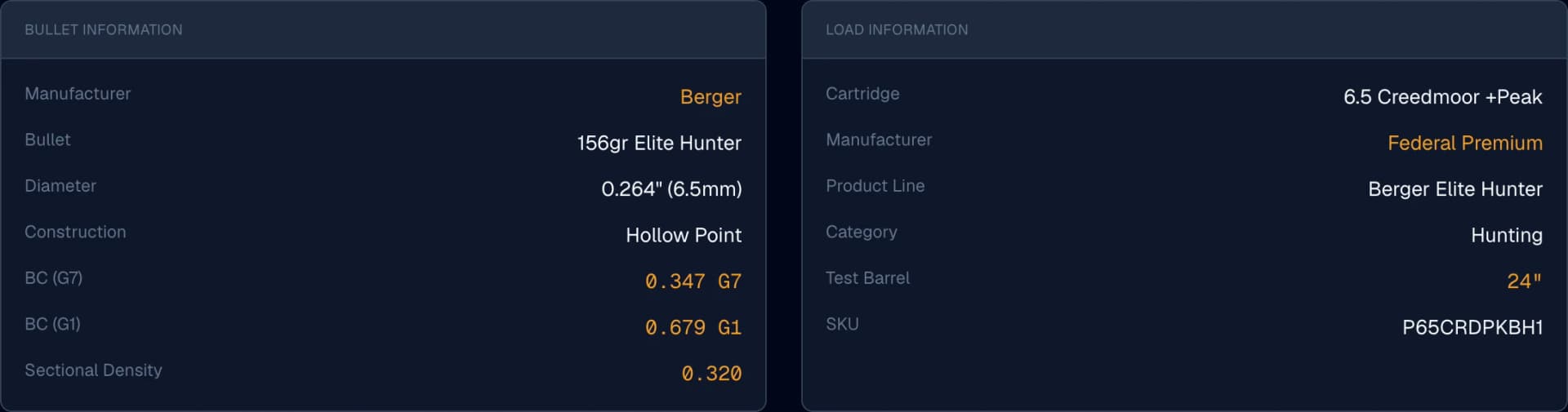
That second number is worth a pause. Nothing in the entire .30-06 catalogue reaches .679 — its best is twenty-four grains heavier and still less slippery. That's the 6.5 bore doing what it's famous for: more aerodynamic performance per grain of lead.
| Muzzle | 300 yd | 500 yd | Wind at 500 | Recoil | |
|---|---|---|---|---|---|
| .30-06, 180 gr Bondstrike | 3,035 ft-lbs | 2,152 | 1,686 | 15.2" | 23.5 ft-lbs |
| 6.5 CM +Peak, 156 gr Berger | 2,913 | 2,165 | 1,756 | 12.3" | 17.4 ft-lbs |
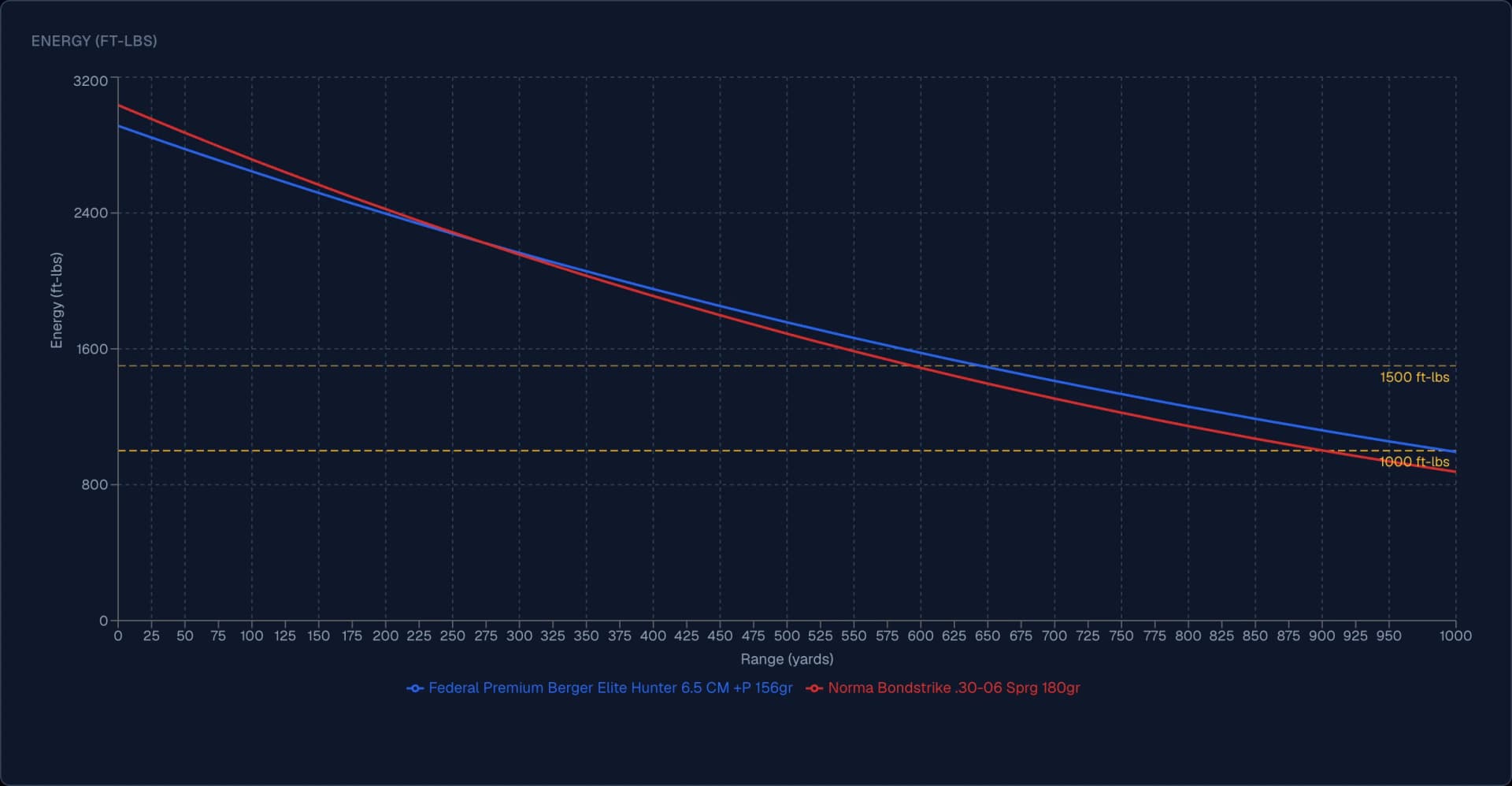
The .30-06 leaves the muzzle ahead and stays ahead to about 265 yards. Then the 6.5 passes it and never gives the lead back — 70 ft-lbs up at 500, 123 ft-lbs up at 800, and drifting less in the same wind the whole way — 2.9 inches less at 500.
So the honest answer to "is the +Peak the new .30-06" is: not inside about 265 yards, where the old cartridge is still ahead and where most hunting happens. Past that the gap only widens, at about a quarter less recoil. I expected "knocking on the door." The door was open.
The elk question, and the one number that surprised me most
The 7mm elk piece set two bars at 500 yards: 1,500 ft-lbs retained, and wind small enough to hold rather than dial — roughly 2 to 3 MOA. I promised I'd come back to the +Peak with those bars. Here it is, run against every load we hold in all three 6.5 cases at 120 grains and up.
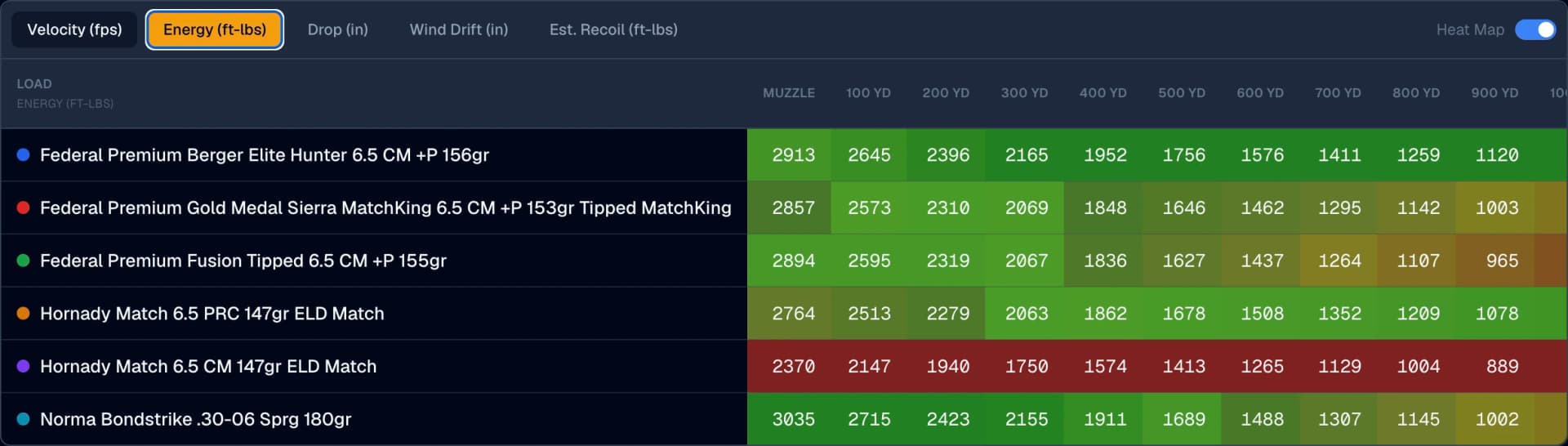
- Standard 6.5 Creedmoor: 0 of 69 loads clear both bars. Not one. The best of them — Hornady's 147-grain Match — makes 1,413 ft-lbs, and comes up 87 short.
- 6.5 Creedmoor +Peak: 3 of 5 clear, led by the 156-grain Berger at 1,756 ft-lbs and 2.35 MOA.
- 6.5 PRC: 10 of 33 clear, the best of them on wind the same 147-grain Hornady Match, at 1,678 ft-lbs and 2.31 MOA.
That first line is the finding. The 6.5 Creedmoor is not an elk-at-500 cartridge — not in 69 attempts — and the same case at 80,000 psi is. The +Peak doesn't improve the Creedmoor at the margins; it moves it into a category it was categorically not in.
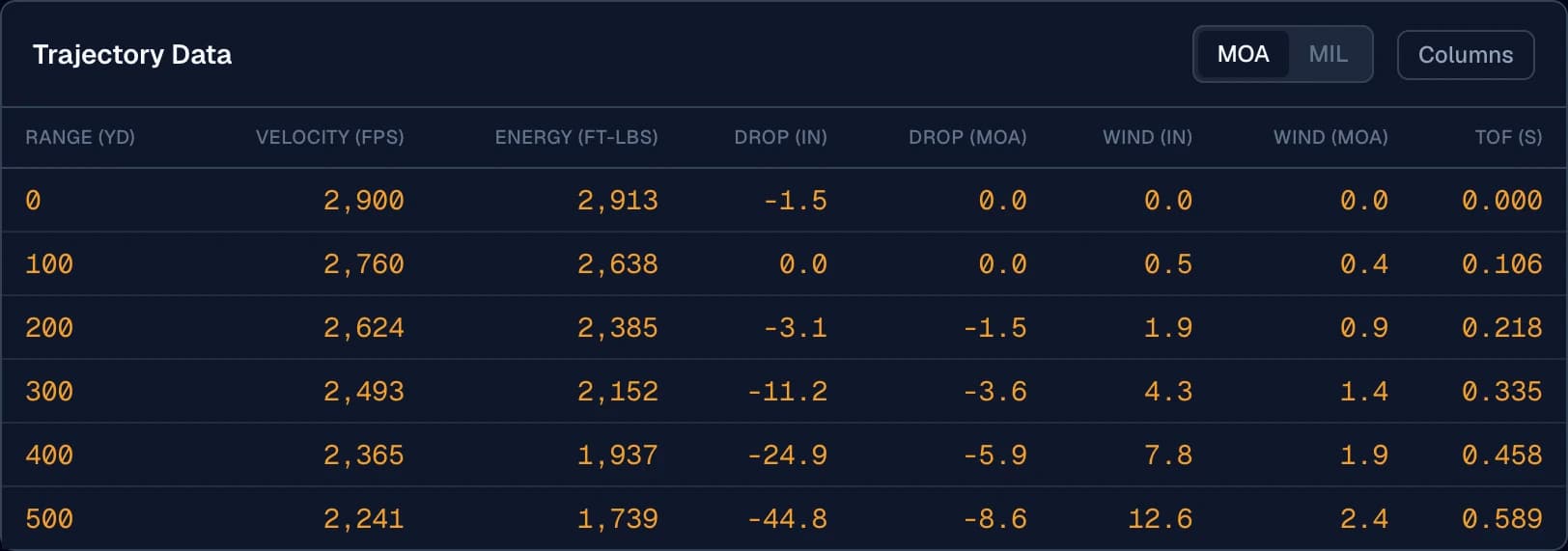
Note the third line, though — the correction I owe the PRC. Compare like for like and it clears the bar comfortably, and its best load holds wind a shade better than the +Peak's. The +Peak does not out-shoot the PRC. Weatherby loads the same 156-grain Berger in 6.5 PRC, where the +Peak wins by 50 fps and 67 ft-lbs — real, but a hair. What the +Peak has isn't ballistics. It's that it does this from a short action, standard boltface, in a rifle you can buy anywhere, with more rounds in the magazine and meaningfully less recoil.
Recoil is the axis this whole thing turns on
Everything above is downrange performance, which is what shooters argue about. What decides whether a rifle becomes your one gun is what it does to your shoulder.
| Load | Free recoil (8 lb rifle) |
|---|---|
| .223 Remington, 55 gr | 3.4 ft-lbs |
| 6.5 Creedmoor, 100 gr Barnes VOR-TX | 9.4 ft-lbs |
| 6.5 Creedmoor, 130 gr Terminal Ascent | 13.1 ft-lbs |
| 6.5 CM +Peak, 130 gr Terminal Ascent | 14.9 ft-lbs |
| 6.5 CM +Peak, 156 gr Berger | 17.4 ft-lbs |
| .308 Winchester, 175 gr | 18.3 ft-lbs |
| .30-06, 180 gr Bondstrike | 23.5 ft-lbs |
| 7mm Backcountry, 195 gr Berger | 30.6 ft-lbs |
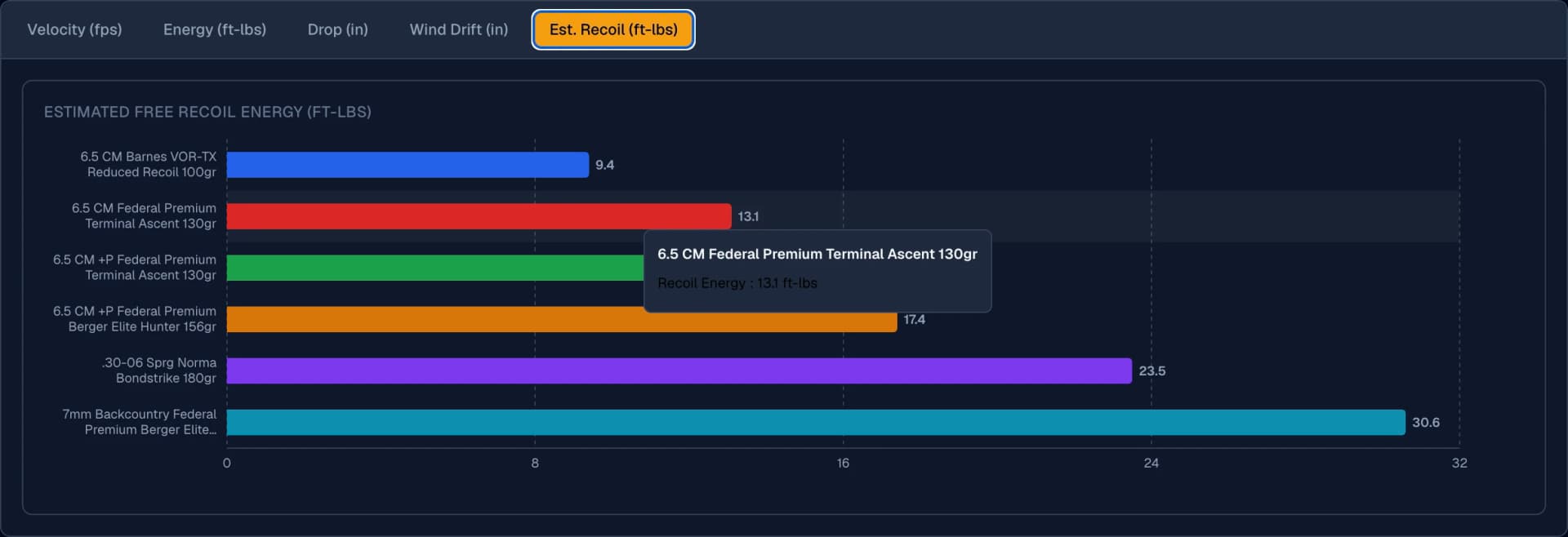
Two things fall out of that table.
The first is personal. My son is twelve, shoots my .223 happily, and has never pulled the trigger on the .30-06 — sensibly, he's never asked to. My daughter is nine. A 100-grain 6.5 Creedmoor load lands at 9.4 ft-lbs, less than half the .30-06 and closer to his .223 than to my deer rifle. That's the difference between a rifle two kids enjoy for an afternoon and one they flinch through. One gun, in my house, has to mean a gun everybody in the house can shoot. Barnes even sells that 100-grain as a reduced-recoil load, but you don't need the label — the light hunting and varmint loads already are one.
The second is the road not taken. The 7mm Backcountry recoils harder than a .30-06 — 30.6 against 23.5. I looked hard at it and called it a proof of concept. Now I can say why it isn't my one gun: it's a superior long-range cartridge that buys its superiority in exactly the currency my argument refuses to spend.
The actual reason I'm buying one
Everything up to here is ballistics, and ballistics isn't why this decision is easy.
Buy a 7mm Backcountry and, if Peak Alloy doesn't take off, you own an orphan — a rifle fed by a handful of loads from one manufacturer, a half-step from a wall hanger.
Buy a 6.5 Creedmoor to shoot +Peak and, if Peak Alloy doesn't take off, you still own a 6.5 Creedmoor. Hundreds of factory loads, every bullet weight, every price bracket, every sporting goods store in America. You lose nothing.
Those are two fundamentally different transactions. The Backcountry is a bet on a technology. A 6.5 Creedmoor that shoots +Peak is a free option on the same technology — all the upside if Peak Alloy becomes the future Federal thinks it is, and if it quietly disappears I'm holding the most-supported hunting cartridge of the last twenty years. Federal picked the one chambering where the downside is zero, and I doubt that was an accident.
The rifle availability makes the same point in numbers. Savage's own caliber pages list 34 rifles in 6.5 Creedmoor, against 12 in 7mm Backcountry — and zero in .280 Ackley Improved, which is a story I've already told.
What Federal actually claims, and what they don't
A cartridge running fifteen thousand psi above the industry's century-old ceiling deserves care rather than enthusiasm.
I had the reason wrong going in, and only found out by going back to the source. I'd absorbed the idea that the case absorbs the extra pressure so the chamber never sees it. That isn't what Federal says. On the Vortex Nation podcast, Federal's Eric Miller put it the other way round: legacy cartridges sit at 60,000–65,000 psi because that's brass's limit, not the rifle's. "The guns can hold way more." When a rifle fails, "it's usually the brass that fails." Makers changed nothing to chamber the Backcountry, because actions were already built far above these pressures — its SAAMI proof load runs 114,000 psi, and manufacturers have put five of those through one rifle.
That's a better claim than the one I was carrying. Brass was always the weak link, and Peak Alloy replaces it.
On barrel life, Miller's answer is that erosion tracks powder rather than pressure: "Throat erosion is just the amount of powder that you're throwing and type of powder… we're just not throwing that much down there." He says they see better life than a 7 PRC. I'll take that as the informed answer it is, while noting what it is — the manufacturer on their own product, no independent data, no round count.
And two things Federal says in their own materials that belong in front of you rather than buried:
- "Refer to your rifle manufacturer for recommendations on compatibility with high-pressure ammunition." Federal repeats this. Their testing shows +Peak "operates in a variety of 6.5 Creedmoor firearm platforms" — but that is not a clearance for your rifle, and neither is this article. Ask whoever built it.
- Your chamber must be clean and dry. Federal warns that any ammunition, Peak Alloy included, fired in a heavily-lubed chamber may damage a rifle. It never makes the headlines and it's the detail most likely to actually hurt somebody.
The reassuring part is why this landed on a 6.5 Creedmoor at all. Asked whether they'd ever offer a lower-pressure Backcountry, Miller said no: Peak Alloy will always be its own cartridge, "so that you don't go back the other way and inadvertently load a brass case to the high pressure." That's the safety architecture in one sentence, and it's why the technology arrived on a cartridge standardized in 2007 rather than 1952. There is no such thing as a 1956 6.5 Creedmoor rifle — every rifle this ammunition can chamber was built in the modern era, to modern pressures. Do it to a .308 and eventually somebody chambers one in a rifle their grandfather bought.
The limits
Every figure here is manufacturers' published, test-barrel data. Your rifle, your barrel and your day will chronograph differently — true of every comparison on this site, and worth saying twice about a cartridge with five loads and no field record.
Our recoil model estimates powder charge from case capacity, so it assumes +Peak burns the same charge as a standard 6.5 Creedmoor. That's defensible — the premise is buying velocity with pressure, not volume — but if Federal uses more or different powder, the real recoil figures are higher than the ones above, not lower.
And this is a mature cartridge against a brand-new one. The .30-06 has 120 years of every bullet anyone ever wanted behind it. The +Peak has five loads, from one company, none of them cheap, and no guarantee of a sixth.
Splitting hairs, and the one time it isn't
I ended the .260 Remington piece admitting the whole hobby is hair-splitting, and that I love it. Forty feet per second. A thousandth of an inch of chamber.
This isn't that. Zero of sixty-nine against three of five — a cartridge that could not clear an elk bar at 500 yards clearing it three ways from the same case, in a rifle you already own, and passing the .30-06 at about 265 yards on the way. Whatever else you say about the +Peak, it is not splitting hairs, and after four articles of cheerfully splitting them I know the difference.
So: Savage 110 Core, probably the Predator with the 22-inch barrel. Which is a funny place to land, because last time I wrote about buying a rifle, the 110 Core was what made the .260 Remington a real option — a mainstream maker chambering a cartridge everyone had left for dead. The .260 lost that argument to the +Peak. And the rifle I'm buying to shoot the +Peak is the same rifle, in the boring, popular, man-bun chambering I spent that whole article trying to talk myself out of.
The machine was right the first time. It just needed Federal to make it interesting.
When I get it, and when I start shooting it, I'll write about that too — this one is the plan, not the report. Nothing here has been fired. It's been calculated, from published data, the same way everything on this site is.
Splitting Hairs
The numbers behind the comparisons — what the data actually shows, and where it stops. No hype, no gear reviews.
Related Articles
Cartridges4 min read
.308 vs .30-06 vs .300 Win Mag vs .300 PRC: The Slower Magnum Wins
Everyone knows the ladder: more case, more powder, more performance. Run five Hornady Precision Hunter loads through the same math and the ladder holds — but the cartridge that wins at distance is the one that gave up 100 fps at the muzzle, and the .300 Win Mag needed two extra inches of barrel to lose.
Ballistics Board Staff·
Cartridges7 min read
7mm Backcountry vs .280 Ackley Improved: Does the Ackley Still Make Sense?
The .280 Ackley Improved was my answer for a do-it-all 7mm — then Federal's steel-cased, 80,000-psi 7mm Backcountry showed up doing the same job from a shorter barrel. On coolness, ballistics, and availability, does the Ackley still hold up? I ran the numbers.
Steve Sansford·

Cartridges6 min read
Best 7mm Cartridges for Elk: 7mm PRC, 7mm Rem Mag, and .280 AI
Don't shop the headstamp — shop the job. We set two rules an elk load has to clear at 500 yards, then ran the numbers on every 7mm hunting load in the database to see which cartridges actually make the cut.
Ballistics Board Staff·