6.5 Creedmoor vs .260 Remington: Splitting Hairs Over a Rifle I Didn't Even Buy
I set out to buy an East Coast whitetail rifle and talked myself into the esoteric .260 Remington over the 6.5 Creedmoor. Then I ran the numbers — and learned more about how we really pick a cartridge than about ballistics.
Steve Sansford
Steve is the builder of Ballistics Board. He doesn't get to the range as often as he'd like, but he's been fascinated by exterior ballistics and the rabbit hole of cartridge comparison for as long as he's owned a rifle.
Walk onto any rifle range and eventually somebody ambles over and asks the only question that matters: "What are you shooting today?"
There is exactly one answer that makes a certain kind of shooter's face fall a little, and it's "6.5 Creedmoor."
It shouldn't be that way. The 6.5 Creedmoor is one of the most quietly perfect cartridges ever standardized — I've said as much. But it got popular, and popularity breeds contempt. It's the man-bun of cartridges. The "6.5 Needs-more." Nobody wants to answer "6.5 Creedmoor," at least nobody insecure enough to care what the guy at the next bench thinks — which, if we're honest, is most of us.
I wanted to be the other guy. The one who says something you have to think about for a second. And I had a candidate: the .260 Remington.
This was going to be my East Coast whitetail rifle first and foremost — a little 1,000-yard plinking on the side would be a bonus. And you already know the setup if you read the .243 piece: when the Creedmoor showed up, half the internet said "why do we need this? We already have the .260 Remington." They were right that the two are nearly the same cartridge. They were wrong that it was ever about the cartridge.
Because my reason for wanting the .260 wasn't ballistic. It was the same reason I wanted a .280 Ackley instead of my .30-06: I didn't want to be the guy in deer camp shooting the same thing as everyone else. That's not logic. That's cool factor. And cool factor is the single most powerful force in the firearms industry — bigger than ballistics, bigger than price, bigger than availability. We just don't like to admit it.
So I asked a robot what to buy
One day, for fun, I did the responsible thing. Clean slate. I wrote down everything I wanted a rifle to do — kill whitetail out to any range I'd ever shoot one, stay cheap and easy to feed, kick lightly enough to shoot all day, and stretch to 1,000 yards when I felt like it — and I asked an AI to tell me what to buy. No emotion. Just the spec sheet.
It said 6.5 Creedmoor. Of course it did. Second place: .308 Winchester — which, if you've read that one, you know is basically the same conclusion wearing a different hat. The only thing that tipped it to the Creedmoor was the long-range target shooting, 1,000 yards and out.
The machine was right. The machine is always right. And I didn't want to listen to it, because the right answer was the uncool one.
Then Savage did something interesting: they started chambering the new 110 Core in .260 Remington. A mainstream maker bringing back a cartridge everyone had left for dead. Suddenly the esoteric choice wasn't a custom-rifle-and-handloading proposition — it was a gun I could buy off a rack and feed with factory ammo. Savage doesn't chamber a cartridge nobody's going to buy. The .260 was back on the table, and my heart already knew what it wanted.
So I ran the numbers, hoping they'd agree with me
This is a data website. So I did the thing it's built for: I ran the comparison, quietly hoping it would hand me the excuse I was looking for. Every number below comes from the manufacturers' published specs through the same ballistics calculator, under standard conditions — sea level, 59°F, a 100-yard zero, and a 10 mph full-value crosswind.
First, the hunting loads — the actual job. Two factory loads each from three makers, .260 against Creedmoor. Here's the whole mess.
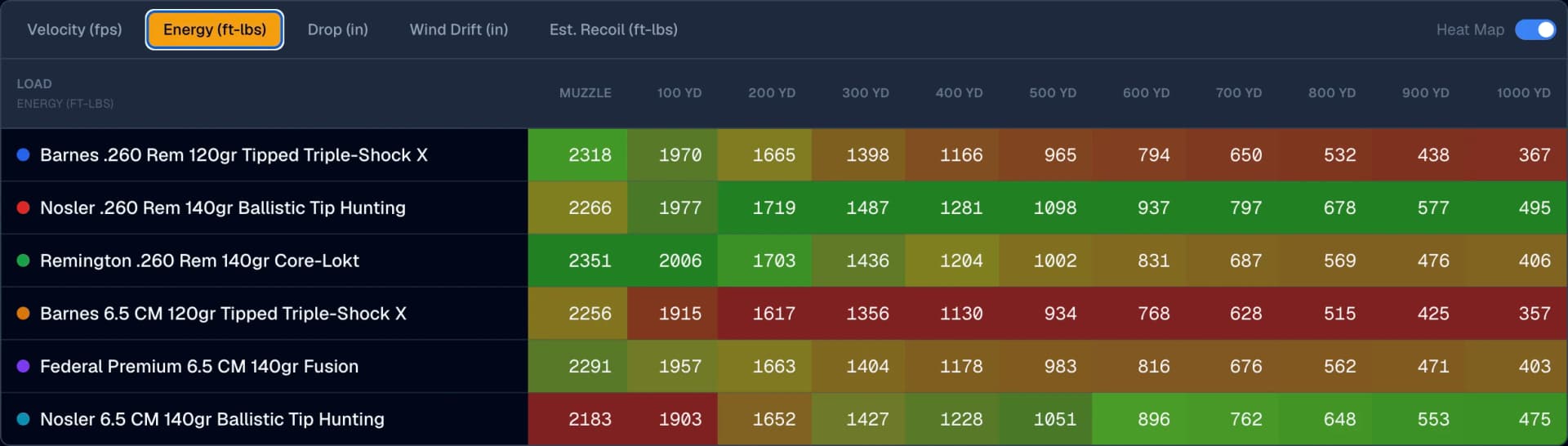
It looks like somebody spilled a bag of Skittles. There's no clean line, no winner — just a jumble, because at the ranges you hunt a whitetail these are the same cartridge. At 300 yards — a long poke in the East Coast woods, where I'll mostly be looking at half that — every one of these loads is dropping about a foot and still carrying somewhere between 1,350 and 1,500 ft-lbs, comfortably past the roughly 1,000 ft-lbs most people call the floor for deer. You could pick one blindfolded.
But look closely and the .260 leaves a fingerprint. Where a maker loads the exact same bullet in both — Barnes' 120-grain TTSX, Nosler's 140-grain Ballistic Tip — the .260 leaves the muzzle 40 to 50 fps faster, every single time. Its case holds a hair more powder, the same edge the .243 Winchester has over the 6mm Creedmoor. It's real. It's measurable. And it is utterly meaningless for killing a deer. But it showed up on the hunting side — the side that actually mattered for this rifle — and it backed my heart. That was enough. I didn't need more.
The match side was pure bonus. And here's where the data got honest with me in a way I didn't love.
Up close, the .260's 130-grain ELD Match is a star. It leaves faster than the Creedmoor's heavier match loads — 2,840 fps — and carries more muzzle energy than the Creedmoor's 120 or 140. Through the middle distances it's flat and punchy. If the game ended at 500 yards, the .260 would win going away.
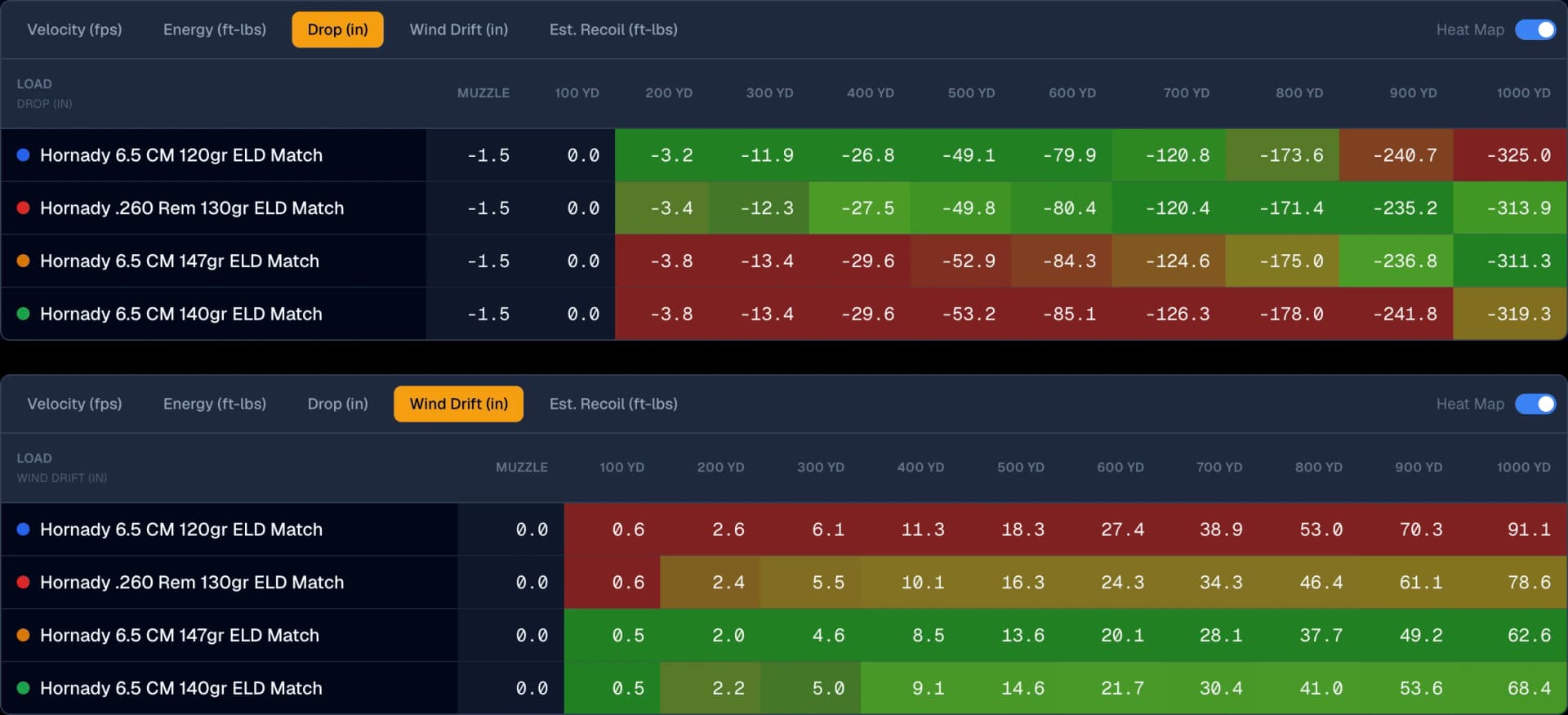
The game doesn't end at 500. At 1,000 yards — the one distance where I claimed the ballistics actually mattered to me — the Creedmoor's 147-grain ELD Match walks away from it: 62.6 inches of wind drift against the .260's 78.6, and more than 200 extra ft-lbs of retained energy. Sixteen inches of wind is the difference between a hit and a good story about a miss. And it isn't because the .260 is the lesser cartridge — it's the same lesson from the .243 piece and the .308 piece, a third time: Hornady's only factory match load for the .260 is that mid-weight 130, while the Creedmoor gets the deep bench of heavy, high-BC 140s and 147s. The cartridge is a twin. The shelf decides.
There's an asterisk, and I'll be honest about it: if I owned the .260 and wanted that long-range edge back, I could just handload the 147 into it — the case has room to spare, and it'd likely nose ahead of the Creedmoor there too, like it does everywhere else. But I don't reload, and this is a factory-ammo website and a factory-ammo life. The option is real. It's just not mine.
Here's the part nobody admits
So the data backed me where it counted and quietly embarrassed me where it didn't. And you know what I did with that? I still wanted the .260.
That's the whole confession this article exists to make: we choose with the heart, and then we go looking for numbers to justify it. Every one of us. We fall for a rifle — the lines of it, the cool factor, the story we get to tell at the bench — and then we open a ballistics calculator and hunt for the column where our pick comes out ahead. There's always a column. The .260 handed me the hunting edge and the muzzle-velocity edge, and I'd have waved those around like a trophy while conveniently not mentioning the 1,000-yard wind.
I'm allowed to say that because it's true of the whole industry, and because it's the strange uphill battle this website fights every day. Ballistics Board is a machine for making rational cartridge decisions — and rational is not how anyone actually decides. I built a data tool for an audience that, myself very much included, buys on feeling. That's not a flaw in you. It's human. The tool isn't here to overrule your heart. It's here so that when your heart's already decided, you at least know exactly what you're choosing, and what it costs you at 1,000 yards.
Splitting hairs
Here's what the "6.5 Needs-more" crowd gets right, and I'll hand it to them: for the hunting most of us actually do, the new cartridges don't do a thing a hundred-year-old .30-06 won't. I've made this exact point before — inside any range you should be shooting an animal, everything from a .243 to a .30-06 is a twin, and the shooter matters more than the box. Past that point, we're splitting hairs. Forty feet per second. A thousandth of an inch of chamber. A cartridge that's cool to say out loud.
And I want to be clear: I love splitting hairs. The hair-splitting is the entire hobby. Chasing a couple fewer inches of drift, arguing .260 versus Creedmoor like it's a moral question — that's the fun. That's the rabbit hole. I built a whole website to climb down it. I'm not above any of this. I'm the target market.
So did I buy the .260?
No. The .260 Remington is off the table.
Not because the 6.5 Creedmoor finally won the argument on the merits — it didn't, and my heart was never going to concede to the man-bun cartridge. The .260 lost to something that isn't splitting hairs at all: the 6.5 Creedmoor +Peak. An 80,000-psi Creedmoor. As good as the .260 Remington is — and it is every bit as good as I wanted it to be — it cannot touch a 6.5 Creedmoor running at 80,000 psi. For once the cool thing and the right thing are the same thing, and my heart and the machine finally agree.
But that's a story for its own article.
One honest caveat before you go build your own version of this. Every number above comes from manufacturers' published, test-barrel data — the same foundation the whole site runs on. Your rifle, your barrel, and your day will chronograph differently. The tool shows you what these loads are capable of and how they stack up on equal footing. Which one is right for your hunt — and which one you just want — was always yours to decide.
Run the hunting comparison yourself and see the Skittles for yourself.
Splitting Hairs
The numbers behind the comparisons — what the data actually shows, and where it stops. No hype, no gear reviews.
Related Articles
Cartridges9 min read
6.5 Creedmoor +Peak vs .30-06: The One-Gun Rifle Bet You Don't Have to Make
The .30-06 has been the one-gun answer for a century. I ran Federal's 80,000-psi 6.5 Creedmoor +Peak against it without looking at a single number first — and the result changed which rifle I'm buying this fall, though not for the reason I expected.
Steve Sansford·
Cartridges7 min read
7mm Backcountry vs .280 Ackley Improved: Does the Ackley Still Make Sense?
The .280 Ackley Improved was my answer for a do-it-all 7mm — then Federal's steel-cased, 80,000-psi 7mm Backcountry showed up doing the same job from a shorter barrel. On coolness, ballistics, and availability, does the Ackley still hold up? I ran the numbers.
Steve Sansford·

Cartridges6 min read
Best 7mm Cartridges for Elk: 7mm PRC, 7mm Rem Mag, and .280 AI
Don't shop the headstamp — shop the job. We set two rules an elk load has to clear at 500 yards, then ran the numbers on every 7mm hunting load in the database to see which cartridges actually make the cut.
Ballistics Board Staff·