6mm Creedmoor vs .243 Winchester: Why Does the Newer Cartridge Exist?
The 6mm Creedmoor and the .243 Winchester shoot the same bullets from nearly the same case. So why did one take over precision rifle while the other sat it out? We ran the numbers — and the answer isn't ballistics.
Ballistics Board Staff
Every 6mm thread eventually produces the same one-liner: the 6mm Creedmoor is just a .243 Winchester with better marketing. It gets typed with real confidence, usually by someone who's owned a .243 since before the Creedmoor existed and doesn't see what the fuss is about.
They're more right than they know. And they're also missing the entire point. Both of those things are true at once, and untangling them is the most useful thing this comparison can do — because the honest answer to "why does the 6mm Creedmoor exist?" turns out to have almost nothing to do with ballistics.
The .243 Winchester arrived in 1955 as a dual-purpose varmint-and-deer round — a .308 necked down to shoot fast, light 6mm bullets. The 6mm Creedmoor showed up around 2017 as a 6.5 Creedmoor necked down for one job: launching long, heavy, high-BC match bullets in precision rifle competition. Sixty-two years apart, same bore, same bullets. Every number below comes from manufacturers' published specifications run through our ballistics calculator under identical conditions: sea level, 59°F, a 100-yard zero, and a 10 mph full-value crosswind.
On paper, the cynics are right
The way to test "it's just a .243" is to do the thing most comparisons refuse to do: hold the bullet constant. Same projectile in both cases, and see what the cartridge actually contributes.
So we used the same bullet — Hornady's 108-grain ELD Match — in each. And here's the first tell, before a single number: you can buy that load off the shelf in 6mm Creedmoor. In .243 Winchester, you can't. There's no factory equivalent. So we built one in the custom-load builder: the 108 ELD-M at 3,000 fps, a stout but entirely ordinary handload — Hodgdon's published data runs this bullet in the .243 from about 2,700 up past 3,050 fps, so 3,000 sits comfortably below maximum. The factory Creedmoor load leaves at 2,960.
One of these you buy. The other you have to make. Hold that thought.

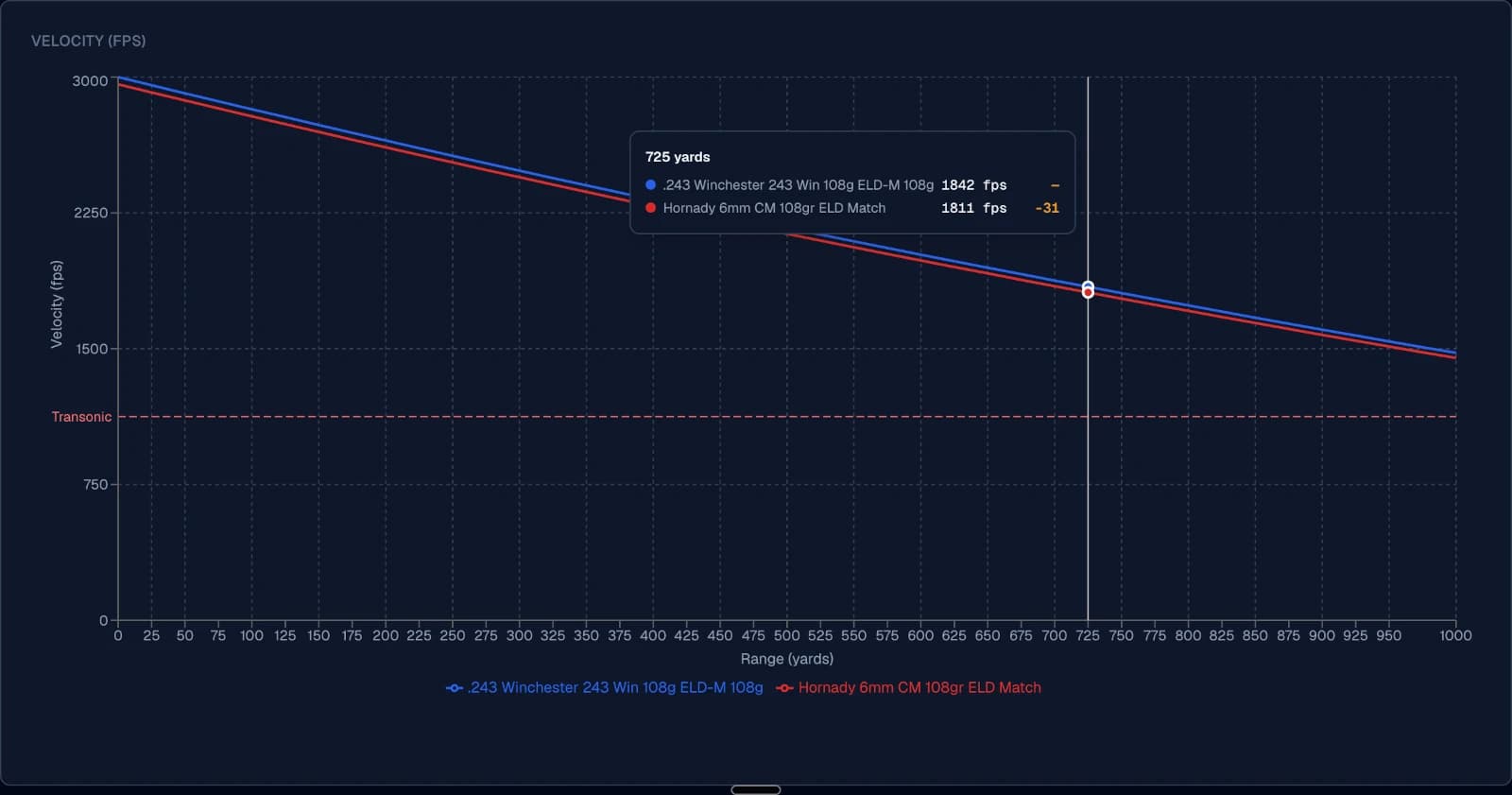
The chart is almost boring, and that's the point. With the same bullet, the two cartridges are twins:
- Drop at 500 yards: the .243 falls about 44 inches, the Creedmoor about 46 — an inch and a half between them. At 1,000 yards the .243 is roughly 9 inches flatter.
- Wind in that 10 mph crosswind: a third of an inch apart at 500 yards, under two inches apart at 1,000.
- Velocity and energy: the .243 leads by exactly the margin its 40 fps head start buys — a hair more speed, a hair more energy, all the way down.
Read that again: the .243 isn't losing. If anything the older cartridge is fractionally ahead, because its case is actually a touch larger and pushes the same bullet a little faster. The only thing it gives up is half a foot-pound of recoil — 11.7 ft-lbs against the Creedmoor's 11.2, a difference you will never feel. As cartridges, stripped down to the ballistics, they are the same cartridge. The guy on the forum is right.
Which raises the real question. If they're twins, why did the 6mm Creedmoor take over precision rifle while the .243 Winchester — older, more common, sitting in a million gun safes — barely shows up at a match?
Now try to actually shoot it
The twins chart is real. It's also a trap, because it quietly assumes two things your .243 Winchester may not be able to deliver.
First, twist rate. The .243 was born in 1955 for varmint and deer bullets, and for decades factory rifles came with a slow 1:10 twist to match. That twist will not stabilize the long 108-grain match bullet the whole comparison depends on. You can put that ammo in the chamber; it won't fly straight. The 6mm Creedmoor was cut from the start with a fast 1:7.5 or 1:8 twist built for exactly those bullets. The twins chart only exists if your barrel can spin the bullet — and most .243 barrels in the field can't.
That wall, though, is coming down. New .243 rifles are quietly fixing the twist: the Tikka T3x ships at 1:8, some Savage 110 rifles at 1:9.25. Buy a modern fast-twist .243 and the rifle is no longer the problem.
Second — and this is the one that actually decides it — the ammo. Even with a brand-new fast-twist .243, walk into a store and try to buy a box of 108-grain match ammo for it. You can't. It essentially doesn't exist. Manufacturers won't load heavy match bullets for the millions of slow-twist .243s already in the field — most of those rifles couldn't shoot it — so the shelf never fills, so the fast-twist owner ends up at a reloading press anyway. It's a chicken-and-egg the 6mm Creedmoor solved by being born fast-twist with match ammo from day one.
That's the whole moat. Not ballistics, not even twist anymore. The 6mm Creedmoor's remaining advantage is a box you can buy. (And if a big manufacturer ever does load a factory .243 match round, don't expect it to embarrass the Creedmoor — factory ammo gets loaded conservatively for the entire installed base and for liability, so it would almost certainly land at or below the Creedmoor's numbers. Not a conspiracy. Just how factory ammo is made.)
There's one more limit worth naming, because it keeps everyone honest: the 6mm Creedmoor isn't even the top of this class. Step up to the 6mm GT and it does more with less — Hornady's factory 109-grain load leaves 90 fps slower than the Creedmoor, yet by 1,000 yards it's carrying more speed, more energy, and drifting about five inches less, all on a slightly higher-BC bullet. That's ballistic coefficient beating muzzle velocity, and it's the actual logic of modern precision cartridges. Above the GT sits the 6mm Dasher, the real match darling — which has no factory ammo whatsoever. You build it yourself and put it on the chart. The 6mm Creedmoor's genius was never being the fastest 6mm. It was being the turnkey one.
So what does the 6mm Creedmoor do that your .243 can't?
Nothing. And everything. It depends on which question you're actually asking.
As a cartridge, it does nothing your .243 Winchester can't. Give the .243 a fast-twist barrel and a handload, and it matches or beats the Creedmoor with the same bullet. The cynics were right: on paper, it's the same round.
As a system, it does the thing that matters most — it's already done. Fast twist from the factory, match ammo on the shelf, no press required. The precision crowd is right too: for competition, the .243 was left at the start line the Creedmoor built.
So it comes down to who you are. If there's a .243 Winchester in your safe and you hunt with it, the 6mm Creedmoor is not an upgrade — it's a lateral move to a rifle that shoots exactly the same. Keep what you have. Off the shelf, the .243 you can actually buy is a fast, light 90-grain hunting load, and inside 300 yards it's flatter than anything; it only falls apart way out where you shouldn't be shooting at game anyway. But if you're buying a dedicated low-recoil precision rig new, and you want to load match ammo from a box instead of a press, the 6mm Creedmoor is the answer to a question the .243 makes you work for.
The 6mm Creedmoor didn't out-shoot the .243 Winchester. Sixty-two years later, it just out-organized it. That turns out to be worth more than a few feet per second — which is the whole reason it exists.
Splitting Hairs
The numbers behind the comparisons — what the data actually shows, and where it stops. No hype, no gear reviews.
Related Articles
Cartridges9 min read
6.5 Creedmoor +Peak vs .30-06: The One-Gun Rifle Bet You Don't Have to Make
The .30-06 has been the one-gun answer for a century. I ran Federal's 80,000-psi 6.5 Creedmoor +Peak against it without looking at a single number first — and the result changed which rifle I'm buying this fall, though not for the reason I expected.
Steve Sansford·
Cartridges7 min read
7mm Backcountry vs .280 Ackley Improved: Does the Ackley Still Make Sense?
The .280 Ackley Improved was my answer for a do-it-all 7mm — then Federal's steel-cased, 80,000-psi 7mm Backcountry showed up doing the same job from a shorter barrel. On coolness, ballistics, and availability, does the Ackley still hold up? I ran the numbers.
Steve Sansford·

Cartridges6 min read
Best 7mm Cartridges for Elk: 7mm PRC, 7mm Rem Mag, and .280 AI
Don't shop the headstamp — shop the job. We set two rules an elk load has to clear at 500 yards, then ran the numbers on every 7mm hunting load in the database to see which cartridges actually make the cut.
Ballistics Board Staff·