Maximum Point-Blank Range, Explained — Your Vital Zone Matters More Than Your Cartridge
Maximum point-blank range is the longest distance you can hold dead-on and still hit the vitals. We ran every .270 Winchester factory load in our database through our ballistics calculator: the entire field spans 65 yards, while changing the vital-zone assumption on a single load swings it 109. The number you invent moves the answer more than the ammunition you buy.
Ballistics Board Staff
Ask a room full of deer hunters how to sight in a rifle and you will get one answer more than any other: put it a couple of inches high at 100 yards and you're good to 300. It is the closest thing the hunting world has to received wisdom, it has been passed down for decades, and it is built on a real and genuinely useful idea — maximum point-blank range.
The idea is sound. The number attached to it usually isn't, and the reason why turns out to be more interesting than the correction.
Every figure below is manufacturers' published data run through our ballistics calculator under identical conditions: sea level, 59°F, a 1.5-inch sight height and a 10 mph full-value crosswind. We didn't fire a shot; we ran the math.
What maximum point-blank range actually is
Maximum point-blank range is the longest distance over which you can aim dead-on and still hit the vitals — no holdover, no dialing, no rangefinder.
It works by spending trajectory deliberately. Instead of zeroing so the bullet crosses your line of sight close in, you tilt the barrel up slightly so the bullet arcs above the line of sight through the middle distances, then comes back down. Draw an imaginary circle the size of an animal's vitals, centered on your line of sight, and stretch it downrange. The optimal trajectory is the one that just kisses the top of that tube and stays inside it as long as possible. MPBR is where it finally falls out the bottom.
That framing matters, because it means MPBR is not one number. It's the answer to a question that contains an assumption — how big are the vitals? — and that assumption is an input you supply.

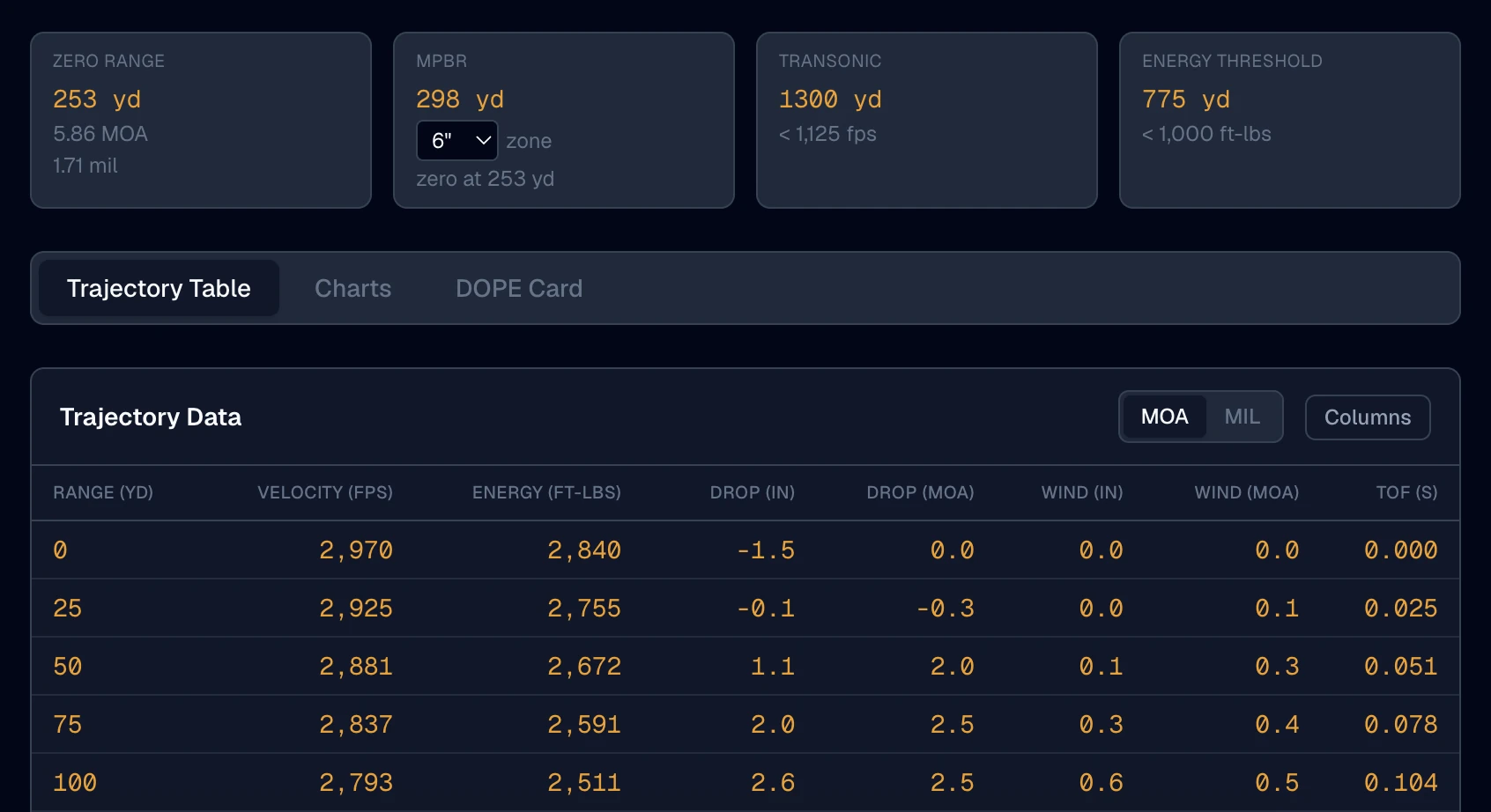
Our worked example throughout is the Hornady Precision Hunter 145-grain ELD-X in .270 Winchester at 2,970 fps — a mainstream load in a cartridge that has been answering this exact question since 1925. In a 6-inch vital zone it gives an MPBR of 298 yards, from a 253-yard zero.
The two-inch rule, tested
So does the folk rule get you there? We solved that same load at each of the popular holds:
| Setup | Trajectory peak | Actual zero | Stays in a 6″ vital zone to |
|---|---|---|---|
| 1.5″ high at 100 yd | 1.64″ | 203 yd | 258 yd |
| 2″ high at 100 yd | 2.27″ | 228 yd | 278 yd |
| 2.5″ high at 100 yd | 2.95″ | 252 yd | 296 yd |
| 3″ high at 100 yd | 3.69″ — above the zone | 273 yd | 314 yd |
| Optimal (2.6″ high) | 3.00″ | 253 yd | 298 yd |
Two inches high at 100 yards is 22 yards short of the 300 it promises. That is not a disaster — it's a good rule that drifted — but it is wrong in the direction that matters, because the shooter believes they have margin they don't have.
The fix many shooters reach for is worse in a subtler way. Three inches high at 100 does reach 314 yards, but its trajectory peaks 3.69 inches above the line of sight. In a 6-inch vital zone — three inches above center, three below — that bullet climbs out the top of the circle just past 100 yards and does not come back into it until about 200. It bought 36 yards at the far end by leaving the zone it claimed to be inside at the near end. If you hold dead-on at a deer at 175 yards with that setup, you are aiming at the middle of the lungs and sending the bullet at the spine.
The honest number for this load is 2.6 inches high at 100 yards. Nobody's rule of thumb says two and six tenths.
The number the ammunition barely touches
Here is where it gets interesting. We ran every .270 Winchester factory load in our database that publishes both a velocity and a ballistic coefficient — 66 when this was last checked. In a 6-inch zone, the entire field spans 260 to 325 yards.
That is 65 yards of spread across bullets ranging from 96 to 156 grains, G1 ballistic coefficients from .252 to .542, and muzzle velocities from 2,800 to 3,543 fps. Every one of them lands within about 15 percent of 300 yards.
Narrow it further. These four .270 loads all fire a 150-grain bullet at exactly 2,850 fps — identical weight, identical velocity, different bullets:
| Load | BC | MPBR (6″) | Optimal zero | Wind drift @ 500 yd | Energy @ 500 yd |
|---|---|---|---|---|---|
| Remington Premier Long Range | .542 G1 | 286 yd | 243 yd | 16.7″ | 1,397 ft-lbs |
| Federal Fusion | .471 G1 | 282 yd | 240 yd | 19.7″ | 1,254 ft-lbs |
| Winchester Super-X Power-Point | .344 G1 | 273 yd | 233 yd | 29.2″ | 914 ft-lbs |
| Remington Core-Lokt | .261 G1 | 262 yd | 225 yd | 42.2″ | 624 ft-lbs |

Read that table twice. MPBR separates these four loads by 24 yards — call it nine percent, a difference no hunter could detect in the field. The same four loads are 2.5 times apart on wind drift at 500 yards, and the top one arrives there with more than double the retained energy of the bottom one — despite leaving the muzzle with exactly the same 2,705 ft-lbs.
Our calculator's energy card makes the gap starker still. The distance at which each load falls below the 1,000 ft-lb hunting threshold: 750 yards for the Premier Long Range, 650 for the Fusion, 475 for the Power-Point, and 375 for the Core-Lokt. The two loads that MPBR ranks 24 yards apart, retained energy ranks 375 yards apart.

MPBR compresses precisely the differences that decide whether a load is any good. It is a measure of trajectory flatness over the first 300 yards, and over the first 300 yards, modern centerfire cartridges are all flat.
That holds across cartridges too, not just within one. Running every load in our database for six popular chamberings, the median MPBR in a 6-inch zone comes out at 212 yards for the .30-30 Winchester, 266 for the .308 Winchester, 276 for the 6.5 Creedmoor, 293 for the .300 Winchester Magnum, 294 for the .270 Winchester — and 300 for the .243 Winchester.
A .243 Winchester and a .300 Winchester Magnum come out level. Restrict each to the bullet weights people actually hunt with — 90 to 105 grains for the .243, 150 to 200 for the magnum — and the medians land at 295 and 294 yards. Nobody would argue those two cartridges are equivalent, and that is exactly the point: MPBR isn't measuring what makes them different.
The number that actually moves it
Now hold the load completely fixed and change only the vital-zone figure — the assumption, not the ammunition:
| Vital zone | MPBR | Optimal zero |
|---|---|---|
| 4″ | 255 yd | 218 yd |
| 6″ | 298 yd | 253 yd |
| 8″ | 333 yd | 283 yd |
| 10″ | 364 yd | 309 yd |
109 yards, from a dropdown. Every .270 factory load in our database, taken together, spans 65. The single largest lever on your maximum point-blank range is a number you chose about the animal, and it beats every ammunition decision available to you combined.

Set it to 10 inches and the calculator will tell you this load is good to 364 yards. It isn't lying. It is answering the question you asked, which was: how far can I shoot if a deer's vitals are a 10-inch circle and I'm willing to use every inch of it? Change it to 4 inches — the honest figure if you want your bullet in the top of the heart rather than merely somewhere in the chest — and the same load is a 255-yard proposition.
Set the zone in the ballistics calculator and watch the other numbers move. Nothing about the ammunition changed.
What MPBR can't see
It is blind to wind. MPBR is a purely vertical statistic. The four 150-grain loads above are separated by 24 yards of MPBR and 25.5 inches of drift at 500 yards in a 10 mph crosswind. If you hunt open country, the number MPBR reports is not the number that will cost you an animal — a point our piece on why BC beats velocity at distance takes apart in detail.
It is blind to terminal performance. MPBR says you can hold dead-on at 262 yards with that Core-Lokt. It does not say whether the bullet arrives with enough energy to do the job, or whether it will expand at that velocity. Those are separate questions, and for larger game they're the binding ones — the 7mm elk piece sets a 1,500 ft-lb bar at 500 yards for exactly that reason.
The vital zone is an assumption wearing a measurement's clothes. There is no standard. Published figures for a whitetail's vital zone run from about 8 to 10 inches, but the honest zone is smaller than the anatomical one, because it has to absorb your own error, your rest, the animal's angle, and the fact that it may not be standing square. A 6-inch zone on an 8-inch target is not conservatism; it's the margin doing its job.
The setup precision it demands is more than most people can confirm. The optimum asks you to be 2.6 inches high at 100 yards. Miss by half an inch — well inside a normal three-shot group — and the answer moves substantially:
| Error at 100 yd | Trajectory peak | Resulting MPBR |
|---|---|---|
| −0.5″ | 2.40″ | 281 yd |
| −0.25″ | 2.67″ | 289 yd |
| Exact | 3.00″ | 298 yd |
| +0.25″ | 3.39″ | 307 yd — above the zone |
| +0.5″ | 3.84″ | 318 yd — above the zone |
A 37-yard swing, from an error you very likely cannot see. And the high side doesn't just add range: at a quarter inch high the trajectory already peaks at 3.39 inches, and at half an inch at 3.84 — both out the top of the 6-inch zone. As we found when looking at whether altitude and temperature move your zero, a three-shot confirmation group scatters around half an inch off a machine rest before the shooter is involved at all. The method is asking for a setting finer than the tool used to verify it.
None of this makes MPBR useless. It makes it a planning number rather than a specification.
So what is it good for?
It is good for the thing it was invented for: telling you how far you can shoot without thinking. For most modern centerfire deer cartridges, in a 6-inch vital zone, the answer is somewhere between 260 and 300 yards, off a zero between 225 and 255 yards. That is a genuinely useful thing to know, and it means a hunter with a .270, a 250-yard zero, and the discipline to pass on anything past 300 needs no turrets, no rangefinder and no dope card.
What it is not good for is choosing ammunition. The spread across an entire cartridge's factory offerings is smaller than the error bar on your own zeroing, and smaller still than the difference the vital-zone assumption makes. Choose your load on wind drift and retained energy, where the differences are real and large. Then compute MPBR for whatever you chose, because it will be within a few yards of every other option anyway.
And when the calculator hands you 364 yards, look at what you told it. That number came from you, not from the cartridge.
Splitting Hairs
The numbers behind the comparisons — what the data actually shows, and where it stops. No hype, no gear reviews.
Related Articles
Ballistics9 min read
Altitude and Temperature Don't Move Your Zero — Unless You Zeroed Far Out
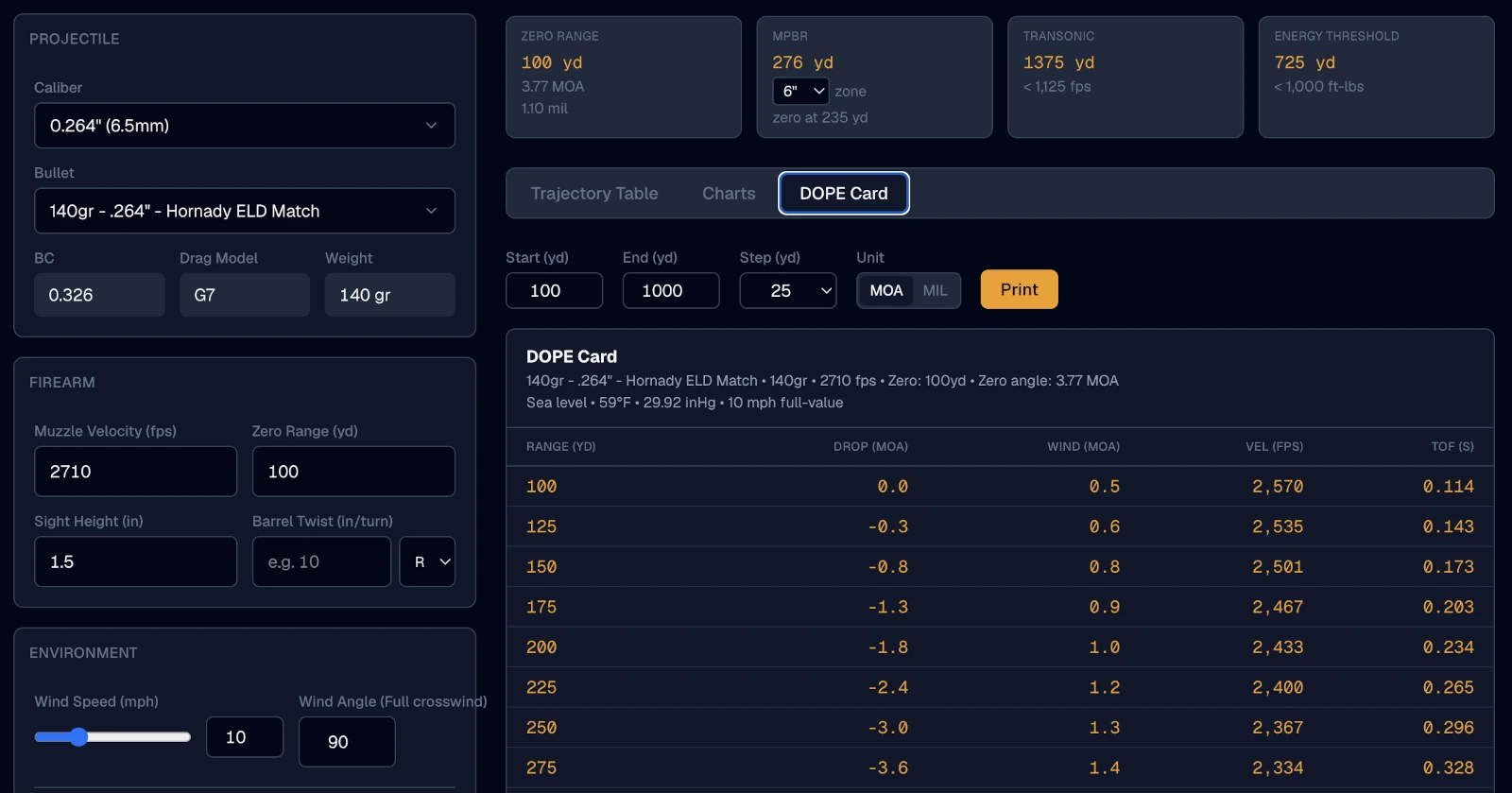
Everyone says to re-zero when you get to the mountains. We ran a 6.5 Creedmoor from sea level to 10,000 feet and from 0°F to 100°F, and a 100-yard zero never moved — 0.04 inch across the entire envelope. What moves is everything past it: 33 inches at 1,000 yards. Unless your zero itself is distant, in which case all of this inverts.
Ballistics Board Staff·

Ballistics5 min read
Wind Drift: Why Ballistic Coefficient Beats Velocity at Distance
Everyone reaches for the fastest load to fight the wind. It's exactly backwards. We ran the numbers on five popular .308 loads from the manufacturers' published data — and one of the slowest bullets drifts the least, while two loads of the same weight come out 29.5 inches apart.
Ballistics Board Staff·
Cartridges4 min read
.308 vs .30-06 vs .300 Win Mag vs .300 PRC: The Slower Magnum Wins
Everyone knows the ladder: more case, more powder, more performance. Run five Hornady Precision Hunter loads through the same math and the ladder holds — but the cartridge that wins at distance is the one that gave up 100 fps at the muzzle, and the .300 Win Mag needed two extra inches of barrel to lose.
Ballistics Board Staff·