Can You Trust a Ballistics Calculator to Compare Two Loads?
Ballistics calculators disagree, and so do manufacturers' printed tables. We put two pairs of factory loads through two independent calculators and then fed them a deliberately wrong BC. The single figures moved by inches. The gap between the loads barely moved at all.
Ballistics Board Staff

Run the same load through three ballistics calculators and you'll get three answers. Look at two manufacturers' printed tables for the same bullet and they won't quite line up either. So it's a fair question, and one a lot of shooters ask: if the calculators can't agree, why trust any of them to tell you which of two loads shoots flatter?
It turns out the question has two halves, and they don't have the same answer. A calculator's single figures can wander. The gap between two loads is far harder to knock over. To show it, we took two pairs of factory loads that fire the same bullet from two different makers, ran them through our ballistics calculator and through an independent one written by other people, then fed both a deliberately wrong number. Every figure below is the manufacturers' published data under identical conditions: sea level, 59°F, 29.92 inHg, a 100-yard zero, a 1.5" sight height and a 10 mph full-value crosswind. We didn't fire a shot; we ran the math.
Two boxes, one bullet
Hornady's Precision Hunter and Federal Premium's ELD-X load in .308 Winchester carry the same projectile: Hornady's 178-grain ELD-X, at the same published G7 BC of 0.278. Hornady lists 2,600 fps at the muzzle and Federal 2,610. Ten feet per second is the only difference between them.
Both makers publish a range table on their product pages, so the obvious way to compare the two is to read one table against the other. Here's what that gives you at 500 yards, beside what one calculator gives you for both:
| Load | Muzzle | 500 yd, maker's own table | 500 yd, one calculator |
|---|---|---|---|
| Hornady Precision Hunter | 2,600 fps | 1,868 fps | 1,855 fps |
| Federal Premium ELD-X | 2,610 fps | 1,872 fps | 1,864 fps |
| Gap | 10 fps | 4 fps | 9 fps |
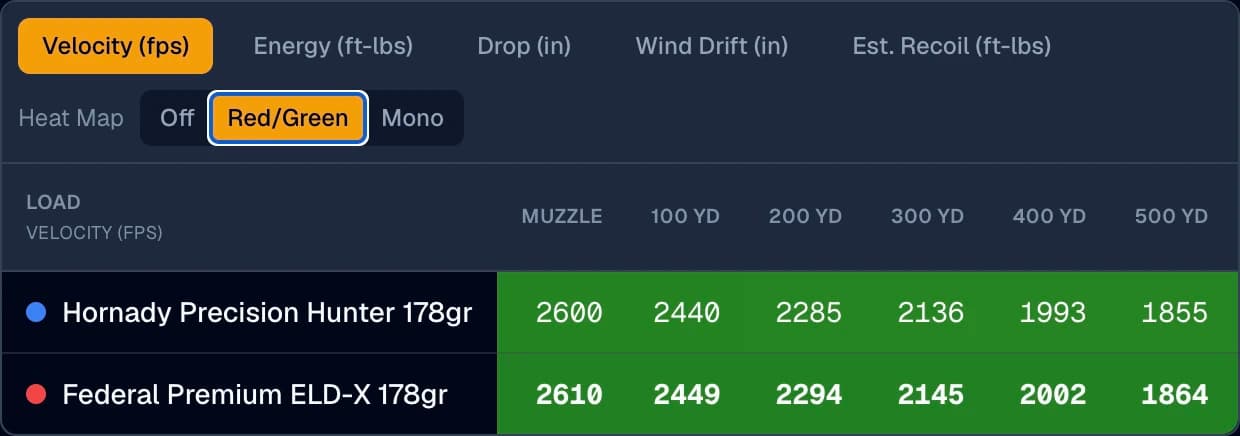
Neither maker's table is wrong. Each company computes its own with its own drag model and its own assumptions, and both put the bullet a little faster at 500 yards than ours does, which is normal between calculators. The trouble is only in putting them side by side. Two tables computed two ways can't tell you the difference between two loads, because some of the difference you're reading is the difference between the calculations. A bullet that leaves 10 fps faster stays about 9 fps faster at 500 yards. The printed tables say 4.
That's the whole reason we run every load through one calculator, whoever made it. But it only moves the question along: how do we know our calculator is right?
A second opinion
The cleanest check is a second calculator that shares none of our code. py-ballisticcalc is an open-source engine written independently of ours, with its own atmosphere model, its own zeroing and its own integrator. It reads the same standard drag curves. We gave it the same two loads and the same conditions.
| Drop | Hornady, ours | Hornady, theirs | Federal, ours | Federal, theirs | Gap, ours | Gap, theirs |
|---|---|---|---|---|---|---|
| 300 yd | −15.4" | −15.4" | −15.2" | −15.2" | 0.2" | 0.2" |
| 500 yd | −61.4" | −61.4" | −60.9" | −60.9" | 0.5" | 0.5" |
| 800 yd | −211.2" | −211.3" | −209.3" | −209.4" | 1.9" | 1.9" |
| 1,000 yd | −388.7" | −389.0" | −385.2" | −385.5" | 3.5" | 3.5" |
The single figures agree to a fraction of an inch at every range, and at 1,000 yards they differ by 0.3". The gaps agree to the tenth of an inch. Two calculators built separately land in the same place, which is what you'd hope for and not something to take for granted.
Put an error in on purpose
Agreement between two calculators says the arithmetic is sound. It can't say the inputs are. Every BC is a maker's published figure, and published BCs carry real uncertainty: they depend on the velocity they were measured at, the standard atmosphere they were stated in, and how they were measured. So suppose every BC we used were about 3% too high. What would that do to a comparison?
We re-ran both ELD-X loads at a G7 of 0.270 instead of 0.278. The Hornady load at the lower BC is one click away in the ballistics calculator.
| 1,000 yd | Hornady | Federal | Gap |
|---|---|---|---|
| Published BC (0.278) | −388.7" | −385.2" | 3.5" |
| BC about 3% lower (0.270) | −397.0" | −393.3" | 3.7" |
| Change | 8.3" | 8.1" | 0.2" |
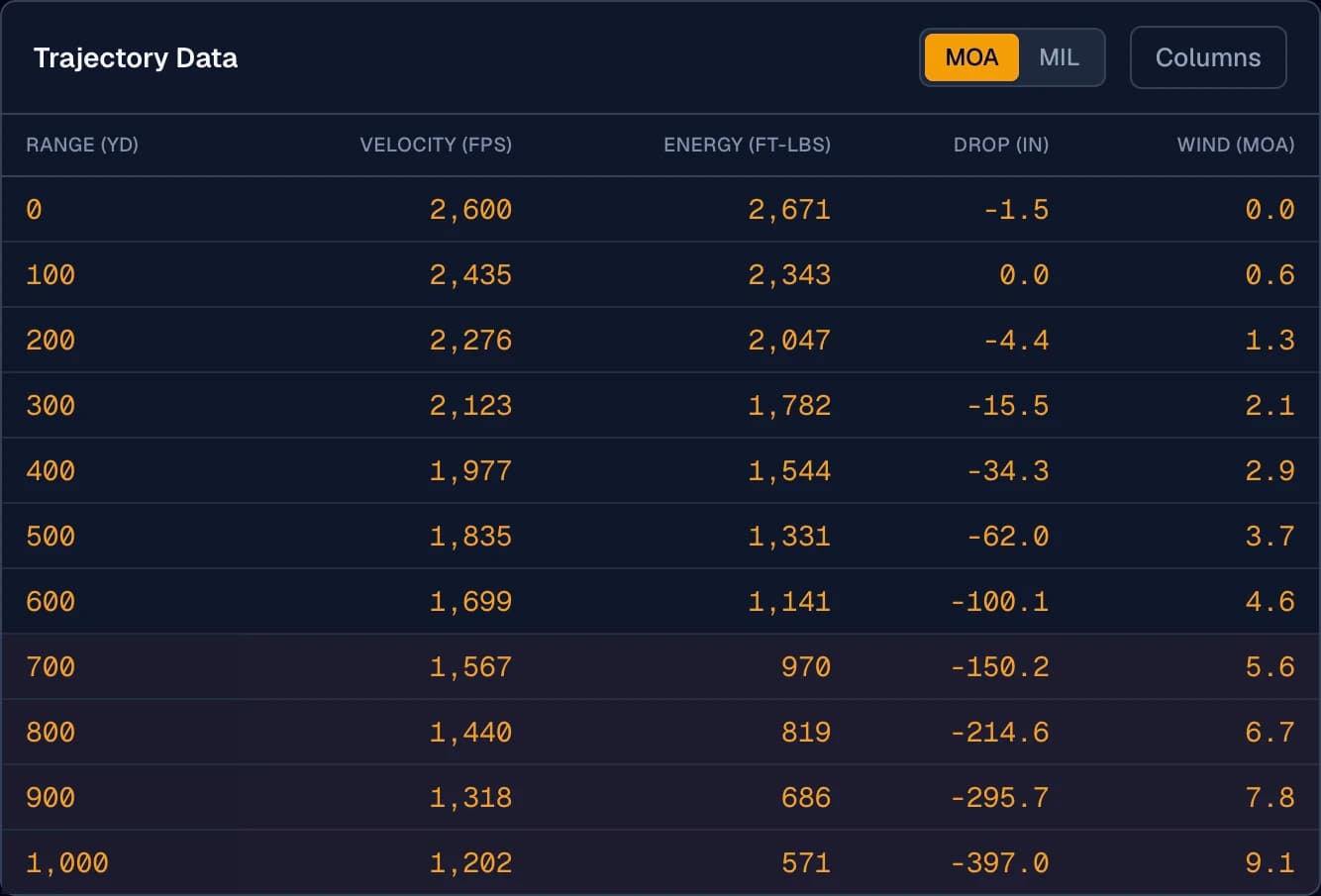
Each load's drop at 1,000 yards moved by more than eight inches, about 0.8 MOA, which is more than enough to matter if you dialed from it. The gap between the two loads moved by two tenths of an inch. An error that hits both loads alike falls almost entirely out of the comparison, because the comparison is the difference and both sides of it moved together.
A pair that actually differs
Ten feet per second makes a small gap, so here's one with something to measure. Nosler's Trophy Grade and Federal Premium's Nosler Partition load in .30-06 Springfield carry the same 180-grain Partition at a G1 of 0.474, but Nosler lists 2,750 fps and Federal 2,700.
| Drop gap, Nosler vs Federal | 500 yd | 1,000 yd |
|---|---|---|
| Our calculator | 2.5" | 16.8" |
| Independent calculator | 2.5" | 16.8" |
| Both BCs about 3% lower (0.460) | 2.6" | 17.2" |

The 50 fps difference is worth 16.8 inches at 1,000 yards, and both calculators say so. Knock 3% off both BCs (the Nosler load at 0.460 is in the ballistics calculator) and each load drops more than nine inches further, while the gap grows by less than half an inch. The difference between the loads is the signal, and it comes through both a second calculator and a wrong input almost untouched.
How we keep it that way
None of this would mean much if it were checked once. Every time our calculator's code changes, it is checked automatically against the independent calculator across eighteen factory loads from seven makers, including the four above. Velocity and time of flight have to stay within 0.5%, drop within 1% and wind drift within 2%, and we set that margin before comparing a single figure. The gap between any two loads has to match too, and no two loads may swap places. Figures quoted in our articles are recomputed from their own calculator links, so an article can't quietly drift away from the tool. Our methodology page has the details.
The limits
The inputs are the manufacturers'. A calculator, ours or anyone's, carries a published BC and velocity through faithfully. If a maker's BC is off for your bullet's velocity, or its velocity came from a longer barrel than yours, every figure inherits that. The gap between two loads also reflects their published velocities, which were measured in each maker's test barrel, not your rifle.
Two calculators agreeing isn't the same as the bullet agreeing. Both are point-mass models built on the same standard drag curves. They confirm the math is done correctly; they can't confirm that a real bullet flies exactly like the curve. Only a drag curve measured by Doppler radar for that bullet gets closer, and few makers publish one.
The cancellation has a condition. A BC error falls out of a comparison when it pushes both loads the same way, as it would for one bullet loaded by two makers. Compare two different bullets and each carries its own uncertainty, which can widen or narrow the gap. The comparison is still the stronger figure, but not by as much.
Near the speed of sound, calculators part ways more. Drag changes fastest there, and small differences in how a calculator reads the drag table add up. Our own checks allow a wider margin past that point for exactly this reason.
The conclusion
Ballistics calculators do disagree, and so do manufacturers' printed tables, but mostly in their single figures, and mostly by less than people expect. For choosing between two loads, the number that matters is the gap between them. That gap held to the tenth of an inch across two independent calculators, and it barely moved when we fed both a wrong BC. That's what makes a side-by-side comparison worth trusting, even when the absolute figures carry some uncertainty.
What it won't do is dial your rifle. A single figure at 1,000 yards can sit eight inches from the truth on an input you can't see, so the drop you dope from still has to be confirmed on paper.
Ballistics Board newsletter
The numbers behind the comparisons — what the data actually shows, and where it stops. No hype, no gear reviews.
Related Articles
Ballistics6 min read
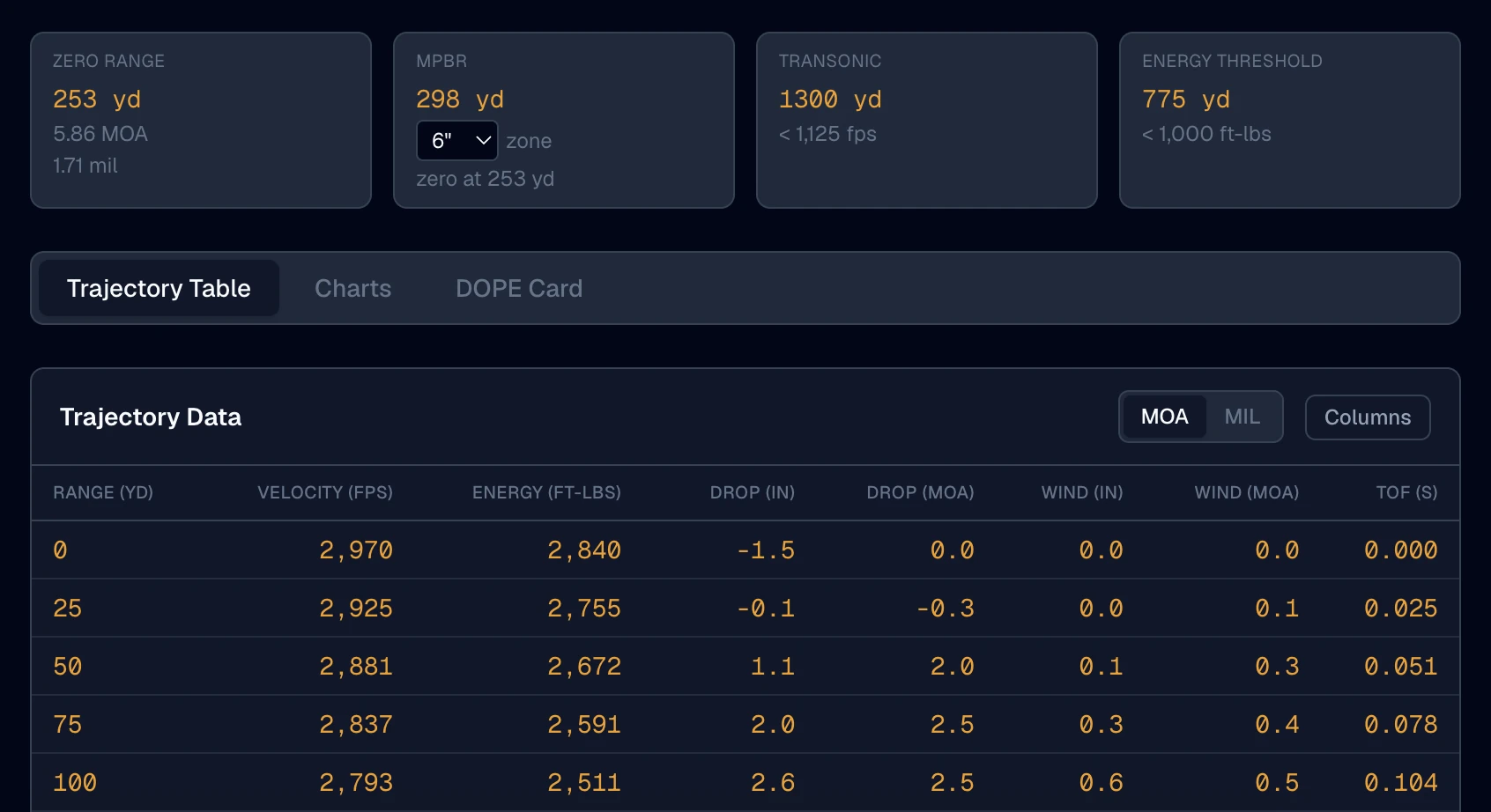
Maximum Point-Blank Range, Explained — Your Vital Zone Matters More Than Your Cartridge
Maximum point-blank range is the longest distance you can hold dead-on and still hit the vitals. We ran every .270 Winchester factory load in our database through our ballistics calculator: the entire field spans 65 yards, while changing the vital-zone assumption on a single load swings it 109. The number you invent moves the answer more than the ammunition you buy.
Ballistics Board Staff·
Ballistics9 min read
Altitude and Temperature Don't Move Your Zero — Unless You Zeroed Far Out
Everyone says to re-zero when you get to the mountains. We ran a 6.5 Creedmoor from sea level to 10,000 feet and from 0°F to 100°F, and a 100-yard zero never moved — 0.04 inch across the entire envelope. What moves is everything past it: 33 inches at 1,000 yards. Unless your zero itself is distant, in which case all of this inverts.
Ballistics Board Staff·

Ballistics5 min read
Wind Drift: Why Ballistic Coefficient Beats Velocity at Distance
Everyone reaches for the fastest load to fight the wind. It's exactly backwards. We ran the numbers on five popular .308 loads from the manufacturers' published data — and one of the slowest bullets drifts the least, while two loads of the same weight come out 29.5 inches apart.
Ballistics Board Staff·