6.5 PRC vs .30-06 vs .270 Winchester: Same Powder, a Century Apart
The modern cartridges are supposed to win by being bigger. Run six loads through the same math and the 6.5 PRC holds the same charge of powder as a 1906 .30-06, recoils less than a .270 Winchester, and beats both downrange anyway — because the advance went into the bullet and the bore, not the case.
Ballistics Board Staff

The story everyone tells about modern cartridges is a story about size. The 7mm PRC, the .300 PRC, the 6.5 PRC — big fat cases, long throats, more powder than your grandfather's rifle ever held, and that's why they shoot flatter. The old cartridges aren't bad, the story goes. They're just small.
The story is wrong about part of the field, and the part it's wrong about is the interesting part.
We took the six loads from our own homepage comparison — two classics and four moderns — and ran them through the same math. Every figure below is the manufacturer's published data run through our ballistics calculator under identical conditions: sea level, 59°F, 29.92 inHg, a 100-yard zero, and a 10 mph full-value crosswind. We didn't fire a shot — we ran the math.
The case sizes don't say what you'd expect
Before any trajectory, look at how much powder each of these actually holds:
| Cartridge | Introduced | Case capacity |
|---|---|---|
| .30-06 Springfield | 1906 | 68 gr H₂O |
| .270 Winchester | 1925 | 67 gr H₂O |
| 6.8 Western | 2021 | 75 gr H₂O |
| 6.5 PRC | 2018 | 68 gr H₂O |
| .300 PRC | 2018 | 95.5 gr H₂O |
| 7mm PRC | 2022 | 80.9 gr H₂O |
Three of the six are the same cartridge by volume. The 6.5 PRC holds the same 68 grains of water the .30-06 held in 1906, and a grain more than the .270 Winchester of 1925. The other three are bigger: the 6.8 Western by about 12% over the .270, the 7mm PRC by 19% over the .30-06, and the .300 PRC by 40%.
So whatever the 6.5 PRC is doing, it is not doing it with more powder.
What it does instead
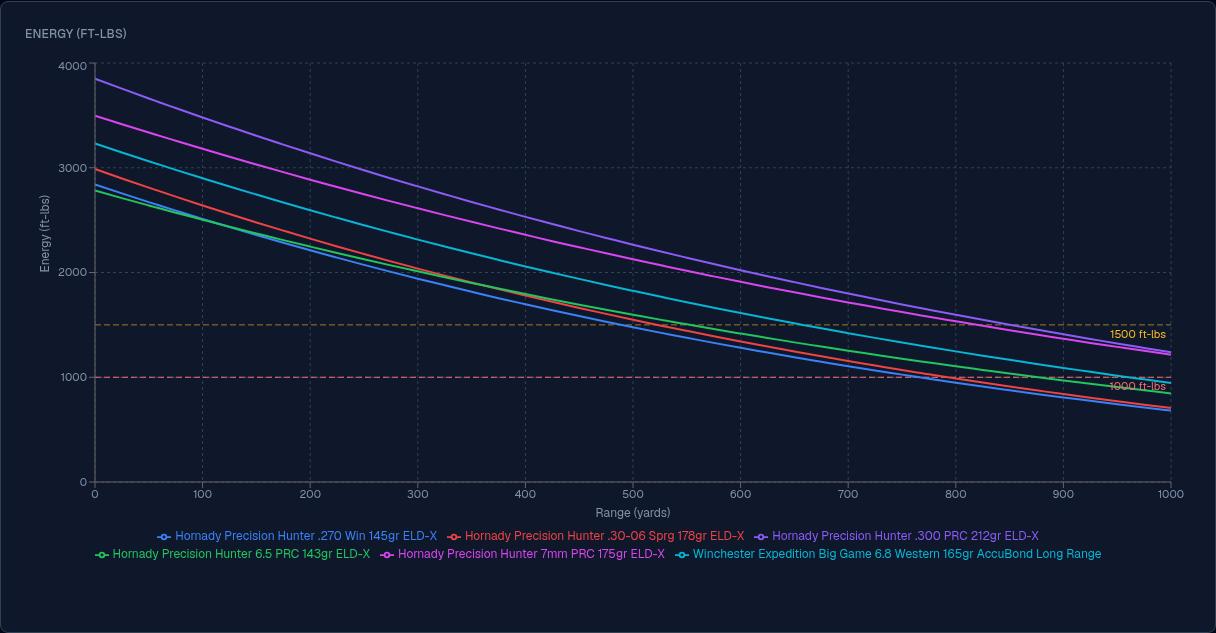
| Cartridge | Bullet | G7 BC | MV | Recoil | Wind @ 500 | Velocity @ 500 | 1,500 ft-lbs to |
|---|---|---|---|---|---|---|---|
| .270 Winchester | 145gr ELD-X | 0.270 | 2,970 | 19.4 | 15.8" | 2,142 | 490 yd |
| .30-06 Springfield | 178gr ELD-X | 0.278 | 2,750 | 23.1 | 17.2" | 1,980 | 525 yd |
| 6.5 PRC | 143gr ELD-X | 0.315 | 2,960 | 19.2 | 13.3" | 2,243 | 555 yd |
| 6.8 Western | 165gr AccuBond LR | 0.306 | 2,970 | 24.8 | 13.7" | 2,232 | 660 yd |
| 7mm PRC | 175gr ELD-X | 0.347 | 3,000 | 28.6 | 11.7" | 2,339 | 820 yd |
| .300 PRC | 212gr ELD-X | 0.334 | 2,860 | 38.9 | 13.1" | 2,194 | 850 yd |
The 6.5 PRC line is the one to read twice. Same powder as the .30-06. Fractionally less recoil than the .270 Winchester — 19.2 ft-lbs against 19.4. And it drifts 2.5 inches less than the .270 at 500 yards, arrives 101 fps faster, and holds elk-legal energy 65 yards further.
Against the .30-06 the margin is wider on every axis that matters at distance: 3.9 inches less drift, 263 fps more velocity at 500, 30 yards more of the 1,500 ft-lb line — while recoiling 17% less.
That is not a bigger cartridge beating a smaller one. It is the same case capacity in a smaller bore — and both loads carry an ELD-X, so the difference is not the bullet's vintage but what the smaller bore lets it be: long and sleek for its weight.
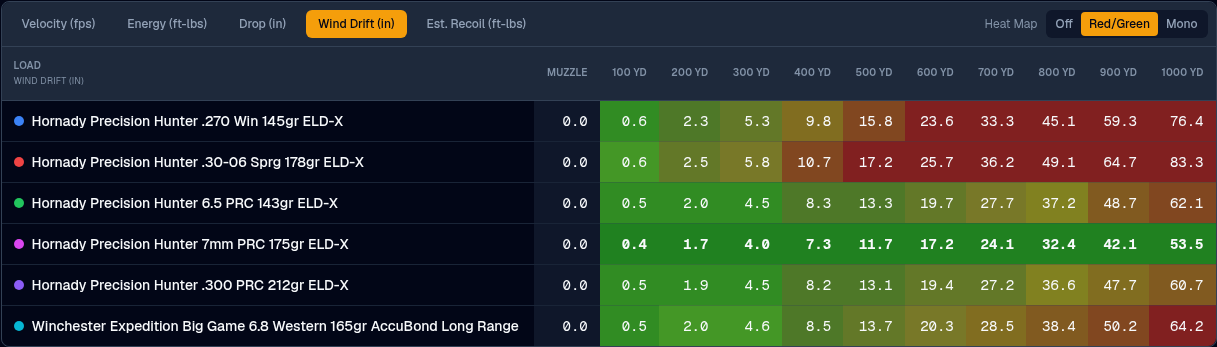
The 6.8 Western sits between the two stories. Its case is about 12% bigger than the .270 Winchester's, and it spends that on bullet rather than speed: the same 2,970 fps, but a 165-grain bullet at a G7 of 0.306 against 145 grains at 0.270. It drifts 2.1 inches less than the .270 at 500 yards and holds the 1,500 ft-lb line 170 yards further, at 24.8 ft-lbs of recoil — more than either classic.
The 7mm PRC and .300 PRC, the two that are much bigger, behave exactly as the size story predicts — and send the bill. The 7mm PRC is the best ballistic performer here by a clear margin, drifting 11.7 inches at 500 and holding 1,500 ft-lbs to 820 yards. It also recoils 28.6 ft-lbs, half again as much as the 6.5 PRC. The .300 PRC reaches furthest of all, at 38.9 ft-lbs — roughly double the 6.5 PRC's recoil, for 295 more yards of energy. Those are real gains honestly priced, and they are a different purchase from the one the 6.5 PRC is offering.
Can you just put a better bullet in the old case?
If the advantage is the bullet rather than the case, the obvious question is whether the classics can simply be loaded better. They can — partly.
The .30-06 in the table above carries a 178-grain ELD-X at a G7 of 0.278, which is not the best its case can do. Winchester loads a 190-grain AccuBond Long Range at 0.301 at the same 2,750 fps:
| .30-06 load | G7 BC | Wind @ 500 | Energy @ 500 | 1,500 ft-lbs to | Recoil |
|---|---|---|---|---|---|
| 178gr ELD-X | 0.278 | 17.2" | 1,549 | 525 yd | 23.1 |
| 190gr AccuBond LR | 0.301 | 15.7" | 1,745 | 615 yd | 25.1 |
Ninety extra yards of elk-legal energy and an inch and a half less drift, for two foot-pounds of recoil and no new rifle. On the energy line that puts the .30-06 ahead of the 6.5 PRC's 555 yards. The .270 Winchester gains similarly: a 150-grain AccuBond Long Range at 0.298 takes it from 15.8 inches of drift to 14.6, and from 490 yards to 525.
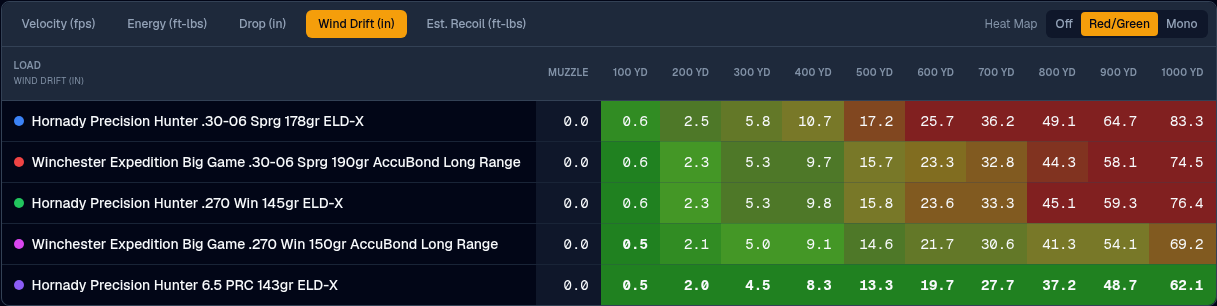
But the gap narrows rather than closes, and where it stops is the honest answer to the whole question. The best G7 ballistic coefficient available in a factory .270 Winchester in our catalogue is 0.298; in the .30-06 it is 0.308, Norma's 180-grain Bondstrike. The 6.5 PRC's ordinary hunting load is 0.315 and the 7mm PRC's is 0.347. The modern cartridges are built around long, heavy-for-calibre bullets, and the old cases are not where those bullets are loaded and sold.
That is a fact about the ammunition shelf rather than a law of physics — but the ammunition shelf is what you actually buy from.
The limits
This is a comparison of six loadings, not six cartridges. Five are Hornady Precision Hunter and one is a Winchester Expedition Big Game, at six different weights in five different bores. Nothing here isolates a single variable, which is the price of comparing cartridges as they are actually sold. For the controlled version of this question — the same bullet in different cartridges, nothing changing but the case — see our .30-caliber comparison, which holds the projectile fixed and lets only capacity vary.
Case capacity figures vary by source and by how they were measured, and ours are a single published value per cartridge, not a survey. The 6.5 PRC's 68 grains sits at the high end of what is commonly quoted. That matters less than it looks: an overstated capacity overstates the estimated powder charge and therefore the computed recoil, so the 6.5 PRC's headline figure of 19.2 ft-lbs is, if anything, generous to the argument it loses.
Recoil is computed, not measured — free recoil for an 8-pound rifle with the powder charge estimated from case capacity. It is sound for ranking these cartridges against each other and it is not what your shoulder reports. Rifle weight, stock fit, a brake and a pad all move it.
Availability and price are not in any of these numbers, and they run the other way. The .30-06 and .270 Winchester are on the shelf of every hardware store in the country; the 6.8 Western and the PRCs are not, and cost more when they are. Winchester publishes no test barrel length for any of its three loads here, so the 6.8 Western and both AccuBond Long Range upgrades are not directly comparable to the five Hornady loads measured at 24 inches.
Everything here is enough inside 400 yards. All six carry more than 1,500 ft-lbs to 400 and none goes transonic inside 1,000. The differences on this page are arguments about the far end of the range, not about whether these cartridges work.
What a century actually bought
Not more powder — or not necessarily. Three of these six hold the same charge the .30-06 held in 1906. The three that hold more charge for it in recoil, and the two biggest at a rate most shooters would decline if it were itemised.
What it bought is a better exchange rate. The 6.5 PRC takes a 1906-sized case and returns less recoil than a .270 Winchester and better ballistics than either classic — not by burning more, but by pointing a longer, sleeker bullet down a bore built to spin it. That is the whole of the advance, and it is a real one.
Which also means the classics are not beaten so much as underloaded. A .30-06 with a 190-grain high-BC bullet in it recovers part of the deficit and beats the 6.5 PRC outright on retained energy, using a rifle that has been in production for a hundred and twenty years. If you own one, the upgrade costs a box of ammunition rather than a rifle — and that is the cheapest 90 yards in this article.
Ballistics Board newsletter
The numbers behind the comparisons — what the data actually shows, and where it stops. No hype, no gear reviews.
Related Articles

Cartridges6 min read
Sako 100: The Ultimate One-Gun Solution for the World Hunter
A newsletter put a $6,000 switch-barrel rifle on my radar, and I have no practical reason to want it. So I did the next best thing: picked my cartridges and ran Sako's own ammunition through the ballistics tools. I saved thousands, but had to settle for finding out what one stock and five cartridges look like on paper.
Steve Sansford·

Cartridges5 min read
7mm-08 Remington vs .308 Winchester: Does the 7mm-08 Really Out-Carry the .308?
Only sometimes: the 7mm-08 out-carries the .308 past 100 yards in one of three factory pairs, though it is flatter and recoils less in all three.
Ballistics Board Staff·

Cartridges5 min read
.270 Winchester vs .30-06: Does the Bullet Matter More Than the Cartridge?
Swapping the bullet moves .30-06 energy at 500 yards by 855 ft-lbs; swapping the cartridge in a pair moves it 72 to 289 ft-lbs. The .270 is the flatter half in all three pairs.
Ballistics Board Staff·