Sako 100: The Ultimate One-Gun Solution for the World Hunter
A newsletter put a $6,000 switch-barrel rifle on my radar, and I have no practical reason to want it. So I did the next best thing: picked my cartridges and ran Sako's own ammunition through the ballistics tools. I saved thousands, but had to settle for finding out what one stock and five cartridges look like on paper.
Steve Sansford
Steve is the builder of Ballistics Board. He doesn't get to the range as often as he'd like, but he's been fascinated by exterior ballistics and the rabbit hole of cartridge comparison for as long as he's owned a rifle.

I wasn't shopping for a rifle. I want to get that on the record first.
Then a Sako newsletter landed in my inbox. A promo piece for the new Sako 100: a switch-barrel hunting rifle. Shot after shot of it, mostly in walnut. I wanted to see more. I went looking for reviews and more pictures, which was a mistake, because by the time I'd finished, I wanted one. Not needed — wanted. There's no gap in my gun safe this rifle fills, and no question I've been asking that it answers. It just looks fantastic, and often that's the only reason one needs. I want one. But I can't have one (yet).
So, let's have some fun with the numbers instead.
The $6,000 rifle versus the one I might actually buy
The wood-stocked Explorer runs a little over $6,000 at US retail, and the carbon version closer to eight. I am, for the record, still considering the Savage 110 Core in 6.5 Creedmoor I've been talking about all year, for about $800. That rifle is easy to get, easy to afford, and it'll do everything I ask of it.
The Sako is the one I'll keep opening the photos of.
If I were ordering one, it would be the wood. The carbon stock is the sensible choice — lighter, tougher, indifferent to a week of rain — and in the pictures it's a handsome rifle in its own right. But when I picture a hunting rifle, I picture walnut. That's not an argument. That's just the rifle I'd want to hand down.
For the fun math part, I set myself one rule to keep it tidy: Sako rifle and Sako ammunition. Every number below is Sako's own published load, run through the same Ballistics Board calculator everything else on this site uses. Sako, handily, loads its own ammunition for every barrel they offer for the new 100.

A barrel you can swap at the kitchen table
Here's the part that hooks me. A switch-barrel rifle is one action and one stock, and the barrels come and go. On the Sako 100, according to TJ Schwanky's review for North American Deer Hunter, the change is two screws, and Sako built the barrel tool — with a torque indicator — right into the stock. The scope lives on the barrel, so each barrel keeps its own zero, and requires its own scope. Sako says no re-zeroing after a swap, but count on another $1,000 per barrel for the optic.
Switch barrels have a much bigger following in Europe than here, and I'll admit I don't fully know why. What I do know is what they offer: convenience, and familiarity. Same stock against your cheek, same trigger under your finger, same safety, same bolt throw, whatever cartridge is on the front. You don't learn a new rifle every time you want a new cartridge. You learn one rifle, really well, and it just keeps changing its mind about what it shoots.
Sako's barrel list runs from .243 Winchester to .375 H&H. So the fun question is: which ones?
Barrel one: 6.5 Creedmoor, all day
This was not a hard decision. I've written enough about the 6.5 Creedmoor on this site — against the .308, against the .260, and the last time I asked the one-gun question — that you can guess where I land. Easy on the shoulder, accurate, plenty for deer, and ammunition on every shelf. Sako's own 120-grain Powerhead Blade would be my starting load.
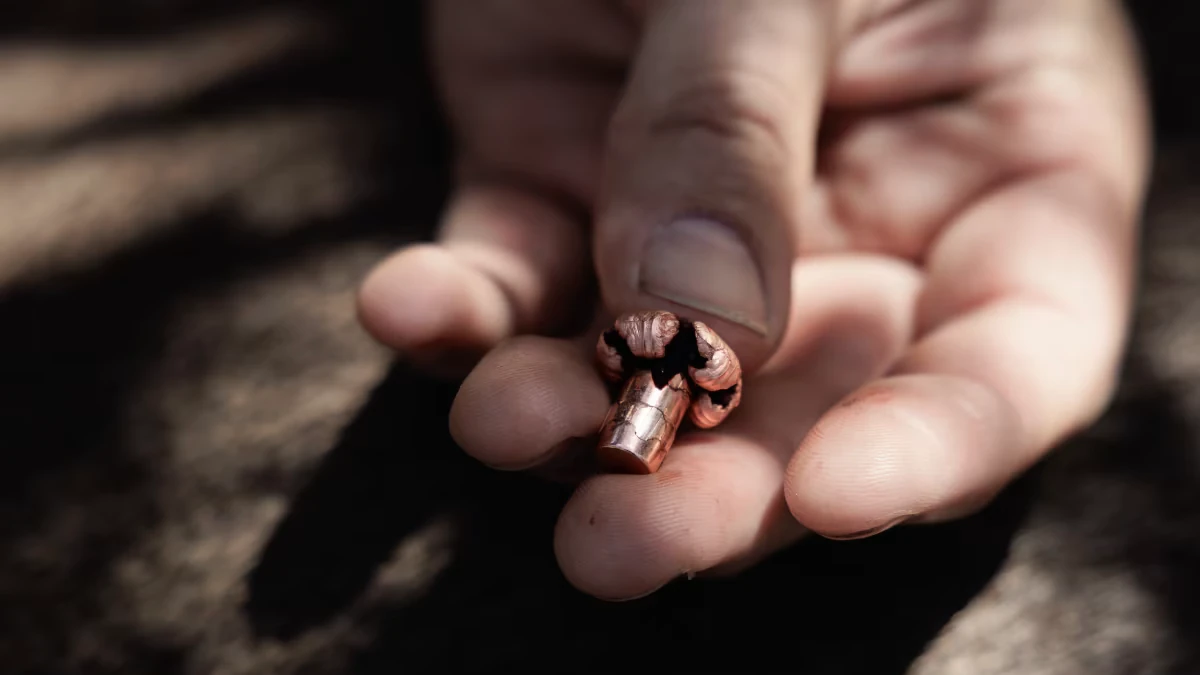
The honest competition is the .30-06, and I could argue that one all evening. It's splitting hairs, and splitting hairs is half the fun of this hobby. But here's what a switch barrel does to that argument: it ends it. With a one-gun rifle you have to pick the cartridge in the middle and hope it stretches far enough both ways. With this rifle, barrel one only has to be right for most days. The edges are what barrel two is for.
Barrel two depends on the family
Which way barrel two goes doesn't depend on me. It depends on my kids.
If they shoot the 6.5 Creedmoor and tell me it's a bit much, barrel two is a .243 Winchester. It's the coyote rifle, the laser beam, the cartridge a lot of us learned on. More importantly, it's trigger time for a kid who isn't quite ready for more. Whether a quarter less recoil is enough to make the difference is something I'll only find out by watching their faces, but it's a real step down.
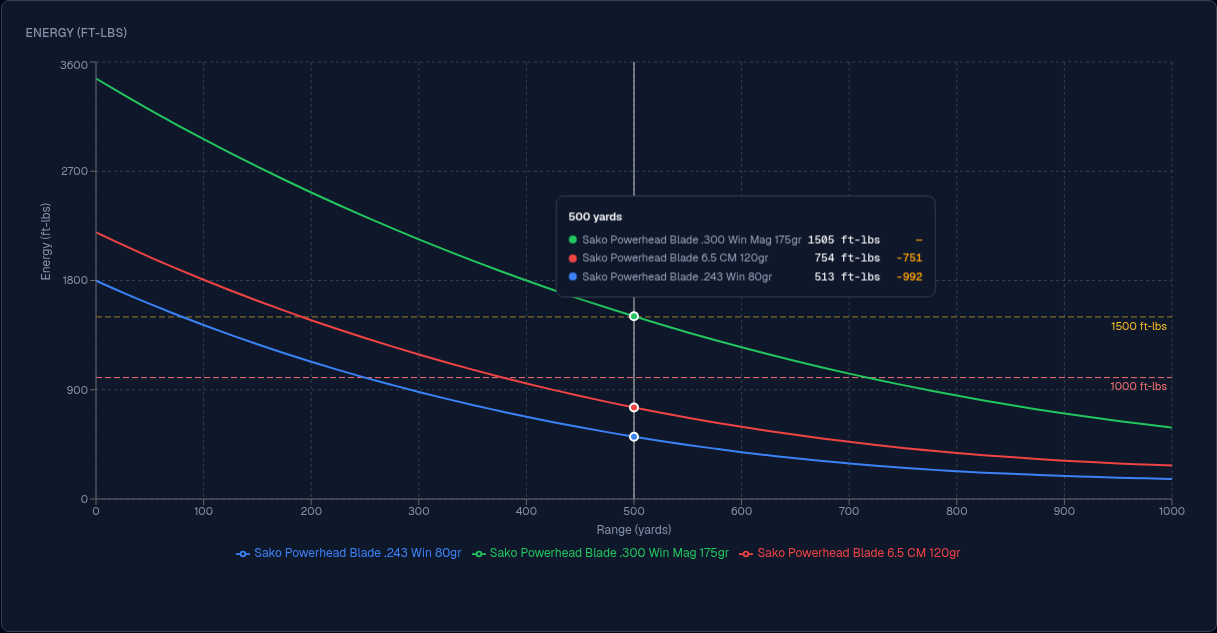
If they shoot the 6.5 and love it, barrel two goes the other way: a .300 Winchester Magnum. In my book a 6.5 Creedmoor and a .300 Win Mag between them cover anything North America has to offer. And there's a second reason I like it: it's a chance to get properly comfortable with real recoil, on a rifle I already know inside out. Same stock, same trigger, a lot more shove.
It buys plenty, too. Put the three side by side and at 500 yards the .300 is still carrying 1,505 ft-lbs — twice the 6.5's 754, and nearly three times the .243's 513.
Here's what "a lot more" means. One bullet line from Sako — their Powerhead Blade, which they load in every one of these barrels — run through our recoil calculation at the same rifle weight:
| Barrel | Sako Powerhead Blade | Free recoil |
|---|---|---|
| .243 Winchester | 80 gr | 8.8 ft-lbs |
| 6.5 Creedmoor | 120 gr | 12.2 ft-lbs |
| .30-06 Springfield | 162 gr | 20.8 ft-lbs |
| .300 Win Mag | 175 gr | 31.4 ft-lbs |
| 9.3x62 | 230 gr | 32.3 ft-lbs |
| .375 H&H | 261 gr | 46.2 ft-lbs |
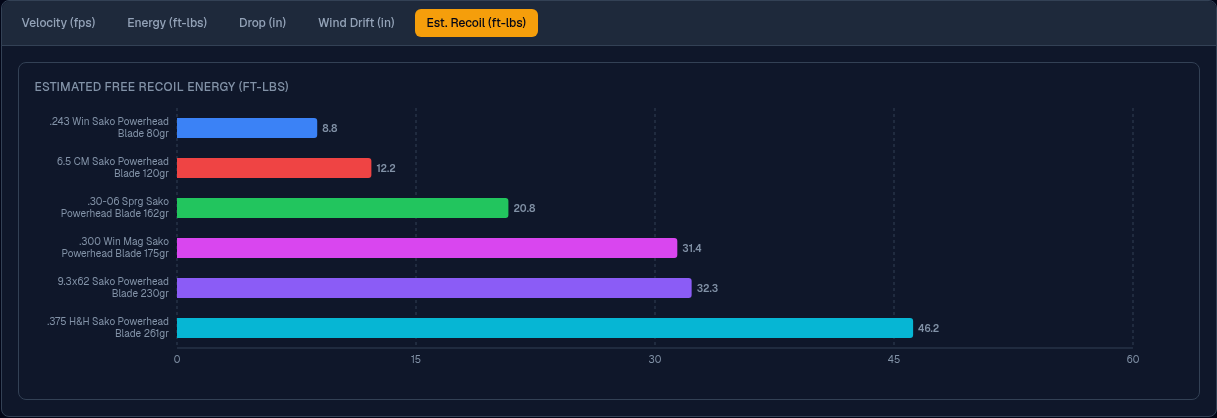
The .243 kicks about 28 percent less than the 6.5. The .300 Win Mag kicks more than two and a half times as hard. Same rifle. That's the whole switch-barrel idea in one column.
The barrels I'd add just because
Then there are the barrels few people need, but many want.
The .375 H&H is the someday-Africa barrel. You hunt North America for years with your 6.5 or your .300, and then one day you book the trip. You don't go buy a dangerous-game rifle — you buy a barrel, bolt it onto the stock you've been shooting for a decade, and bring the 6.5 along for plains game. Sako even loads a solid alongside the expanding bullet at the same weight, which is exactly the pairing that kind of hunt asks for. It's also the top line of that table: more than five times the recoil of the .243, from the same rifle.
Or, just for fun, something European. Look at the 9.3x62 in that table: an old Mauser-era round, kicking almost exactly like the .300 Win Mag. Or the 8x57 IS, which in Sako's loads sits right around .30-06 territory. I have no practical reason for either. That's rather the point.
Which barrel would I actually add second? I don't know. And the best thing about this rifle is that I don't have to know. I don't have to spend $6,000 and realize three years later I should have started with a different cartridge. I just buy another barrel — not cheap, I'm sure, but a lot cheaper than another rifle.
The fine print
Sako doesn't publish a weight for the Sako 100. Schwanky estimates the wood version at about 8 pounds, which is what I ran every barrel at; the magnum barrels are probably a bit heavier, which would take a little off their numbers. Free recoil here is a calculation, not a measurement — it's for comparing cartridges in the same rifle, not for predicting what your shoulder reports. Velocities are Sako's published figures from their own test barrels, and the Sako 100's barrels may run a little different. And the bill doesn't stop at the barrel: each one carries its own scope, and Schwanky notes each chambering has its own magazine too.
Back to the Savage
Let's be honest with ourselves. Three Savage 110s would cover the same ground for less than half the money, and this rifle won't put a deer down any deader.
But a rifle like this is built to outlast me. It would see me through every hunt I'll ever do, then go to my son for every hunt he'll enjoy, and I'd like to think his kid will put a few rounds through it too. Each of them gets to pick their own barrels. That's the real case for a switch barrel, as far as I'm concerned: not one rifle for every animal, but one rifle for every generation that picks it up.
I'm still buying the Savage. I'm just keeping the newsletter.
Ballistics Board newsletter
The numbers behind the comparisons — what the data actually shows, and where it stops. No hype, no gear reviews.
Related Articles

Cartridges5 min read
7mm-08 Remington vs .308 Winchester: Does the 7mm-08 Really Out-Carry the .308?
Only sometimes: the 7mm-08 out-carries the .308 past 100 yards in one of three factory pairs, though it is flatter and recoils less in all three.
Ballistics Board Staff·

Cartridges5 min read
.270 Winchester vs .30-06: Does the Bullet Matter More Than the Cartridge?
Swapping the bullet moves .30-06 energy at 500 yards by 855 ft-lbs; swapping the cartridge in a pair moves it 72 to 289 ft-lbs. The .270 is the flatter half in all three pairs.
Ballistics Board Staff·

Cartridges5 min read
6.5 PRC vs .30-06 vs .270 Winchester: Same Powder, a Century Apart
The modern cartridges are supposed to win by being bigger. Run six loads through the same math and the 6.5 PRC holds the same charge of powder as a 1906 .30-06, recoils less than a .270 Winchester, and beats both downrange anyway — because the advance went into the bullet and the bore, not the case.
Ballistics Board Staff·